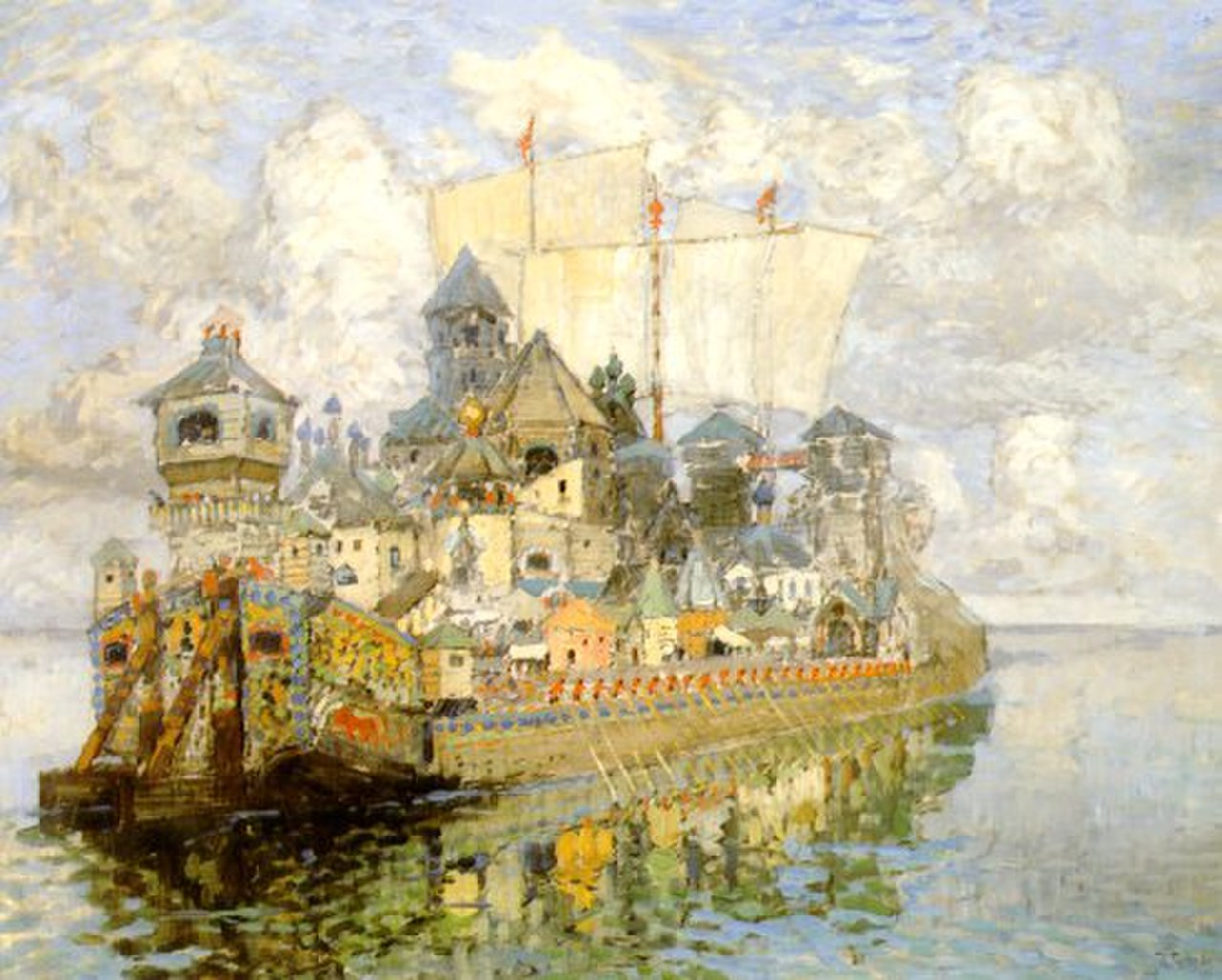
Kitezh
Listen carefully on a calm day at Lake Svetloyar, the old stories say, and you might hear bells ringing from beneath the water. The sound carries up through 33 meters of still, dark lake -- chiming from the cathedral of a city that chose to drown rather than surrender. Kitezh, Russia's Atlantis, has haunted this small oval lake in the Nizhny Novgorod Oblast for nearly eight centuries, a legend so durable that it has inspired an opera by Rimsky-Korsakov, a documentary by Werner Herzog, and a pilgrimage path still walked today. The city has never been found. It was never meant to be.
Two Cities and a Khan
The legend tells of Georgy II, Grand Prince of Vladimir, who first built Maly Kitezh -- Little Kitezh -- on the Volga River, sometimes identified with the present-day town of Gorodets. Seeking a more beautiful site, the prince crossed the rivers Uzola, Sanda, and Kerzhenets until he reached Lake Svetloyar, where he founded Bolshoy Kitezh -- Great Kitezh. The name may derive from Kideksha, a royal residence near Suzdal that the Mongols sacked in 1237. In the late 1230s, Batu Khan's armies swept through the Russian lands. They captured Maly Kitezh first, forcing Georgy to flee through the forests toward his greater city. A prisoner revealed the secret paths to the lake. When the Mongol army reached Great Kitezh, they found something that stopped them: the citizens were not fighting. They were praying.
The Waters Rise
What happened next depends on who tells it. In every version, the outcome is the same: fountains of water erupted from beneath the ground, surrounding the Mongol attackers. The soldiers fell back and watched as the entire city -- walls, houses, churches -- sank slowly into the lake. The last thing visible was the glaring dome of the cathedral, its cross catching the light before the water closed over it. Then only waves remained. The Mongols fled. The city, the legend insists, did not die. It merely became invisible, preserved intact beneath the lake's surface, protected by God from the invaders. Only those pure in heart and soul can find their way to Kitezh. The road to the lake is still called Batu's Path.
Bells Under Water
The claims grow more extraordinary the deeper you go into the folklore. On calm days, people say they can hear bells chiming from beneath the surface and voices singing. The most devout are said to see lights of religious processions moving underwater, even the outlines of buildings on the lake bottom. These stories are not relics of the distant past -- they were actively circulated among the Old Believers, the conservative religious communities who broke from the Russian Orthodox Church in the 17th century. The first written account of Kitezh, the anonymous Kitezh Chronicle, dates only to the late 18th century and is believed to have originated in Old Believer communities. The legend may be ancient, but its literary form is surprisingly modern.
From Opera Houses to Video Games
Kitezh's grip on the imagination has never loosened. Nikolai Rimsky-Korsakov's 1907 opera The Legend of the Invisible City of Kitezh and the Maiden Fevroniya remains one of the great works of the Russian operatic tradition. Anna Akhmatova wove the city into her poetry. Boris and Arkady Strugatsky referenced it in their 1965 novel Monday Begins on Saturday. Werner Herzog traveled to Lake Svetloyar for his 1993 documentary Bells from the Deep, drawn by the image of pilgrims crawling across the frozen lake, pressing their ears to the ice to hear the city below. In 2015, Kitezh resurfaced in an unexpected medium: the video game Rise of the Tomb Raider made it the target of Lara Croft's expedition. Across centuries and formats, the core appeal never changes -- a city that would rather vanish than submit, preserved perfect and unreachable beneath still water.
From the Air
Located at 56.82N, 45.09E at Lake Svetloyar in Voskresensky District, Nizhny Novgorod Oblast. The lake is small and oval (470 x 350 m), set in forested hills -- look for the distinctive basin surrounded by elevated terrain. Nearest major airport: Nizhny Novgorod (UWGG), approximately 130 km to the west. The lake sits between the Kerzhenets and Vetluga rivers, both Volga tributaries. Best spotted at 2,000-4,000 feet AGL in clear conditions. The surrounding area is heavily forested, making the lake's open water stand out.