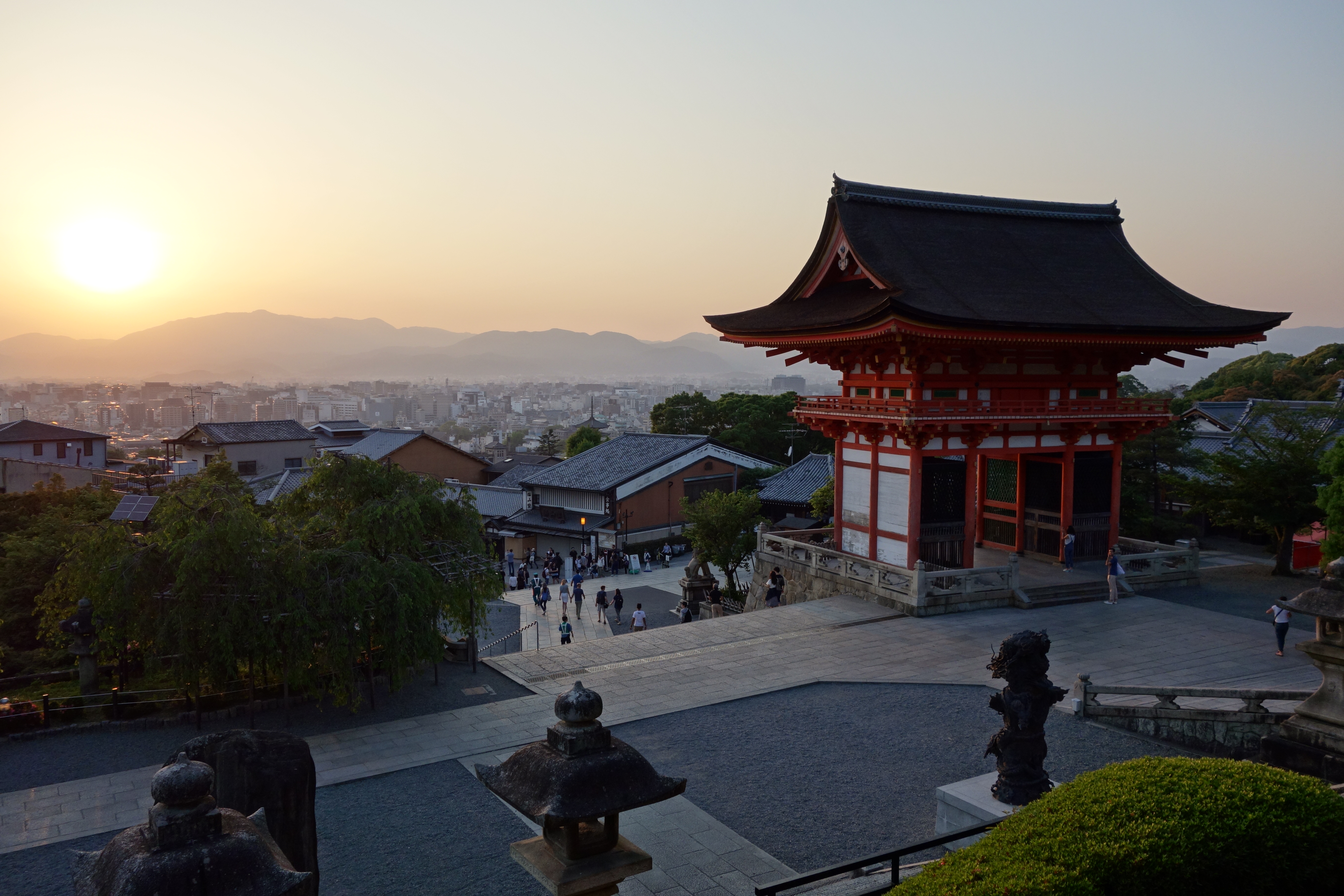
Kiyomizu-dera: The Temple Built Without a Single Nail
During the Edo period, 234 people jumped from Kiyomizu-dera's wooden stage -- a 13-meter plunge over a forested ravine -- believing that survival would grant their deepest wish. Records show 85.4 percent of them lived. The Japanese expression for taking a bold leap of faith, "to jump off the stage at Kiyomizu," traces directly to this tradition of desperate devotion at one of Kyoto's oldest and most spectacular temples. Perched in the foothills of Mount Otowa along the Higashiyama range, Kiyomizu-dera predates Kyoto itself as the imperial capital. Its massive wooden stage, cantilevered over a steep hillside on 139 pillars joined without a single nail, has watched over the ancient city for more than twelve centuries.
A Golden Stream and a 200-Year-Old Hermit
The founding legend of Kiyomizu-dera reads like a supernatural detective story. In 778, a monk named Kenshin from Kofuku-ji temple in Nara received a message in a dream directing him north to Mount Otowa. Following a golden stream to its source, he found a white-robed ascetic named Gyoei Koji practicing austerities beneath a waterfall and praying to Kannon, the bodhisattva of compassion. Gyoei claimed to be 200 years old and told Kenshin he had been waiting for him. He handed over custodianship of the mountain and vanished. Kenshin, convinced Gyoei was an incarnation of Kannon herself, carved a statue from the sacred tree the hermit left behind and enshrined it in the abandoned hermitage. That waterfall still flows on the temple grounds today, known as Otowa Falls, and the temple's full name -- Otowa-san Kiyomizu-dera -- literally means "Pure Water Temple of Mount Otowa." The name has defined the place ever since: pilgrims still cup their hands under three channels of falling water, each believed to confer a different blessing.
Caught Between Rival Monks
Kiyomizu-dera's first centuries were turbulent. The temple maintained ties to Kofuku-ji in Nara but also adopted Shingon Buddhist practices during the Heian period, placing it in a dangerous position between two powerful institutions. The rivalry between Kofuku-ji and the great Tendai monastery Enryaku-ji on Mount Hiei frequently turned violent, and in 1165, warrior monks from Enryaku-ji burned Kiyomizu-dera to the ground. The temple was rebuilt, as it would be again and again -- fire, conflict, and earthquake repeatedly destroying its wooden structures. Most of the current buildings date to reconstructions ordered by Tokugawa Iemitsu in the 1630s. The main hall, designated a National Treasure, was rebuilt in 1633. Fifteen other structures on the grounds are collectively classified as Important Cultural Properties, spanning from the Muromachi period through the Edo period, making the complex a living catalog of Japanese Buddhist architecture across several centuries.
Engineering in Wood
The main hall's famous stage is a feat of traditional Japanese carpentry. The veranda extends out from the hillside on a lattice of 139 zelkova pillars, some standing over 12 meters tall, all fitted together using a technique called kakejukuri -- interlocking joints without metal fasteners. The entire structure is self-supporting, designed to bear the weight of hundreds of pilgrims at once. The stage offers sweeping views over Kyoto's eastern districts and, in autumn, a sea of blazing maple foliage below. Beneath the main hall, the Otowa waterfall splits into three streams where visitors queue to drink. The Tainai Meguri offers a different experience entirely: visitors descend into a pitch-black underground passage said to represent the womb of the bodhisattva Mahapratisara, navigating by touch along a stone-bead handrail until they reach a dimly lit prayer stone at the center. The temple also contains a pair of "love stones" separated by about 18 meters -- legend holds that anyone who walks from one to the other with eyes closed will find true love.
A Century of Reinvention
In 1914, Onishi Ryokei arrived as chief priest and would reshape Kiyomizu-dera's identity over the next seven decades. He served until his death in 1983 at the age of 107, one of the longest tenures in the history of Japanese Buddhism. In 1965, Onishi separated from the Hosso sect entirely and founded the Kita-Hosso sect, making Kiyomizu-dera its headquarters. He launched bimonthly Buddhist culture lectures in 1966 and founded the Japan-China Friendship Buddhist Association in 1974, turning the temple into a center for international dialogue. The temple was nominated as a finalist for the New Seven Wonders of the World in 2007 and underwent a major restoration before the 2020 Olympics, its cypress-bark roof re-laid for the first time in fifty years. As part of the Historic Monuments of Ancient Kyoto, it holds UNESCO World Heritage status alongside sixteen other sites in the Kyoto region, and it remains the 16th stop on the Saigoku Kannon Pilgrimage, a circuit that has drawn devotees for over a thousand years.
From the Air
Located at 34.995N, 135.785E in the Higashiyama foothills on Kyoto's eastern edge. The temple complex and its prominent wooden stage are nestled into the hillside of Mount Otowa. From 3,000-5,000 feet AGL, look for the dense temple rooflines and three-storied pagoda emerging from the forest canopy along the mountain slope east of central Kyoto. The Kamo River runs roughly north-south through the city to the west. Nearest major airport is Osaka Itami (RJOO), approximately 25 nautical miles southwest, with Kansai International (RJBB) about 50 nautical miles to the south.