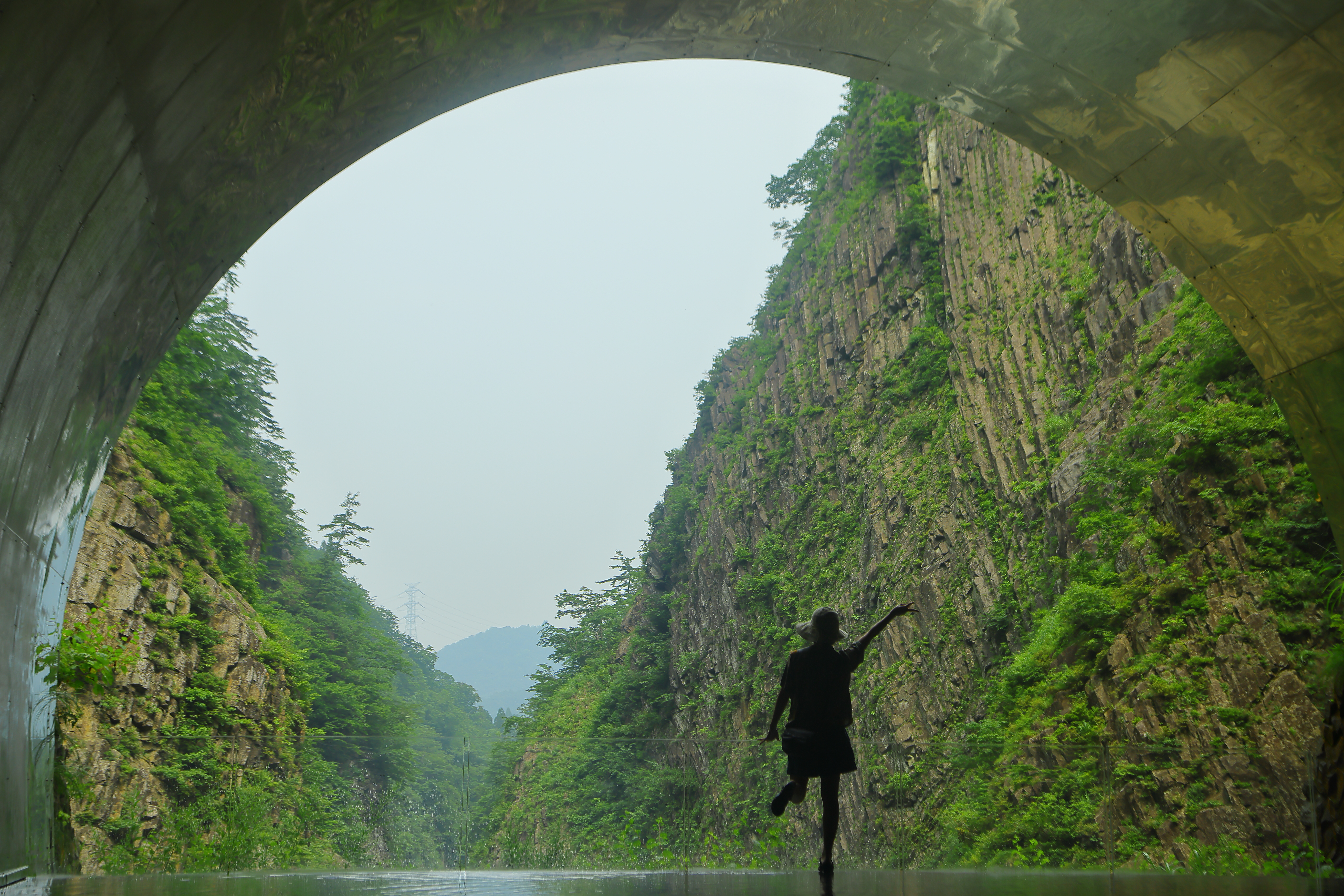
Kiyotsu Gorge
At the end of a 750-meter tunnel bored through solid rock, visitors step into a space where the walls are lined with polished stainless steel and a thin sheet of water covers the floor. The gorge outside -- emerald river, columnar cliffs, canopy of maple -- appears to float in every direction, reflected infinitely in metal and water. This is the Light Cave, the final room of the Tunnel of Light installation at Kiyotsu Gorge, and it has become one of the most photographed spots in Japan. But the gorge itself has been drawing people into Niigata's mountain interior for far longer than any art installation, and the geology on display here is older than the Japanese archipelago itself.
Columns from an Ancient Sea
Sixteen million years ago, an underwater volcanic eruption blanketed this region's seabed with ash, which compressed and chemically transformed into a soft rock called green tuff. Five million years later, magma pushed upward through those tuff layers from below. As the molten rock cooled and contracted, it fractured into tight hexagonal columns -- a process called columnar jointing, the same geology that produced the Giant's Causeway in Northern Ireland and Devil's Tower in Wyoming. The Kiyotsu River has spent the eons since carving through both rock types, exposing sheer walls of columnar andesite that rise in geometric perfection above turquoise pools. The gorge stretches 12.5 kilometers through the heart of Joshin'etsu Kogen National Park, on the border between Yuzawa and Tokamachi in Niigata Prefecture. In 1941, Japan's Agency for Cultural Affairs recognized these formations by designating Kiyotsu Gorge as both a Place of Scenic Beauty and a Natural Monument.
The Three Great Canyons
The Japanese love their ranked lists, and Kiyotsu has earned a place on one of the most coveted: the Three Great Canyons of Japan, alongside Kurobe Gorge in Toyama Prefecture and Osugidani Gorge in Mie Prefecture. Each canyon has its own character. Kurobe is alpine and remote, accessible only by a scenic railway clinging to cliffs above a deep V-shaped valley. Osugidani is subtropical and lush, sheltering ancient cedar trees in the Kii Peninsula's humid mountains. Kiyotsu falls somewhere between -- temperate, volcanic, defined by the angular precision of its columnar rock faces. In autumn, the contrast sharpens: deep red and amber maples frame those grey-green hexagonal columns, and the Kiyotsu River runs cold and clear below. The onsen resort at the gorge's entrance, Kiyotsukyo Onsen, fills with visitors who come for the foliage and stay for the hot mineral water.
Into the Tunnel
A footpath once ran along the river at the base of the canyon walls, but a rockfall in 1988 closed it permanently. The cliffs are beautiful but unstable -- columnar joints fracture cleanly, and whole sections can detach without warning. To preserve access, a pedestrian tunnel was carved 750 meters into the canyon wall, with viewing stations cut through the rock at intervals to frame the gorge below. For years, the tunnel was a simple concrete passage with dim lighting. Then, for the 2018 Echigo-Tsumari Art Triennale, Beijing-based MAD Architects transformed it into the Tunnel of Light. Each viewing station became an art installation themed around one of the five classical elements. The Periscope station features a cedar-roofed cafe with a hot spring foot spa. The Drop station lines the tunnel with convex mirrors backed by fiery orange light. And at the tunnel's end, the Light Cave wraps the final chamber in semi-polished stainless steel, with a shallow pool on the floor reflecting the gorge's colors in an endless loop.
Snow Country's Hidden Face
This is snow country. Niigata's mountain interior receives some of the heaviest snowfall in Japan, and Kiyotsu Gorge can be buried under meters of powder from December through April. The gorge takes on a different severity in winter -- the columnar walls streaked white, the river running dark beneath ice shelves, the tunnel entrance framed by snowbanks taller than a person. Nobel laureate Yasunari Kawabata set his novel Snow Country in this region, capturing the isolation and stark beauty of the mountains around Echigo-Yuzawa. The Joetsu Shinkansen now delivers visitors from Tokyo in about ninety minutes, but step off the train and into the gorge, and the modern world falls away. The columns of cooled magma hold the same geometry they have held for five million years, indifferent to the seasons that paint and repaint them.
From the Air
Located at 36.95N, 138.76E in the mountainous interior of Niigata Prefecture, Japan. The gorge runs roughly north-south along the Kiyotsu River within Joshin'etsu Kogen National Park. From altitude, the deep canyon cut is visible as a dark line through heavily forested mountain terrain. Best viewed at 3,000-5,000 feet AGL in clear conditions. The nearest major airport is Niigata Airport (RJSN), approximately 113 km to the northwest. Toyama Airport (RJNT) lies roughly 183 km to the west-southwest. The terrain is mountainous with peaks exceeding 2,000 meters in the surrounding area, so maintain awareness of minimum safe altitudes. The JR Echigo-Yuzawa station and ski resort areas to the south provide additional visual references.