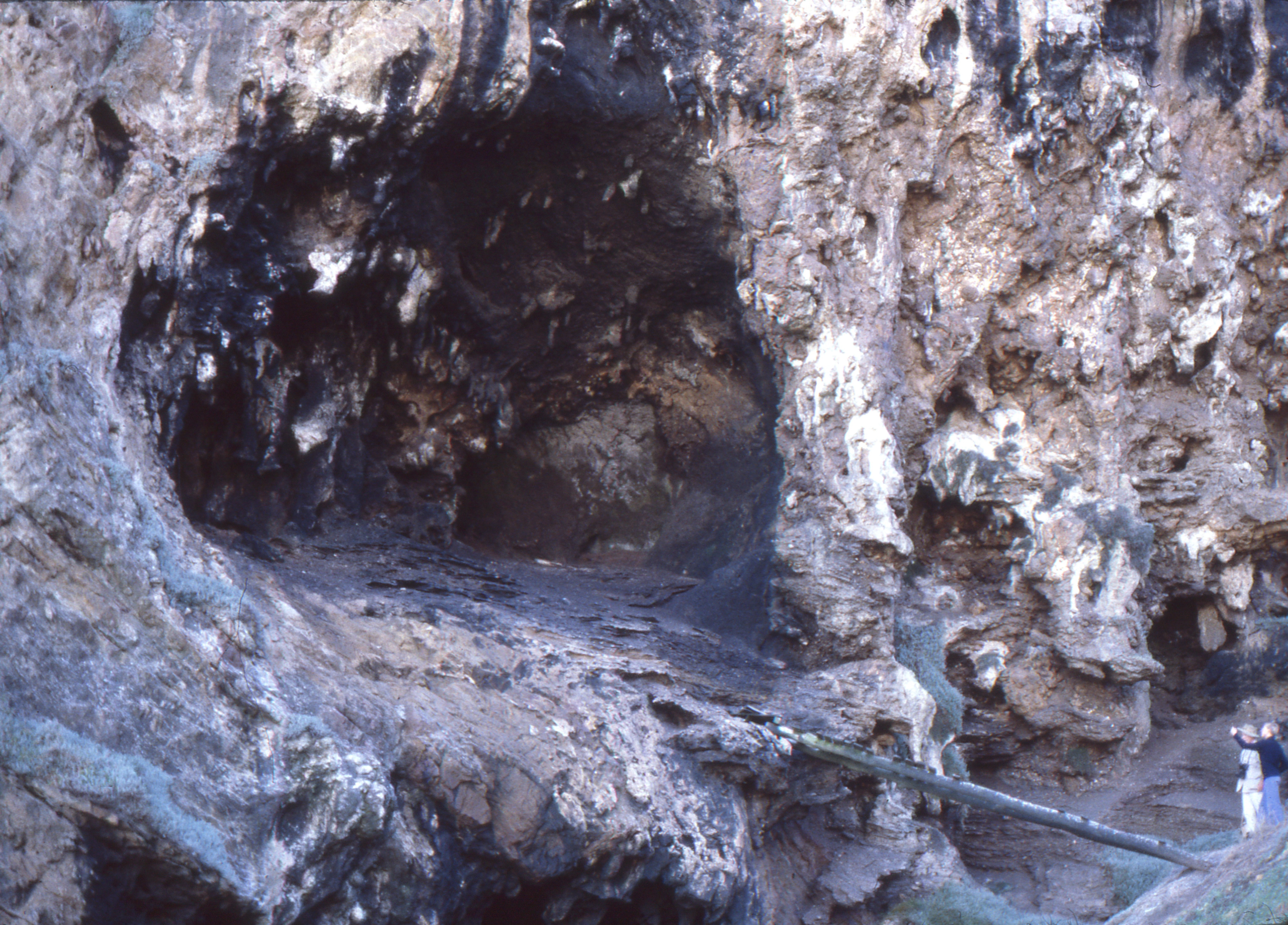
Klasies River Caves
Somewhere around 120,000 years ago, a person living in a sandstone cave on the southeastern coast of Africa cooked starchy roots over a fire. We know this because the charred remains of that meal survived in the cave's hearth, discovered by researchers more than a thousand centuries later. The Klasies River Caves -- three main chambers and two overhanging shelters carved into a cliff less than a kilometer from the Indian Ocean -- hold some of the earliest evidence of anatomically modern humans anywhere on Earth. What these caves contain is not just old. It is foundational: the material record of our species learning to be itself.
The Caves at the World's Edge
The Klasies River Main site sits on a sandstone cliff on the Tsitsikamma coast in the Eastern Cape's Humansdorp district, within the Greater Cape Floristic Region. The environment is a mosaic of mixed woods and fynbos shrubland, with a temperate climate moderated by the Indian Ocean. The district receives 500 to 700 millimeters of rainfall annually. Caves 1 and 1A have produced the majority of finds, while Cave 2 was inaccessible during the earliest periods of habitation due to sediment buildup. From 1967 to 1968, archaeologists John Wymer and Ronald Singer conducted the first major excavations, revealing evidence of Middle Stone Age human habitation beginning approximately 125,000 years ago. The deposits span multiple marine isotope stages, covering glacial and interglacial periods that transformed the landscape from open grassland to forested coast and back again.
Tools That Tell a Story
The stone tool sequence at Klasies River reads like a chronicle of cultural innovation. Four distinct Middle Stone Age phases are represented -- MSA I through MSA IV -- along with the Howiesons Poort industry, a sophisticated tradition characterized by hafted tools and backed blades. Each phase shows different social conventions for tool manufacture, choices that were not dictated by the availability of raw materials but by cultural tradition -- learned techniques passed from one generation to the next. Researcher Sarah Wurz, the site's current primary investigator, has argued that this conventionalized manufacture is itself evidence of symbolic behavior: making a tool in a particular way because that is how your people make tools. Bone tools found at the site include points with longitudinal striations and microstriations consistent with use as arrowheads, potentially pushing the evidence for bow hunting back more than 60,000 years.
Our Ancestors, in Bone and Ochre
The human remains from Klasies River are mostly fragmentary -- cranial pieces, mandibles, teeth, a few hand bones -- but they are profoundly significant. The specimens show anatomically modern human features: no retromolar spaces in the mandibles, supraorbital regions similar to other Homo sapiens specimens. Two mandibles display hypercementosis, a dental condition previously found in Neanderthal and Homo erectus remains. At roughly 119,000 years old, these are the oldest known cases of this condition in Sub-Saharan Africa, demonstrating continuity of the trait through the hominin lineage. Alongside the bones, researchers have found shell beads and concentrations of red ochre in the MSA I and Howiesons Poort levels. Whether the ochre served ritual, symbolic, or practical purposes -- as paint or adhesive -- its deliberate use speaks to people whose lives extended well beyond the demands of mere survival.
A Landscape of Knowledge
Ethnobotanical research at Klasies River has drawn a direct line between the past and the present. A survey of plants within 5 kilometers of the modern site identified 268 species, of which over 50 percent are used medicinally and 43 percent are edible or have other practical applications among Khoi and San communities today. Plants within a 12.5-kilometer foraging radius would have provided 161 native species -- geophytes, leaves, fruits -- sufficient to sustain the people who inhabited these caves. While not all species present today existed during the Middle Stone Age, the continuity of plant knowledge among the region's communities is remarkable. The Khoi and San peoples who still live in the Cape region carry knowledge that connects, however tenuously, to the people who first learned which roots to dig and which berries to gather on this same stretch of coast.
What Modernity Means
Klasies River sits at the center of one of paleoanthropology's most important debates: when did modern human behavior emerge? The traditional view held that anatomical modernity and behavioral modernity arrived together during the European Upper Paleolithic. Klasies challenges that assumption. The evidence here -- conventionalized tool traditions, possible bow hunting, ochre use, shell beads, cooked plant foods -- suggests that behavioral complexity accrued slowly over tens of thousands of years, beginning in Africa during the Middle Stone Age. The debate remains active and contested. Taphonomic processes bias the record toward well-preserved sites, potentially obscuring earlier developments elsewhere. But what Klasies River demonstrates beyond reasonable dispute is that the people who lived in these caves 125,000 years ago were not simply surviving. They were innovating, adapting, and passing knowledge to their children. They were, in every way that matters, us.
From the Air
Coordinates: 34.11S, 24.39E. The Klasies River Caves are located on a sandstone cliff on the Tsitsikamma coast, less than 1 km from the Klasies River mouth where it meets the Indian Ocean. The site is east of the main Tsitsikamma National Park area. Best viewed at 2,000-4,000 ft for the coastal cliff features. Nearest airports: Port Elizabeth (FAPE), approximately 140 km northeast; George (FAGE), approximately 200 km west. The Tsitsikamma mountain range and the N2 highway provide orientation.