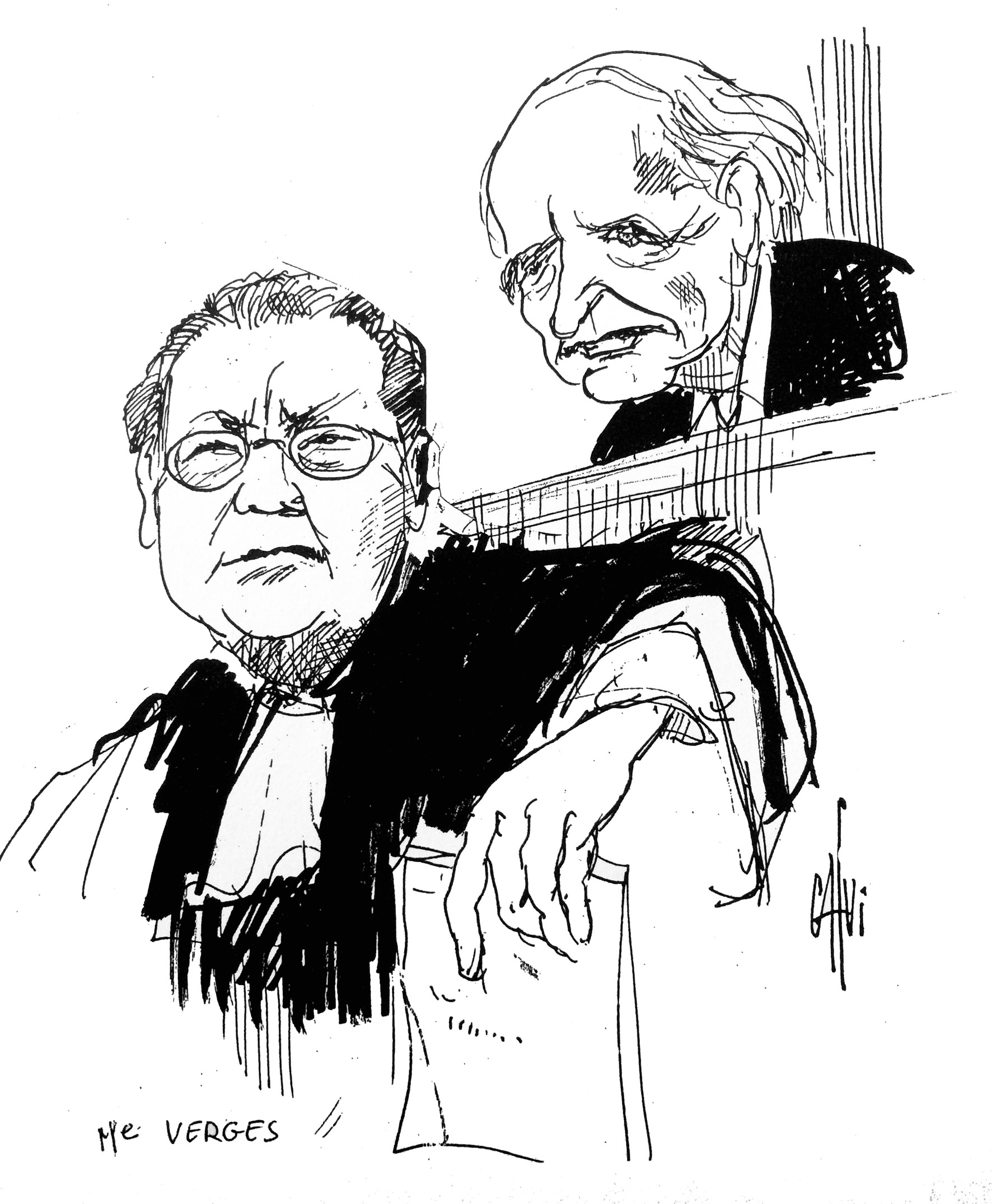
Klaus Barbie
On 3 February 1972, in a government building in La Paz, Bolivia, a French journalist named Ladislas de Hoyos was interviewing a German businessman who called himself Klaus Altmann. The interview was conducted in Spanish, as agreed. Then de Hoyos switched to French and asked whether Altmann had ever been to Lyon. The man who was not supposed to understand French answered automatically -- in German -- that he had not. His fingerprints, taken from the photographs de Hoyos handed him, confirmed what the journalist already knew. Klaus Altmann was Klaus Barbie, the former head of the Gestapo in Lyon, known as the "Butcher of Lyon" for personally torturing Jewish prisoners and French Resistance members during World War II. He had been living freely in South America for over two decades, protected first by American intelligence and then by Bolivian dictators.
The Hotel Terminus
Barbie arrived in Lyon in November 1942, aged 29, as head of the local Gestapo. He set up headquarters at the Hotel Terminus, where he personally tortured prisoners -- adults and children alike. The daughter of one French Resistance leader described how her father was beaten, his skin torn, his head plunged into buckets of ammonia and cold water. He died three days later. Barbie is estimated to have been directly responsible for the deportation of up to 14,000 Jews and Resistance fighters. He personally participated in the Rue Sainte-Catherine Roundup, which saw 84 people arrested in a single day. He arrested Jean Moulin, one of the highest-ranking leaders of the French Resistance, who died in custody. In April 1944, Barbie ordered the deportation to Auschwitz of 44 Jewish children from an orphanage at Izieu. None survived. For these actions, Adolf Hitler awarded him the Iron Cross, First Class.
The Cold War Bargain
What happened after the war is almost as disturbing as what happened during it. In 1947, the U.S. Army Counterintelligence Corps recruited Barbie as an agent, valuing his anti-communist knowledge and his familiarity with European intelligence networks. France, which had sentenced him to death in absentia for war crimes, asked U.S. High Commissioner John J. McCloy to hand him over. McCloy refused. When it became clear that Barbie's past could no longer be concealed, CIC operatives arranged his escape to Bolivia through ratlines used by other fleeing war criminals, aided by Croatian clergy including Krunoslav Draganovic. A 1983 U.S. Department of Justice investigation found that "officers of the United States government were directly responsible for protecting a person wanted by the government of France on criminal charges and in arranging his escape from the law." The United States formally apologized to France that same year.
Thirty Years in the Andes
Barbie arrived in Bolivia in 1951 under the name Klaus Altmann and settled in Cochabamba. He lived well for three decades, cultivating relationships with Bolivian dictators Hugo Banzer and Luis Garcia Meza. His usefulness was specific: he taught paramilitary forces how to use torture effectively and assisted in the arrest, interrogation, and murder of political opponents. Journalists who reported on regime crimes were arrested; activists disappeared into the state's machinery of secret abduction and killing. Barbie participated actively in this repression. He also developed connections with the drug trade, working with Roberto Suarez Gomez and eventually meeting Pablo Escobar, arranging security for coca supply routes in exchange for funding for his anti-communist operations. People who knew him in Bolivia said he remained a committed Nazi ideologue and antisemite to the end, discussing how to help Josef Mengele and Adolf Eichmann evade capture.
Justice, Delayed
Nazi hunters Serge and Beate Klarsfeld identified Barbie in Peru in 1971 after discovering a secret document revealing his alias. The 1972 television interview that unmasked him was broadcast on French television, where Resistance survivor Simone Lagrange -- who had been tortured by Barbie in 1944 -- recognized him immediately. It took another decade for justice to reach him. In February 1983, Bolivia's newly elected democratic government arrested Barbie on a pretext and delivered him to France. His trial began on 11 May 1987 in Lyon, before the same city where he had operated the Gestapo. He was charged with 41 counts of crimes against humanity. His final statement was chilling in its denial: "I never committed the roundup in Izieu. I fought the Resistance, which I respect, with toughness but that was war, and the war is over." The court convicted him on 4 July 1987. He was sentenced to life imprisonment and died in a Lyon prison in 1991, of leukemia and prostate cancer, at the age of 77 -- forty-seven years after the children of Izieu were sent to Auschwitz.
From the Air
Klaus Barbie's connection to Peru centers on his residence at Chaclacayo (approximately 11.96S, 76.73W), east of Lima in the Rimac valley. He also lived extensively in Cochabamba, Bolivia. Jorge Chavez International Airport (SPJC) in Lima is the nearest major airport. The Chaclacayo area is visible as a settlement along the Rimac valley east of Lima's urban core, at roughly 700 meters elevation.