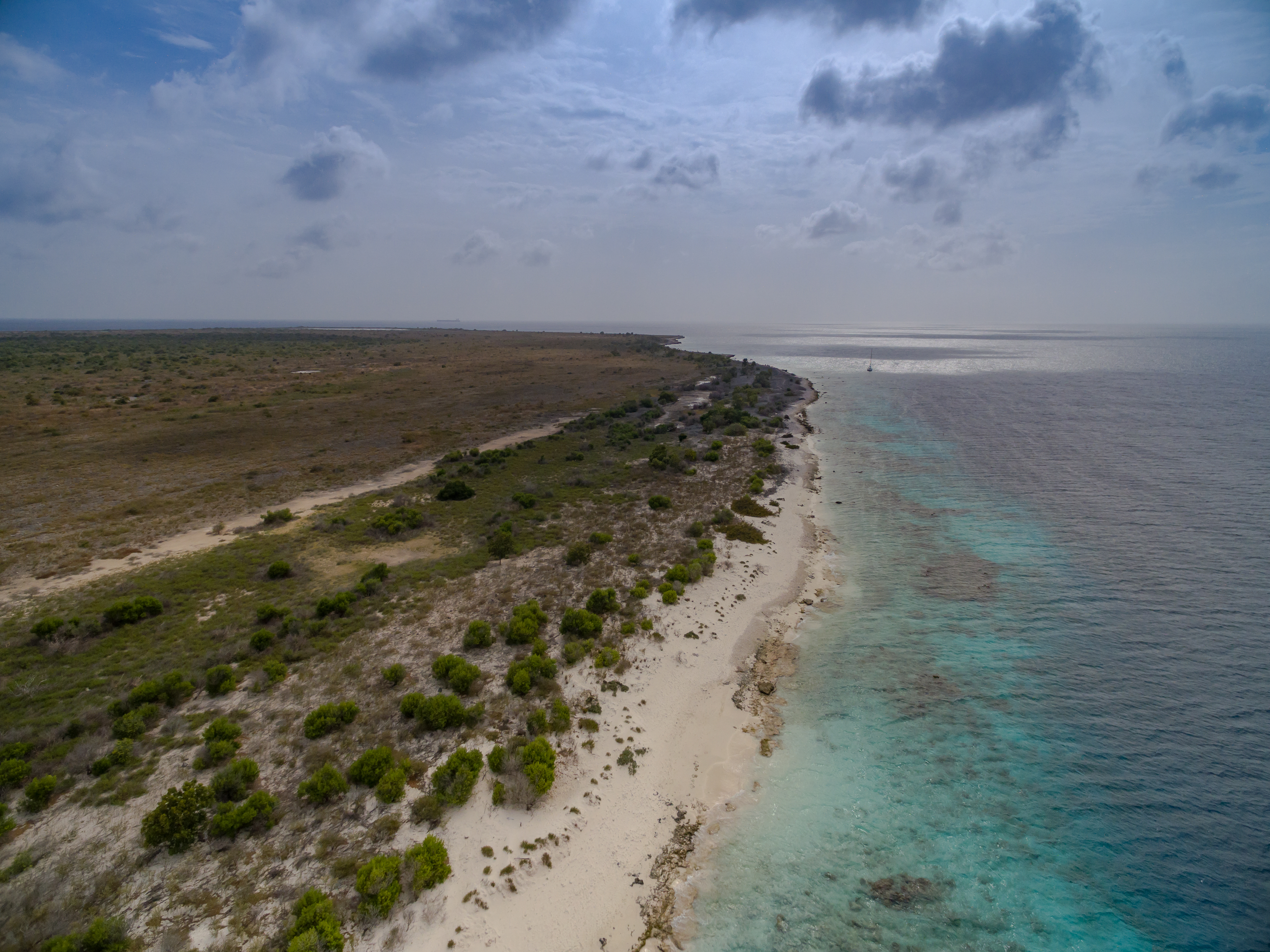
Klein Bonaire
For 131 years, Klein Bonaire belonged to private owners. The flat little island off Bonaire's western coast - six square kilometers of scrubland rising no more than two meters above the sea - changed hands, lost its native trees, and nearly disappeared under resort development plans. Then, in 1999, the people of Bonaire bought it back. The Foundation for the Preservation of Klein Bonaire, working with the Dutch government and the World Nature Fund, raised 9 million Netherlands Antillean guilders - about 5 million U.S. dollars - to purchase the island and place it under permanent protection as part of the Bonaire National Marine Park. It was one of those rare moments when a community looked at a piece of land that someone wanted to develop and said: no, this belongs to the turtles.
Two Meters Above the Waves
Klein Bonaire is not dramatic. It does not rise from the sea in volcanic cliffs or announce itself with towering palms. It sits in the rough crescent formed by the main island's western coast, visible from the hills above Kralendijk as a flat, low smudge on the water. At its highest point, the island barely clears two meters above sea level - a height that storm surges and rising oceans make increasingly precarious. The only structures are the ruins of slave huts, small single-room buildings that date to the era when enslaved people worked Bonaire's salt pans, and a simple open shelter on the beach facing the main island. There is no running water, no electricity, no sanitation. From the air, Klein Bonaire looks like what it is: a piece of the sea floor that barely broke the surface, stubbornly holding on.
Sold, Stripped, and Nearly Lost
In 1868, Klein Bonaire was sold to Angel Jeserun, and for the next century and a half, it remained in private hands. The consequences were visible. Native trees were cleared, leaving the island covered in low scrub growth instead of the vegetation that once anchored its thin soil. Development proposals surfaced repeatedly - the last serious attempt came in 1995, when plans for a resort threatened to transform the island into yet another Caribbean hotel destination. Concerned residents of Bonaire organized in response. The Foundation for the Preservation of Klein Bonaire emerged from that urgency, a grassroots effort that grew into an international campaign. The purchase in 1999 was not inevitable. Private islands in the Caribbean sell for development more often than they sell for conservation. That Klein Bonaire became a marine preserve rather than a marina reflects something particular about Bonaire's culture: an island community that understood the value of leaving something alone.
The Reef Below
The real treasure of Klein Bonaire lies underwater. The coral reef surrounding the island is among the most pristine in the Caribbean, beginning almost immediately offshore - so close to the beach that numbered yellow rocks mark low points where divers can cross without damaging it. A 2011 survey found Montastraea annularis to be the most common coral species, a massive boulder coral that forms the structural backbone of Caribbean reef systems. Visibility often exceeds thirty meters, and the reef supports the full cast of Caribbean marine life. For snorkelers and divers who make the 800-meter boat crossing from Bonaire, Klein Bonaire offers something increasingly rare: a reef not degraded by coastal development, runoff, or anchoring damage. The marine park designation protects it, but so does the island's emptiness - no hotels means no sewage, no construction sediment, no artificial lighting to disorient nesting sea turtles.
Nesting Ground
Green sea turtles and hawksbill sea turtles live around Klein Bonaire year-round. During nesting season, loggerhead sea turtles join them, dragging themselves up the beaches to lay eggs in the sand as their ancestors have done for millions of years. Occasional flamingos wade the shallows. BirdLife International has designated Klein Bonaire an Important Bird Area for its populations of bare-eyed pigeons, least terns, and Caribbean elaenias - species whose ranges are restricted enough that the loss of a single nesting site can matter. Wilson's plovers and snowy plovers breed here too, their small nests hidden among the rocks and scrub. The island's lack of human habitation is precisely its ecological value. No feral cats hunt the shorebirds. No artificial lights draw hatchling turtles away from the sea. No foot traffic crushes plover nests. Klein Bonaire is a sanctuary not because anyone built one, but because everyone agreed to stay away.
Eight Hundred Meters of Separation
The nearest point between Bonaire and Klein Bonaire is about 800 meters, a distance that private boats, water taxis, and the occasional ambitious kayaker cross regularly. The journey takes minutes, but the transition is total. Kralendijk has restaurants, dive shops, and cruise ship traffic. Klein Bonaire has wind, waves, and the sound of terns. Visitors come for the diving and snorkeling, spend a few hours on the white sand beach by the shelter, and return before dark. Nobody stays overnight. Nobody is allowed to. The island that was once private property, stripped of its trees and destined for development, now belongs to everyone and to no one. Its management plan includes reintroducing native vegetation - slowly undoing the damage of a century of private ownership, one planted tree at a time. Klein Bonaire waits as it has always waited: low, flat, and patient, the sea turtles coming ashore in the dark, the reef growing a few millimeters each year, the island holding its place just barely above the waterline.
From the Air
Klein Bonaire is located at approximately 12.16°N, 68.31°W, a flat uninhabited island sitting in the crescent of Bonaire's western coast. From altitude, it is unmistakable: a low, roughly oval landmass about 800 meters offshore from Kralendijk, barely above sea level. The island is approximately 6 square kilometers and completely flat - maximum elevation just 2 meters, making it nearly invisible at higher altitudes. Flamingo International Airport (ICAO: TNCB) is about 3nm to the southeast on the main island. The waters between Klein Bonaire and the main island are sheltered and typically calm, with excellent visibility. The surrounding reef is a protected marine park. Curacao International Airport (TNCC) lies approximately 40nm to the west across open Caribbean Sea.