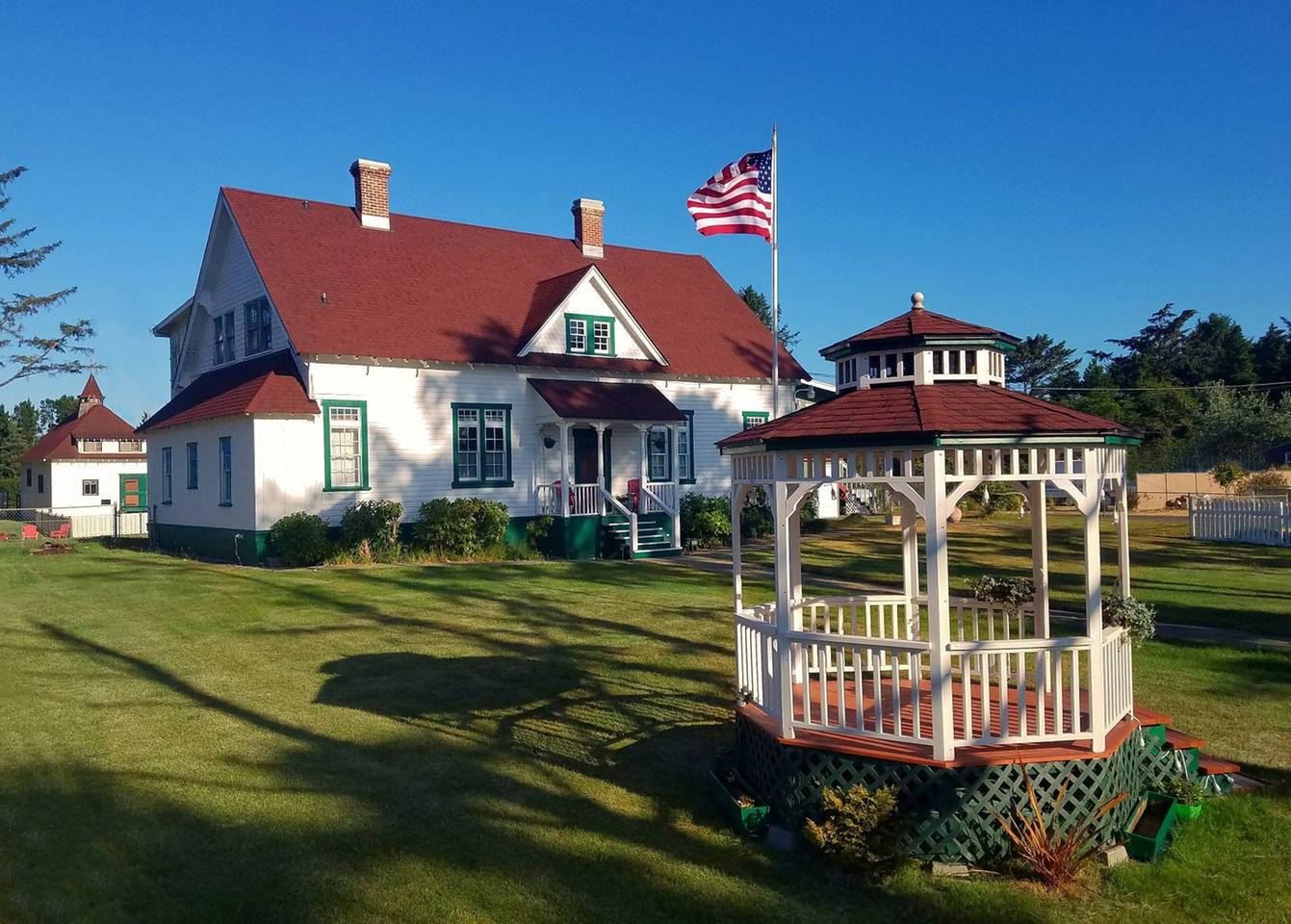
Klipsan Beach Life Saving Station
Seven people drowned within sight of the station on November 3, 1891. The ship Strathblane had gone aground just offshore, and the volunteer crew at the Ilwaco Beach station fired their rescue lines into the gale -- but none reached the vessel. That failure changed everything. Within weeks, the U.S. Life-Saving Service converted the station from a volunteer operation to a full-time professional outfit, and the stretch of Washington coastline known as the Graveyard of the Pacific gained one of its most determined guardians.
A Station Built to a Blueprint
The Klipsan Beach Life Saving Station sits on the Long Beach Peninsula, about 13 miles north of Cape Disappointment in Pacific County, Washington. Established in 1891, it was built in the "Marquette" style -- a standardized design drawn up by architect Albert B. Bibb around 1889 and first used at a station in Marquette, Michigan. Thirteen other stations shared the same plan, scattered along the coasts wherever the Life-Saving Service kept watch. On the West Coast, sister stations stood at Yaquina Bay, the Umpqua River, Coos Bay, and the Coquille River in Oregon, and at Southside, California. The boathouse earned its own nickname: the "witch's hat," for the octagonal ventilator topped with a conical roof that crowned the structure. Standardized plans meant rapid construction, but each station took on the character of its coastline. At Klipsan Beach, that character was relentless surf, shifting sandbars, and fog.
Keepers Against the Sea
After the Strathblane disaster ended the volunteer era, Richard Turk became the station's first professional keeper on December 18, 1891. He served until his death on December 2, 1894. William S. Lawrence followed, though his tenure ended with the terse notation "services dispensed with" in October 1897. George Jorgensen took the post next, serving until he transferred to Point Reyes in 1902, replaced by Theodore Conick, who held the position through the 1915 merger that folded the Life-Saving Service into the newly formed Coast Guard. The station became Coast Guard Station No. 309. By 1929, Chief Warrant Officer Joseph Henderson commanded the post. These were men who spent their careers staring at the Pacific, waiting for the next vessel to founder -- and the list was long. The Glenmorag in 1896, the schooner Solano in 1907, the Alice in 1909, the bark Alfa in 1924. At least twelve significant wrecks occurred along this single stretch of beach during the station's active years.
Rescue by Rail
What made Klipsan Beach unusual among life-saving stations was its railroad. The Ilwaco Railway and Navigation Company ran tracks along the eastern boundary of the station property, and a siding extended to the boathouse overlooking the ocean. A flatcar sat permanently on the siding, ready to carry rescue crews and their boats to wherever a ship had come to grief along the beach. On December 19, 1896, the German bark Potrimpos drifted ashore seven miles south of the station. The horse-drawn lifeboat could not navigate the soft sand, so the railroad loaded a boat and crew onto a train and delivered them to the wreck. Fourteen men remained aboard the Potrimpos. The surfmen launched through the breakers and brought every one of them to shore alive. The railroad served stranger purposes too -- weekly excursion trains brought vacationers to watch the lifeboat rescue drills, turning the deadly serious business of surf rescue into a spectator event. The tracks ran so close to the station that surfmen and their families posed for photographs on the crude platform, rails in the foreground, the station rising behind them.
Tools of the Trade
The surfmen at Klipsan Beach launched into the Pacific from a Dobbins-type lifeboat and a McClelland surfboat, each hauled to the water's edge on a four-wheeled carriage pulled by hand or horse. Beyond the boats, they carried the full arsenal of 19th-century maritime rescue: the Lyle gun, which fired a projectile trailing a line over a stranded ship so that a breeches buoy could be rigged between vessel and shore; Coston flares to signal in darkness and storm; and the breeches buoy itself, essentially a life ring with canvas breeches sewn in, pulled along a rope from ship to beach. Between rescues, surfmen patrolled the shoreline on horseback, scanning the surf for vessels in distress. It was physical, dangerous work performed in conditions where the ocean was always trying to kill someone.
What Remains
The station survived both the Life-Saving Service and the Coast Guard, outlasting its own operational purpose. Although the shoreline has shifted over more than a century -- the ocean now lies farther west than it did when the boathouse doors opened onto breaking surf -- the core buildings remain intact. Listed on the National Register of Historic Places, the restored main station operates today as a vacation rental property. Guests sleep where surfmen once kept watch, in rooms designed by Albert B. Bibb for men who launched boats into storms. The Graveyard of the Pacific earned its name from the hundreds of vessels that broke apart along this coast, and the Klipsan Beach station was one small, stubborn answer to that destruction. The railroad is gone. The Lyle guns are silent. But the station still stands on the peninsula, facing the same ocean that gave it purpose.
From the Air
Located at 46.46°N, 124.05°W on the Long Beach Peninsula, about 13 miles north of Cape Disappointment. The station is visible on the ocean side of the narrow peninsula. Recommended viewing at 2,000-3,000 feet to see the peninsula's full extent between the Pacific and Willapa Bay. Nearest airport: Astoria Regional Airport (KAST) approximately 15 nm south across the Columbia River. The peninsula itself is a distinctive narrow sand spit clearly visible from altitude.