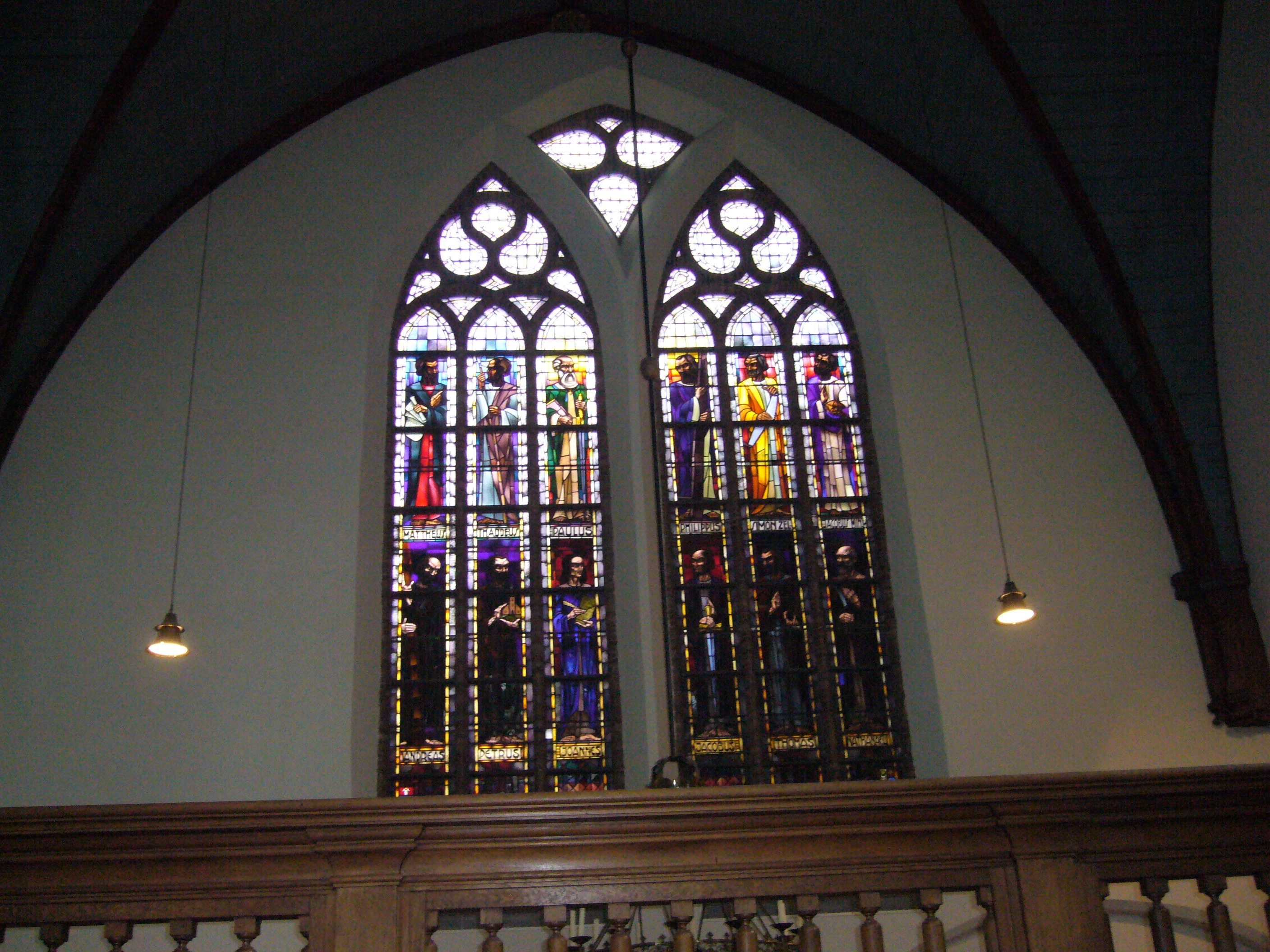
Kloosterkerk, The Hague
On the night of 3 November 1690, the nave of the Kloosterkerk in The Hague was packed floor to ceiling with gunpowder. The Dutch had thrown the Dominican friars out a century earlier, dissolved their monastery, and converted the empty buildings into a cannon foundry for the States of Holland and West Friesland. The choir made the cannons; the nave stored the ammunition; a wall divided one from the other. That night the powder went off. When the smoke cleared, only a single wall of the medieval monastery was still standing. Most churches would have been finished. The Kloosterkerk, somehow, was not. Today it is the quiet thirteen-century-old building on the Lange Voorhout where the Dutch royal family worship and the Bach Choir of The Hague performs cantatas on the last Sunday of every month, as if none of its disasters had ever happened.
Dominicans on the Lange Voorhout
The first church on this site went up in 1397 for the Order of Preachers, the Dominicans, in a period of renewal under the Italian reformer Raymond of Capua. The Dutch court at the time belonged to Albrecht of Bavaria and his second wife, Margaret of Cleves, who turned The Hague into a small but glittering centre of late-medieval art. The illuminated manuscript known as the Hours of Margaret of Cleves was commissioned in this circle between 1395 and 1400; its sister-volume, a Biblia Pauperum, came out of the same workshop. Margaret was buried in the Kloosterkerk in a lead coffin, embalmed - centuries later, when the floor was opened, her remains were found exactly where the records said they would be. Around 1540 the church was expanded and re-dedicated to a new patron, Saint Vincent Ferrer, a Valencian Dominican preacher canonised in 1455. A fire in 1420 had been the building's first crisis. It would not be the last.
Iconoclasm, Foundry, Explosion
The beeldenstorm of 1566 swept Protestant iconoclasts through the Low Countries, smashing altarpieces, statues, and stained glass in every Catholic church they could reach. The Kloosterkerk was emptied of its decorations. The last Dominican friars left in 1574; the monastery was demolished in 1583. For twelve years the church stood abandoned and weather-beaten, with serious proposals to tear it down. In 1588 a cavalry company moved in for shelter. The following year the States of Holland turned the building into a working munitions plant. It was a peculiarly Dutch piece of pragmatism: the cannons for the Eighty Years' War cast inside the building that had once been a house of prayer. Then came the night of 3 November 1690 and the explosion that should have ended everything.
The Theological Squat
Even before the foundry was built, the church had taken a second life. In 1617 the Protestant Church in the Netherlands was tearing itself apart over Arminianism - the Remonstrants, led by the minister Johannes Wtenbogaert and backed by the statesman Johan van Oldenbarneveldt, insisting on a softer doctrine of grace; the Counter-Remonstrants insisting on strict Calvinist predestination. The Remonstrants held the Grote Kerk. The Counter-Remonstrants, locked out, simply squatted the Kloosterkerk and started preaching there. Later that same July, Maurice of Nassau, Prince of Orange, walked into one of the squatters' services to make his political allegiance unmistakable. Oldenbarneveldt was arrested the following year and beheaded in 1619 on the Binnenhof, a few minutes' walk from the church where his rivals had just won. The Kloosterkerk has been a Reformed Protestant church ever since.
Cossacks, Fahrenheit, and a Ship's Bell
In 1795 French revolutionary armies entered The Hague, and a committee met inside the Kloosterkerk's walls to plan the replacement of the Stadholder's family that had just fled to England. In 1813, with the French in retreat, a regiment of Cossack troops was billeted briefly inside the building - imagine the horses on the medieval flagstones. The German-Polish scientist Daniel Gabriel Fahrenheit, who lived and died in The Hague and gave the world the temperature scale that still carries his name, was buried somewhere in the church; in 2002 the Polish ambassador unveiled a bronze plaque in the porch in his memory. Also in the porch hangs the bell of the HNLMS De Ruyter, the Dutch cruiser sunk by the Imperial Japanese Navy at the Battle of the Java Sea in February 1942 with the loss of more than three hundred of her crew. The bell came home. The men did not.
A Royal Parish
The 20th century almost finished the Kloosterkerk. By 1912 the building was so dilapidated that services were suspended and demolition openly proposed; only a strong public objection persuaded the consistory to fund a restoration instead. Services resumed in 1914. During the German occupation of 1940-1945, the neighbouring Duinoordkerk was demolished by order of the occupiers, and its congregation was given refuge in the Kloosterkerk - a refuge that turned permanent. Furniture and art rescued from the Duinoordkerk and stored for safekeeping in the Peace Palace were installed in the church between 1952 and 1957: the Flemish-carved oak pulpit of around 1700, a stained-glass window of the twelve apostles, and Johan Thorn Prikker's 1925 mosaic of the Last Supper. The wall between nave and choir was finally removed. A Marcussen organ was installed in 1966. In 1997 the future King Willem-Alexander made his Confession of Faith here; his youngest daughter, Princess Ariane, was baptised in the church in 2007. Princess Beatrix attended services here for years. After six centuries of explosions, occupations, and reformations, the Kloosterkerk has settled into being, finally, simply a church.
From the Air
The Hague, Netherlands. Coordinates 52.0817 N, 4.3094 E. The Kloosterkerk fronts onto the Lange Voorhout, the long tree-lined park-square in the diplomatic quarter of central The Hague, two minutes' walk from the Binnenhof and a block from the Hotel des Indes. Nearest airports: Rotterdam The Hague (EHRD) 15 km south, Amsterdam Schiphol (EHAM) 45 km northeast. From the air the church is the squat brick form set among the trees just north of the Hofvijver lake.