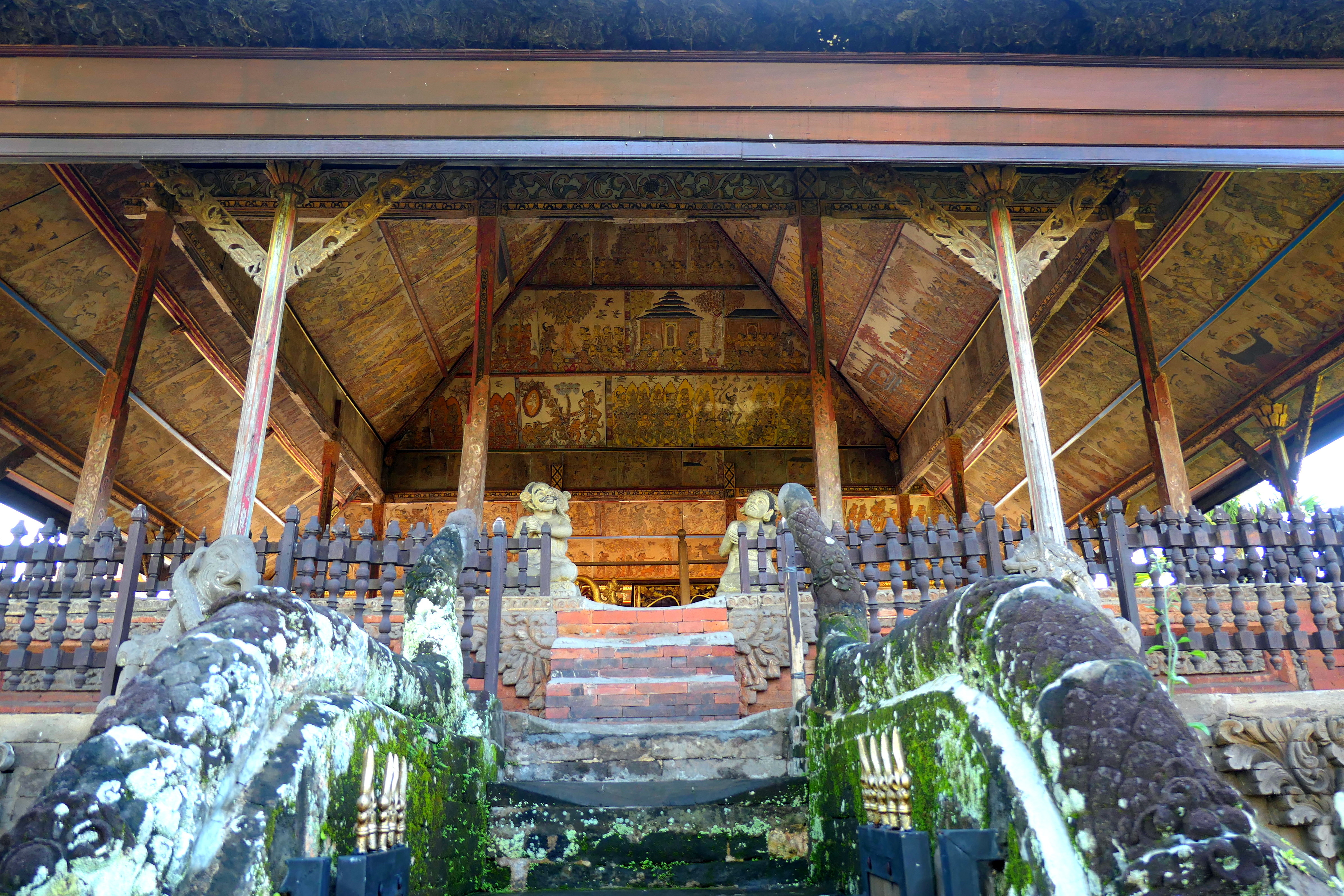
Klungkung Palace: The Abode of the Gods
On the morning of April 18, 1908, the king of Klungkung dressed in white. So did the members of his household, his court, his retainers. They knew what white meant. Dewa Agung Jambe II led them out through the gates of Puri Semarapura, the palace his ancestor had named 'The Abode of the Gods,' and walked toward the Dutch guns. The puputan that followed ended the last independent kingdom on Bali. Women and children marched alongside the warriors. Those not killed by bullets were killed by their own people, ensuring that no one would live under foreign rule. The palace was razed afterward. What remains today, a gate, a pavilion, a floating hall, are fragments of a story that stretches back through two centuries of intrigue, rebellion, and the stubborn persistence of sacred power.
Born from Betrayal
Klungkung Palace exists because of a usurper. For most of the sixteenth and seventeenth centuries, the kingdom of Gelgel had been Bali's dominant power. But under the last Gelgel king, Dalem Di Made, a chief minister named Anglurah Agung gradually seized control. By the 1650s, Anglurah Agung was writing to the Dutch in Batavia as Bali's ruler, while the king languished as a prisoner in his own palace. The usurper held power for decades before falling in battle in 1686. Dewa Agung Jambe I, son of the deposed king, reclaimed the throne with help from nobles of Badung, Karangasem, and Tabanan. Rather than return to tainted Gelgel, he built a new capital three kilometers to the north and gave it a name that announced its ambition: Puri Semarapura, The Abode of the Gods.
Paramount but Not Supreme
The new palace inherited Gelgel's prestige but not its power. Where Gelgel had unified Bali under a single ruler, Klungkung presided over a fractured island. Karangasem, Badung, Buleleng, Tabanan, Mengwi, Sukawati -- these kingdoms acknowledged the Dewa Agung as their paramount lord but governed themselves. The tension between nominal supremacy and actual weakness defined the dynasty for two centuries. Dewa Agung Gede allied with Mengwi for an expedition to Java but died in 1736, provoking a succession war between his sons. One of his successors, Dewa Agung Sakti, was mentally ill. His wife fled to Karangasem, where their son Dewa Agung Putra I was raised before being installed on the Klungkung throne with Karangasem muscle. Putra I proved capable but died fighting a minor war in Bangli in 1809. The dynasty endured, not through military dominance, but through the accumulated weight of sacred legitimacy.
The Queen Who Fought the Dutch
When the colonial era arrived, Klungkung produced one of its most remarkable figures. Dewa Agung Istri Kanya, daughter and co-regent of Dewa Agung Putra I, fought the Dutch to a standstill during the 1849 military expedition, forcing a reconciliation between the Balinese rajas and colonial authorities that held for decades. Her brother Dewa Agung Putra II had signed a treaty with the Dutch in 1843, but conflicting interpretations triggered three military campaigns. The queen's resistance during the third expedition earned a pause in colonial aggression. In the following decades, Dewa Agung Putra III proved equally assertive, imprisoning the Raja of Gianyar in 1885 and helping destroy the rival kingdom of Mengwi in 1891. These were not the actions of a declining power, but of a dynasty determined to maintain its position even as the colonial net tightened.
The Paintings That Survived the Palace
The palace compound followed the pattern of its Gelgel predecessor: a square of roughly 150 meters per side, divided into blocks with ritual and practical functions arranged according to deep cosmological symbolism. Its most enduring legacy is painted, not built. The Kertha Gosa Pavilion, the royal court of justice, bears ceiling paintings depicting Bhima's journey through hell and heaven, along with stories from the Tantri tales and the Garuda legend. Panels illustrating the Palindon, omens predicting earthquakes, suggest a civilization acutely aware of the volcanic ground beneath its feet. Leading artists from the nearby village of Kamasan have repainted these panels across the centuries: Kaki Rambut, Pan Seken, Mangku Mura, and Nyoman Mandra each left their mark. Beside the Kertha Gosa stands the Bale Kambang, the Floating Pavilion, surrounded by a moat meant to evoke the cosmic ocean Anavatapa. Its six-tiered ceiling illustrates the Sutasoma epic and Balinese astrological charts. The pavilion's architecture symbolizes Mount Meru, the center of the universe.
After the Silence
The Dutch razed the palace after the 1908 puputan. They exiled the surviving members of the royal family. For two decades, the compound lay in ruins. In 1929, the family was permitted to return, and they built a new residence, Puri Agung, to the west of the old palace grounds. The descendants of the rajas live there still. What the Dutch could not destroy were the structures they found useful or beautiful enough to preserve. The main gate, bearing its Saka date of 1622, still stands. The Kertha Gosa and Bale Kambang survived, their painted ceilings intact. Today a museum occupies the grounds, and a monument to the north commemorates the puputan. The memorial stands where the royal family walked out to die, a spot where the palace's name acquires its final, unintended meaning. The Abode of the Gods was always meant to describe a place of sacred power. After April 18, 1908, it became a place where mortals chose to meet their gods on their own terms.
From the Air
Klungkung Palace sits at 8.536S, 115.403E in Semarapura, the capital of Klungkung Regency in eastern Bali. From the air, the palace grounds are visible on the north side of the town center, marked by the moat surrounding the Bale Kambang floating pavilion and the open courtyard of the Kertha Gosa. The former kingdom of Gelgel lies three kilometers to the south, toward the coast. Ngurah Rai International Airport (WADD) is approximately 40 kilometers southwest. Mount Agung, Bali's highest peak and the site of Pura Besakih, dominates the northeastern skyline.