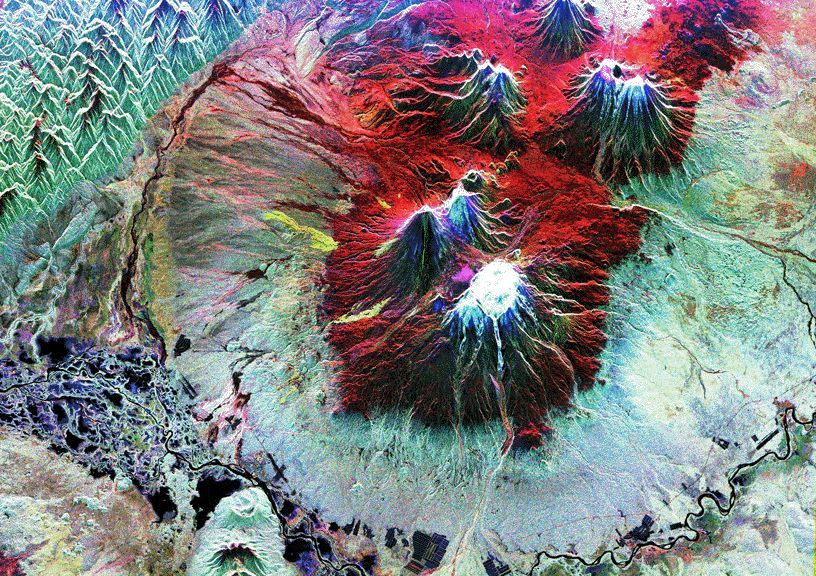
Klyuchevskaya Sopka
In 1788, Daniel Gauss and two companions from the Billings Expedition clawed their way to the summit of a nearly perfect volcanic cone rising from the Kamchatka Peninsula, roughly 100 kilometers inland from the Bering Sea. No one would successfully climb it again for 143 years. When climbers finally returned in 1931, several were killed by flying lava on the descent. Klyuchevskaya Sopka, the highest active volcano in all of Eurasia, has been making the same argument against visitors ever since -- and it makes that argument frequently, having erupted 110 times during the Holocene Epoch.
Eurasia's Volcanic Crown
Klyuchevskaya Sopka appeared roughly 7,000 years ago and has been almost continuously active since. Its steep, symmetrical cone -- the kind of shape a child draws when asked to sketch a volcano -- ranks fifteenth in the world by topographic isolation, meaning there is no higher ground for a very long way in any direction. The volcano is part of the UNESCO World Heritage Site "Volcanoes of Kamchatka," sharing the designation with its restless neighbors: Bezymianny, Tolbachik, Shiveluch, Karymsky, and Kizimen, among others. These volcanoes share magma sources, and their eruptions are interconnected in ways scientists are still mapping. When one neighbor erupts more vigorously, the others sometimes quiet down, as though the pressure has been relieved through a different vent.
A Restless Giant
The eruption catalog reads like a drumbeat. January 2013: a weak Strombolian eruption lasting a single day. August 2013: lava flows that produced, by observer accounts, an excellent fireworks display before stopping when neighboring Gorely volcano woke up and took over. October 2013: three days of on-and-off explosions with ash plumes drifting eastward. November 2013: a powerful blast that sent ash to 10 kilometers and triggered a red aviation alert. Then silence for a year, followed by more Strombolian eruptions in January and March 2015. The pattern continued through the 2020s -- eruptions in December 2020, November 2022, and June 2023, when ash rose 13 kilometers above sea level and disrupted flights as far away as Vancouver, Canada. In July 2025, the volcano erupted again shortly after a major earthquake shook the peninsula.
The Mountain That Kills
Klyuchevskaya Sopka is not merely a spectacle. In September 2022, a group of twelve Russian climbers -- including two guides -- attempted the summit. At roughly 4,000 meters, five climbers fell to their deaths. Four more, including a guide, perished on the mountainside in the aftermath, likely from exposure and injuries sustained during failed rescue attempts in deteriorating conditions. A helicopter managed to land at 1,663 meters on the fourth attempt. The rescuers who emerged faced a two-day climb to reach a volcanologists' hut at 3,300 meters where the three survivors had taken shelter. The mountain's dangers are not theoretical: volcanic bombs, sudden eruptions, extreme weather, and the sheer steepness of its icy slopes combine to make Klyuchevskaya one of the deadliest climbs in Russia.
Volcanic Neighbors
What makes Klyuchevskaya extraordinary is not just the volcano itself but the company it keeps. The Klyuchevskaya volcanic group is one of the densest clusters of active volcanoes on Earth. In January 2013, every major volcano in eastern Kamchatka was erupting simultaneously -- Bezymianny, Karymsky, Kizimen, Klyuchevskaya Sopka, Shiveluch, and Tolbachik -- with only the extinct Kamen sitting the round out. The volcanoes share underground plumbing, their magma chambers interconnected in a subterranean network that scientists monitor with seismographs and satellite imagery. When Tolbachik erupted vigorously in late 2012, it appeared to draw magma away from Klyuchevskaya, dampening its activity. The relationship works both ways; a quiet period at one volcano may signal trouble at another.
Ash Across the Pacific
From the flight deck of a trans-Pacific airliner, Kamchatka's volcanoes are not academic. The November 2023 eruption sent ash 13 kilometers high and caused flight delays in Vancouver, more than 6,000 kilometers away. The Kamchatka Volcanic Eruption Response Team issues color-coded aviation alerts that propagate instantly to flight dispatch centers around the Pacific Rim. Ash from Klyuchevskaya has disrupted air traffic repeatedly -- a 2007 eruption prompted widespread rerouting of North Pacific flights. The volcano's position along major flight corridors between Asia and North America means that every significant eruption ripples through global aviation. Seen from above on a clear day, Klyuchevskaya's perfect cone casts a long shadow across the Kamchatkan wilderness, its summit plume a reminder that the highest point in Eurasia's volcanic chain is also among its most unpredictable.
From the Air
Located at 56.07N, 160.63E in central Kamchatka, rising to approximately 4,750 m ASL. Klyuchevskaya Sopka is a major aviation hazard on trans-Pacific routes. Eruptions regularly send ash to 10-15 km ASL. Monitor KVERT alerts before overflying the region. Nearest significant airfield is Yelizovo/Petropavlovsk-Kamchatsky (UHPP), approximately 350 km south-southwest. The volcanic group includes multiple active cones exceeding 3,000 m. Ash clouds from major eruptions have disrupted flights as far as Vancouver, Canada (CYVR). Approach with caution; check current SIGMET and NOTAM status.