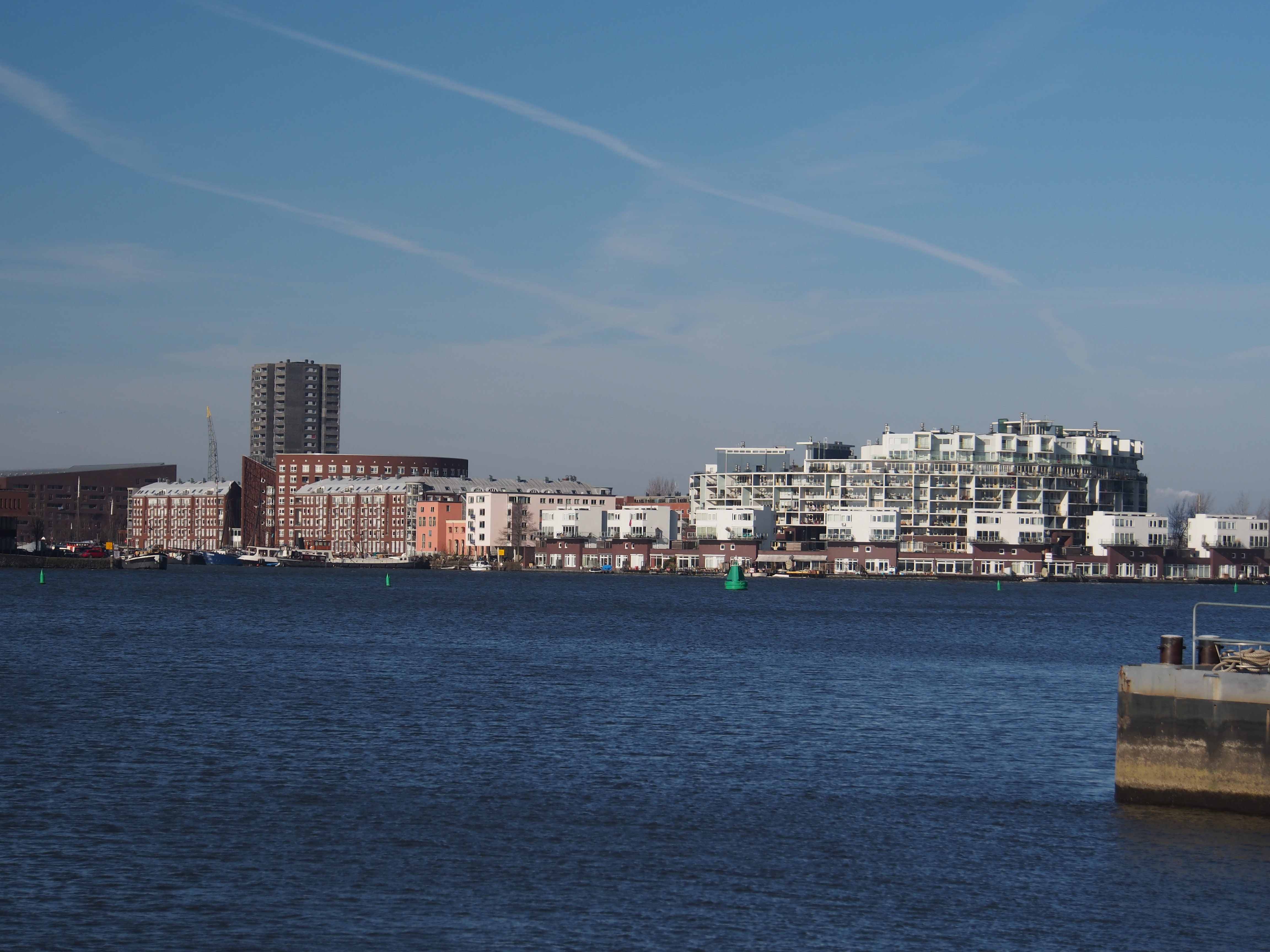
KNSM Island
The ships left in 1977. For most of the previous seventy-four years, KNSM Island had belonged to a single shipping company - the Koninklijke Nederlandsche Stoomboot-Maatschappij, the Royal Dutch Steamboat Company - whose acronym is still bolted onto street signs that no longer point to anywhere a ship goes. The decolonization of the Dutch East Indies had taken away most of the routes. Containers had taken away the rest. The warehouses emptied. The cranes went still. And then, almost immediately, the squatters and artists moved in.
Building an Island for Ships
KNSM Island began as engineering, not geography. In the late nineteenth century Amsterdam piled dredge soil from the new North Sea Canal into the IJ harbor to make breakwaters for the Oostelijke Handelskade - the eastern commercial docks. KNSM, Java, and a clutch of other slivers of made-land emerged from that ballast. By 1903, KNSM had bought up most of the new island and built itself a small industrial town: docks, warehouses, an office for the company's medical staff, a cafeteria, a customs building, and the offices of the Rijn Scheepvaart Maatschappij. From here KNSM ships hauled coffee, cocoa, and people between Amsterdam and the Caribbean, Central America, and the Mediterranean. In 1956 the company celebrated its centennial. Twenty-one years later it was gone.
The Sloap Republic
Through the 1980s, KNSM Island became one of Amsterdam's celebrated 'sloaps' - a Dutch acronym borrowed from English, *sites left over after planning*, places the city had not yet decided what to do with. Squatters, artists, and what the local press called urban nomads occupied the abandoned warehouses. They turned Loods 6, an old storage shed, into studios and improvised cafes. They held parties in halls that had been silent since the last freighter cast off. The municipality tolerated them, then progressively did not. By the early 1990s the orders to leave were arriving in earnest. What stayed behind in the public memory was a sense of the island as a place where art had briefly outflanked planning - a memory the eventual planners would lean on hard when it came time to sell apartments.
Jo Coenen's Super Blocks
In 1988 the architect Jo Coenen drew up his first major commission: a blueprint to turn the island into a residential neighborhood. He kept the bones. The old cafeteria, the medical doctors' houses, Loods 6, the customs office - all preserved by city order. He imagined 'super blocks' along a central avenue, big buildings stuffed with apartments, intentionally echoing the rhythm of the warehouses they replaced. The German architects Hans Kollhoff and Christian Rapp delivered Piraeus between 1989 and 1994 - 304 homes in 150 different floor plans, 95% rentals, deliberately mixed-income because the city had insisted the island not become a gated quarter. Wiel Arets contributed the twenty-story Skydome. The Swiss firm Diener & Diener added Hoogkade and Hoogwerf. Belgian architects designed Albert. The result was a textbook of late-twentieth-century European architecture set on a former dock.
Dockland Chic
The Telegraph called it 'dockland chic.' The Dutch press kept calling it the *yuppen-eiland*, the yuppie island. Both labels are partly fair and partly not. The mandate for rental housing did spread the demographics - Piraeus alone holds hundreds of subsidized apartments - but rents and house prices on KNSM are now among the highest in Amsterdam-Oost. The former company park, designed by Mien Ruys in 1956 with the sober geometry that made her one of the Netherlands' most respected landscape architects, was restored in 1994 with Ruys herself consulting. It was renamed in her honor: Mien Ruysplantsoen. She died in 1999. The park she helped lay out for steamship clerks is now a place where designer dogs are walked by tech consultants.
Amphitrite Comes Home
In 1959, three years late for the centennial they were meant to mark, KNSM employees commissioned a fountain dedicated to Amphitrite - in Greek mythology the wife of Poseidon, queen of the salt sea. The sculptures stood on the island until 1981, when housing development pushed them off to the Oosterdok, near the Nederlands Scheepvaartmuseum. There they waited in a kind of polite municipal exile. In 2009 they came back. They sit now on the Azartplein, where tram line 7 has its terminus, looking out at the IJ. A goddess of the sea, donated by men whose company had already begun to die, returned to an island that no longer has any docks. It is the kind of small, slow Amsterdam ceremony the city does well.
From the Air
Located at 52.38 N, 4.94 E, KNSM Island is the easternmost finger of land in Amsterdam's Oostelijk Havengebied (Eastern Docklands). From altitude it reads as a long, narrow rectangle pointing east into the IJ, with the parallel Java Island immediately to its south and the open IJ harbor to the north. The Skydome tower is the tallest landmark on the island. Nearest airport: Schiphol (EHAM), 16 km southwest.