Koa Kannon
The clay came from the battlefields. In 1940, retired General Iwane Matsui -- former commander of the Shanghai Expeditionary Force during the Second Sino-Japanese War -- gathered soil from the killing fields where Chinese and Japanese soldiers had fallen, including from the vicinity of Nanjing, and shaped it into a statue of Kannon, the bodhisattva of compassion. He placed it atop Mount Izu in Atami, Shizuoka Prefecture, and dedicated it to the war dead of both nations, consecrating friend and enemy alike. On February 24, 1940, a Jodo Buddhist monk from the great temple of Zojo-ji performed the consecration ceremony before a gathering of dignitaries. Then Matsui built a retreat nearby and climbed the mountain each morning to chant the Kannon Sutra before the statue he had made from the earth that had swallowed so many young men. Eight years later, he would join them -- executed as a Class A war criminal by the International Military Tribunal of the Far East.
A Temple Unlike Any Other
Koa Kannon is singular in Japanese Buddhism. Formally registered as the Reihaizan Koa Kannon, it traces its lineage to the Hokke Shu Jin-Monryu, a breakaway sect of Nichiren Buddhism based in Sanjo, Niigata Prefecture, but operates as a fully independent temple -- the only one of its kind in Japan, with its own unique history and rites. It has no graves, which means it has no patrons under the traditional danka system that sustains most Japanese temples through funeral services and memorial rites. The temple admits all worshippers regardless of their religion. Its first head priest, Master Ninrei Itami, led the temple through its most turbulent decades. Today his third daughter, Sister Myojo Itami, serves as head priest, assisted by Yasuaki Itami, a priest of the Soto Zen school. The temple survives on offerings from visitors, volunteers, and a small support group founded in 1942 by Matsui himself.
The Secret Urn
On December 23, 1948, seven men were hanged at Sugamo Prison in Tokyo. Among them were former Prime Minister Hideki Tojo and General Iwane Matsui, the man who had built the very statue on Mount Izu. The American occupation authorities cremated the bodies at Kuboyama Crematorium in Yokohama and disposed of the ashes to prevent any future veneration. But not all the ashes disappeared. Miyoshi Tobita, the crematorium manager, and Shohei Sanmonji, a defense attorney for convicted war criminal Kuniaki Koiso, secretly recovered one urn. On May 3, 1949, they carried it to the Koa Kannon temple, knowing its connection to Matsui. Master Ninrei Itami received the urn and understood immediately what it contained. He hid the ashes for a decade. On April 19, 1959, a stone monument to the "seven warriors" was erected on the temple grounds, its inscription written personally by former Prime Minister Shigeru Yoshida, and the ashes were buried beneath it.
Monuments and Martyrs
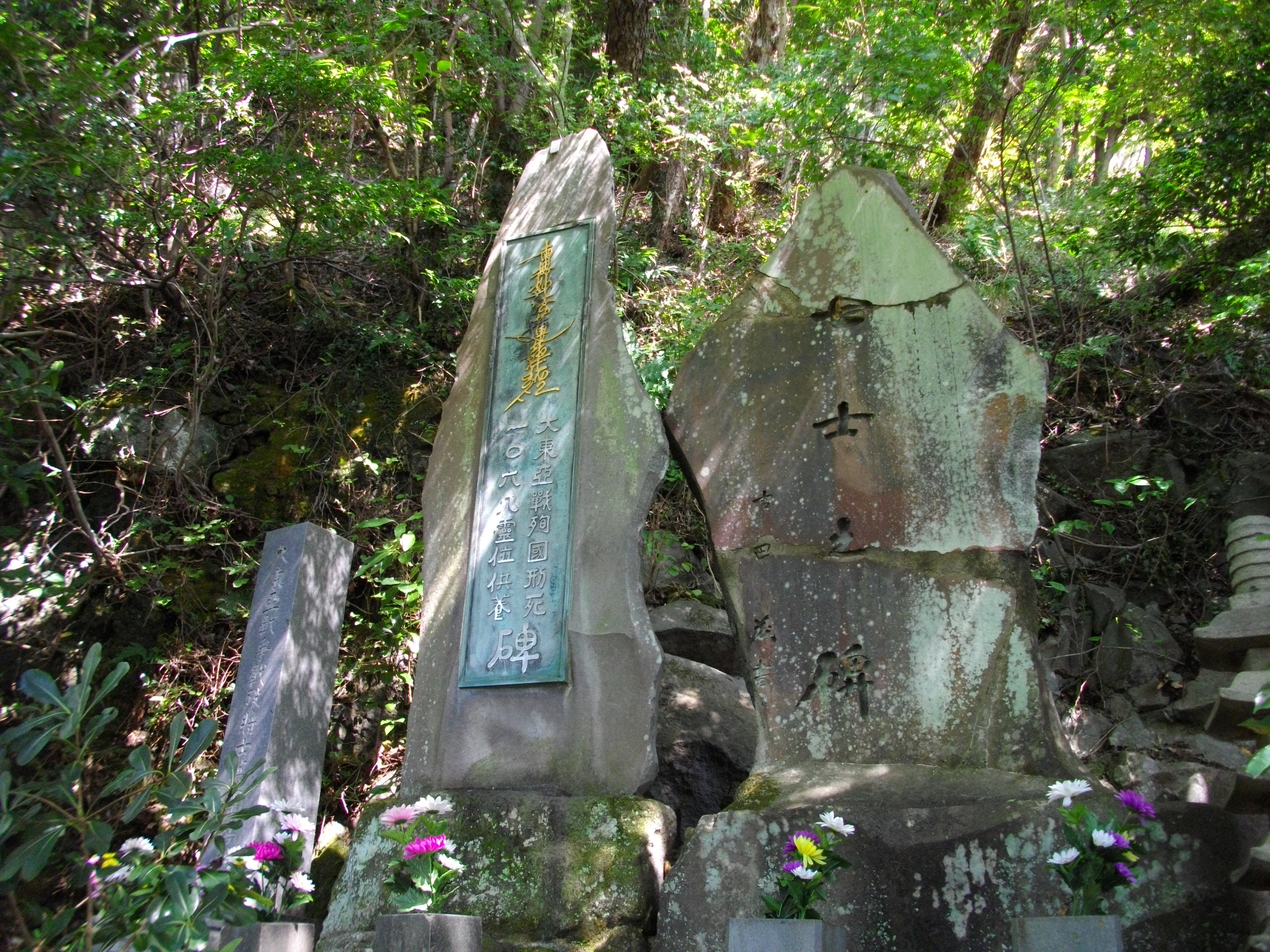
The site grew into something far more than Matsui had envisioned. In 1944, while the Pacific War still raged, a second monument was erected: the "Bodhi for the Warriors Who Fell in Battle in the Great Pacific War," honoring all war dead in the Pacific theater. After the enshrinement of the seven executed leaders, a third monument followed: the "Memorial Stone of the 1,068 Executed Martyrs of the Great Pacific War," dedicated to Class B and C war criminals who were executed or who died in prison. In 1960, a portion of the seven leaders' ashes was removed and reburied at a separate tomb on Mount Sangane in Nishio, Aichi Prefecture. The concentration of war criminal memorials at a single Buddhist temple led some to call Koa Kannon a "little Yasukuni Shrine" -- a comparison that carries enormous weight in a country where the veneration of war criminals remains one of the most contentious issues in public life.
The Fuse That Fell Short
On December 12, 1971, the East Asia Anti-Japan Armed Front, a radical leftist group that viewed the monuments as symbols of Japanese imperialism, attempted to destroy the entire site with explosives. They targeted the Kannon statue, the stone monument of the seven warriors, and the Memorial Stone of the 1,068 Executed Martyrs. The bombing partially succeeded: the monument to the seven warriors was shattered. But the fuse to the other charges was cut too short, and both the great statue of Kannon and the martyrs' memorial survived the blast. Volunteers later restored the destroyed monument. The attack underscored a tension that has defined Koa Kannon since its earliest days -- a place built to honor compassion for all who fall in war, yet inextricable from the specific men who waged it and the judgments history has rendered upon them.
From the Air
Located at 35.119N, 139.092E atop Mount Izu in the city of Atami, on the northeastern coast of the Izu Peninsula. The statue sits on a forested hilltop above the coastal resort city. From the air, Atami is a dense urban cluster compressed between steep green mountains and the waters of Sagami Bay. The Kannon statue may be visible from lower altitudes as a clearing on the hillside above the city. Nearest airports: RJTT (Tokyo Haneda) approximately 50nm northeast, RJTO (Oshima) approximately 25nm east. The Tokaido Shinkansen passes through nearby Atami Station along the coast. Mount Fuji is frequently visible to the northwest.