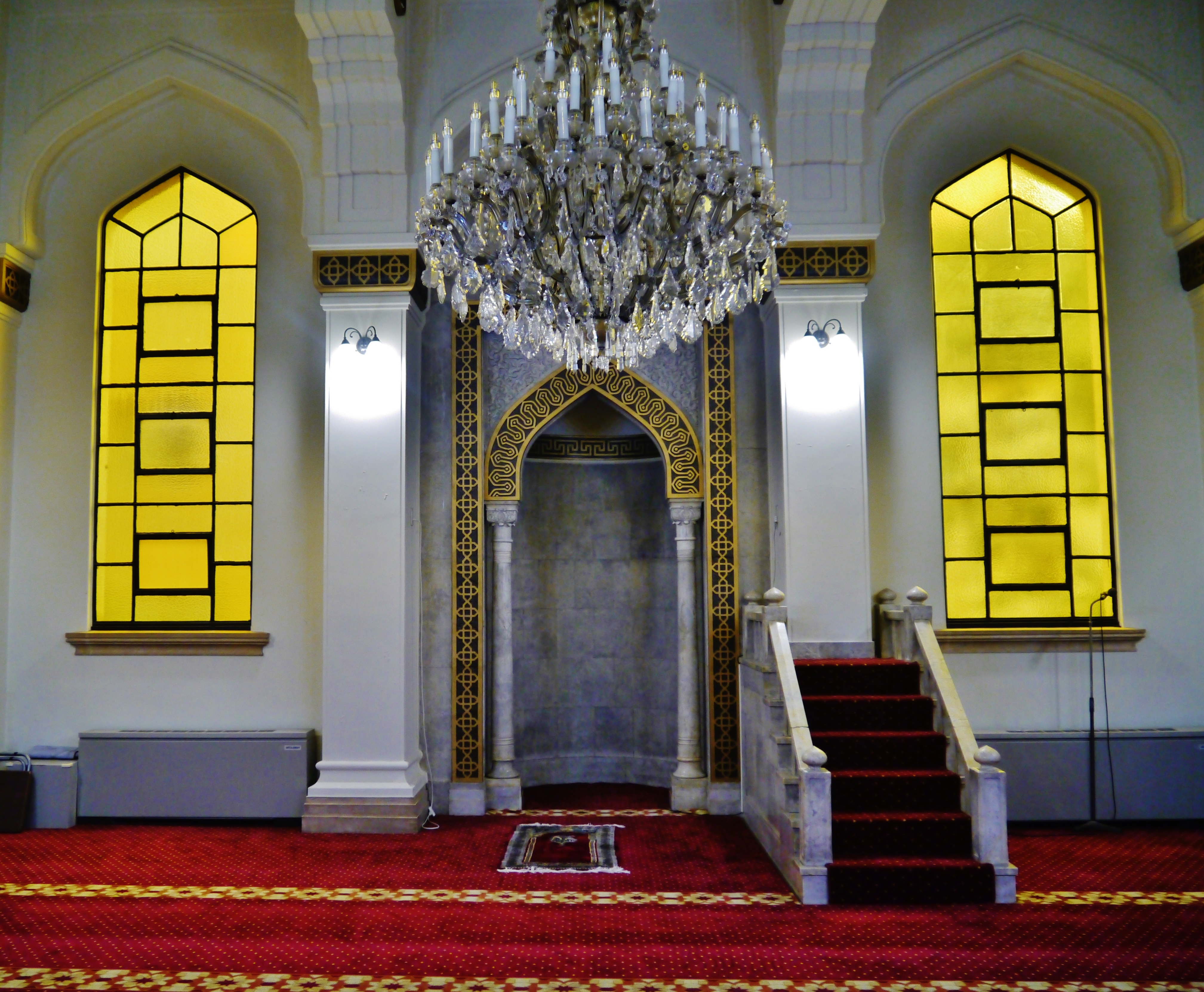
Kobe Mosque
The buildings on either side collapsed. The ones across the street folded in on themselves. But when the dust settled after the Great Hanshin earthquake struck Kobe on January 17, 1995, the three-story mosque at 2 Nakayamate Douri still stood, its reinforced concrete walls intact, its copper-roofed domes undamaged. It was not the first time the Kobe Mosque had refused to fall. Built in 1935 as Japan's first mosque, it had already survived confiscation by the Imperial Japanese Navy, American firebombing raids, and decades of seismic tremors. Locals began calling it the "Miracle Mosque," and in the days after the earthquake, it became a shelter for displaced residents of all faiths -- a building that had outlasted everything the twentieth century could throw at it, still serving the purpose its founders intended.
Tartars, Traders, and a Czech Architect
The story of the Kobe Mosque begins not in Japan but in the upheavals of early twentieth-century Central Asia and the Indian subcontinent. After World War I, Turkish-speaking Tatar Muslims fleeing Bolshevik persecution made their way east, initially settling in Nagoya before relocating to Kobe, where approximately 200 families formed the Turkish Tartar Association. They joined Indian Muslim merchants and Arab traders who had established themselves in Kobe's international port. In 1928, the Islamic Committee of Kobe began collecting donations for a permanent house of worship. The project's largest benefactor was Ferozuddin, a wealthy Indian businessman who contributed 66,000 yen. The committee hired Czech architect Jan Josef Svagr, who had designed several Western religious buildings across Japan, to create the plans. Construction was carried out by the Takenaka Corporation, and the foundation stone was laid on November 30, 1934, by Muhammad Bochia, the committee's primary organizer.
Indo-Islamic Architecture on a Fault Line
The mosque opened on August 2, 1935, and its design was something entirely new to Japan. Svagr blended Indo-Islamic architectural traditions with Asian-Turkish influences, creating a structure of reinforced concrete that spans three levels above ground and one underground. The roofline combines flat sections with copper-clad domes supported by wooden structures beneath. The exterior walls are finished with exposed aggregate, giving the building a distinctive texture that sets it apart from the smooth plaster of surrounding structures. The fusion of styles reflects the diverse origins of the community it was built to serve -- a physical expression of the Tatar, Indian, and Arab cultures that converged in Kobe's cosmopolitan port district. That the building was constructed from reinforced concrete rather than traditional materials would prove critical to its survival.
Seized, Bombed, and Still Standing
In 1943, at the height of World War II, the Imperial Japanese Navy confiscated the mosque for military storage. The congregation lost access to their own building. Then came the American firebombing campaigns of 1945, which devastated much of Kobe. Incendiary bombs scorched the mosque's exterior walls and destroyed its windows, but the reinforced concrete structure held. The building emerged from the war blackened but intact. After Japan's surrender, the congregation reclaimed their mosque and began restoration, aided by donations from Kuwait and Saudi Arabia. For the next five decades, it served quietly as the spiritual center of Kobe's Muslim community -- one of only a handful of mosques in the entire country. By the time of the Great Hanshin earthquake, the building had been standing for sixty years in one of the most seismically active regions on Earth.
The Miracle in Kitano-cho
The 1995 earthquake destroyed more than 200,000 buildings across the Kobe region. In the Kitano-cho foreign district -- the historic neighborhood of Western-style homes and international institutions where the mosque stands -- entire blocks were reduced to rubble. The mosque sustained no structural damage. Photographs from the aftermath show the building standing alone among collapsed neighbors, its domes and minarets intact against a skyline of devastation. In the days that followed, the mosque opened its doors as a refuge for survivors regardless of faith, providing shelter and supplies to displaced families. The episode cemented the building's reputation and its nickname. Today, the Kobe Mosque is one of more than 150 mosques in Japan, but it remains the oldest, a landmark in Kitano-cho's tourist district of historic Western architecture. Visitors walking the narrow hillside streets encounter its distinctive domes and minaret rising among Victorian-era homes -- a building whose survival story is inseparable from the story of Kobe itself.
From the Air
Located at 34.70N, 135.19E in the Kitano-cho district of central Kobe, on the hillside north of Sannomiya Station. The mosque sits in the historic foreign settlement area identifiable from the air by its cluster of Western-style buildings on the slopes of the Rokko mountain foothills, above the dense urban core along the waterfront. Kobe Airport (RJBE) is approximately 5nm south on an artificial island in Osaka Bay. Kansai International Airport (RJBB) lies roughly 35nm southeast across the bay. Osaka International Airport (RJOO) is approximately 25nm northeast. The Kitano-cho district is recognizable from low altitude by its position on the hillside between the Shin-Kobe Shinkansen station (with its distinctive ropeway ascending the mountain) and the harbor below.