The Fishing Village That Launched a Revolution
Katsu Kaishu had a problem. He had just returned from crossing the Pacific Ocean aboard the Kanrin Maru in 1860 -- Japan's first steam-powered warship to make the voyage -- and everything he saw in America confirmed his worst fear: Japan's feudal navy was hopelessly outmatched by Western imperial powers. The Tokugawa shogunate, his own employer, had already shut down his previous training center in Nagasaki for being too progressive. So in May 1864, this stubborn Military Commissioner did something remarkable. He chose a small fishing village called Kobe in Settsu Province and opened a naval training center there, funding much of it from his own pocket. The school would last barely a year. Its graduates would reshape Japan forever.
A School Built on Defiance
The Kobe Naval Training Center had three ambitious goals: establish an officer's training academy, build a shipyard capable of constructing modern warships, and develop Kobe into a modern seaport. From the start, the shogunate withheld official funding, forcing Katsu to rely on his personal fortune and donations from a handful of sympathetic daimyo. The opposition was not merely financial. Katsu's school attracted exactly the kind of students the shogunate feared most -- masterless ronin and radical young samurai who supported the sonno joi movement to expel foreign influence and restore the emperor's authority. The shogunate watched nervously as pro-imperial firebrands enrolled alongside loyal retainers, all learning the same modern naval techniques. Katsu was teaching potential enemies how to build warships.
The Incidents That Killed the Dream
Two violent episodes in 1864 sealed the school's fate. The Kinmon Incident saw rebel forces attack the imperial palace gates in Kyoto, while the Ikedaya Incident -- a bloody nighttime raid by the Shinsengumi on a pro-imperial meeting house -- killed several activists with ties to Katsu's students. One casualty, Mochizuki Kameyata of Tosa domain, was enrolled at the Kobe Naval Training Center at the time of his death. The presence of such radicals among his students made Katsu's position untenable. The shogunate recalled him to Edo, and by mid-1865, the center was shut down. The fishing village school had survived barely a year. But its alumni were already scattering across Japan, carrying with them the navigational knowledge, Western military concepts, and revolutionary ambitions that Katsu had nurtured.
Graduates Who Changed History
The roster of Kobe Naval Training Center alumni reads like a who's who of the Meiji Restoration. Sakamoto Ryoma, perhaps the most celebrated samurai of the era, used his naval training to found the Kaientai, a private shipping and trading company that helped broker the crucial alliance between the rival Satsuma and Choshu domains -- the partnership that ultimately toppled the shogunate. Mutsu Munemitsu, another graduate, became a leading Meiji-era diplomat and foreign minister. Ito Sukeyuki rose to command the Imperial Japanese Navy. The school's indirect influence stretched even further. Sakamoto's Kaientai inspired a Tosa trading official named Iwasaki Yataro, who went on to found Mitsubishi -- a company that would become one of the central engines of Japan's naval and industrial expansion.
A Monument Where Fishing Boats Once Landed
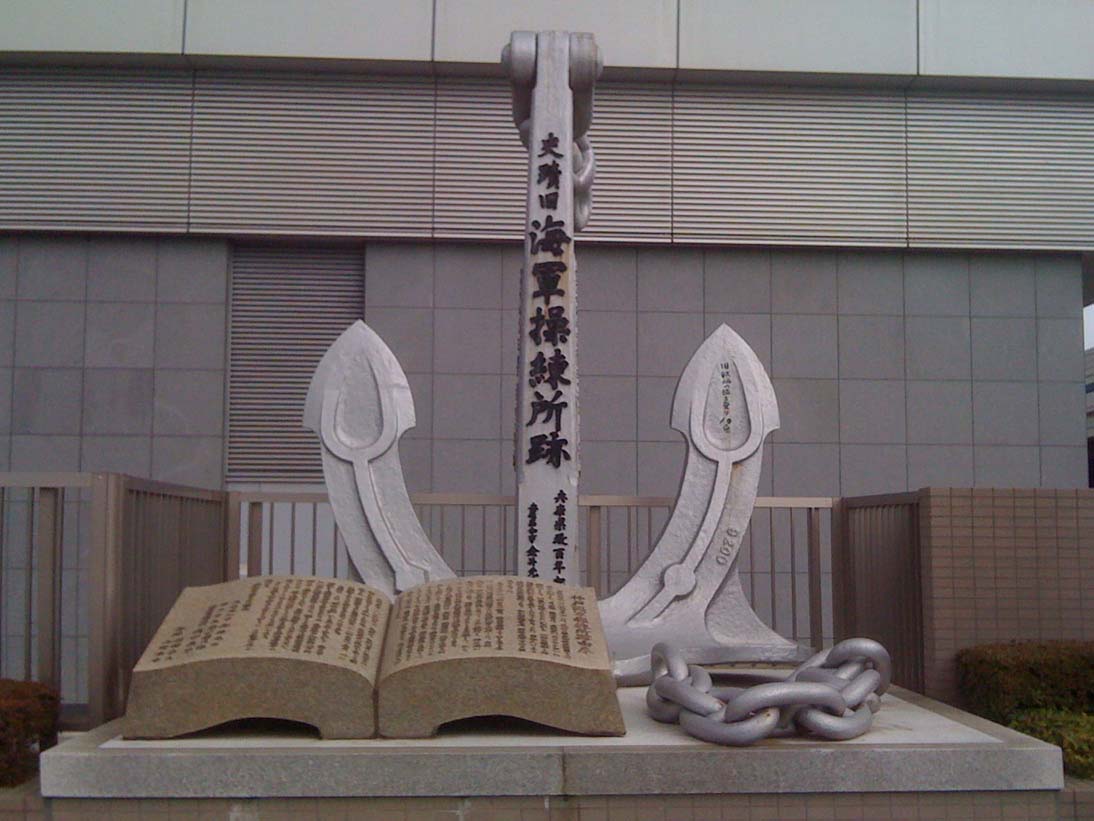
Today, a stone monument marks the site where Katsu Kaishu's improbable school once stood. The fishing village of 1864 is long gone, replaced by the modern port city of Kobe, Japan's seventh-largest city and one of its busiest harbors. The irony is thick: Katsu's three goals for the training center -- a naval academy, a shipyard, and a modern seaport -- all came to pass in Kobe, just not under the shogunate's flag. The port city that grew from that small village became exactly what Katsu envisioned, a gateway between Japan and the world. His one-year school, funded out of pocket and shut down by his own government, proved to be one of the most consequential educational experiments in Japanese history.
From the Air
Located at 34.686°N, 135.193°E in Kobe's waterfront area along Osaka Bay. From altitude, the monument site sits near the modern Port of Kobe, identifiable by its container terminals and the distinctive red Kobe Port Tower nearby. Best viewed at 2,000-4,000 feet AGL when approaching from Osaka Bay. Kobe Airport (RJBE) lies approximately 4 nautical miles to the south on its artificial island. Osaka Itami Airport (RJOO) is about 15 nautical miles to the northeast, and Kansai International Airport (RJBB) is roughly 25 nautical miles to the southwest across the bay. Mount Rokko rises steeply behind the city to the north.