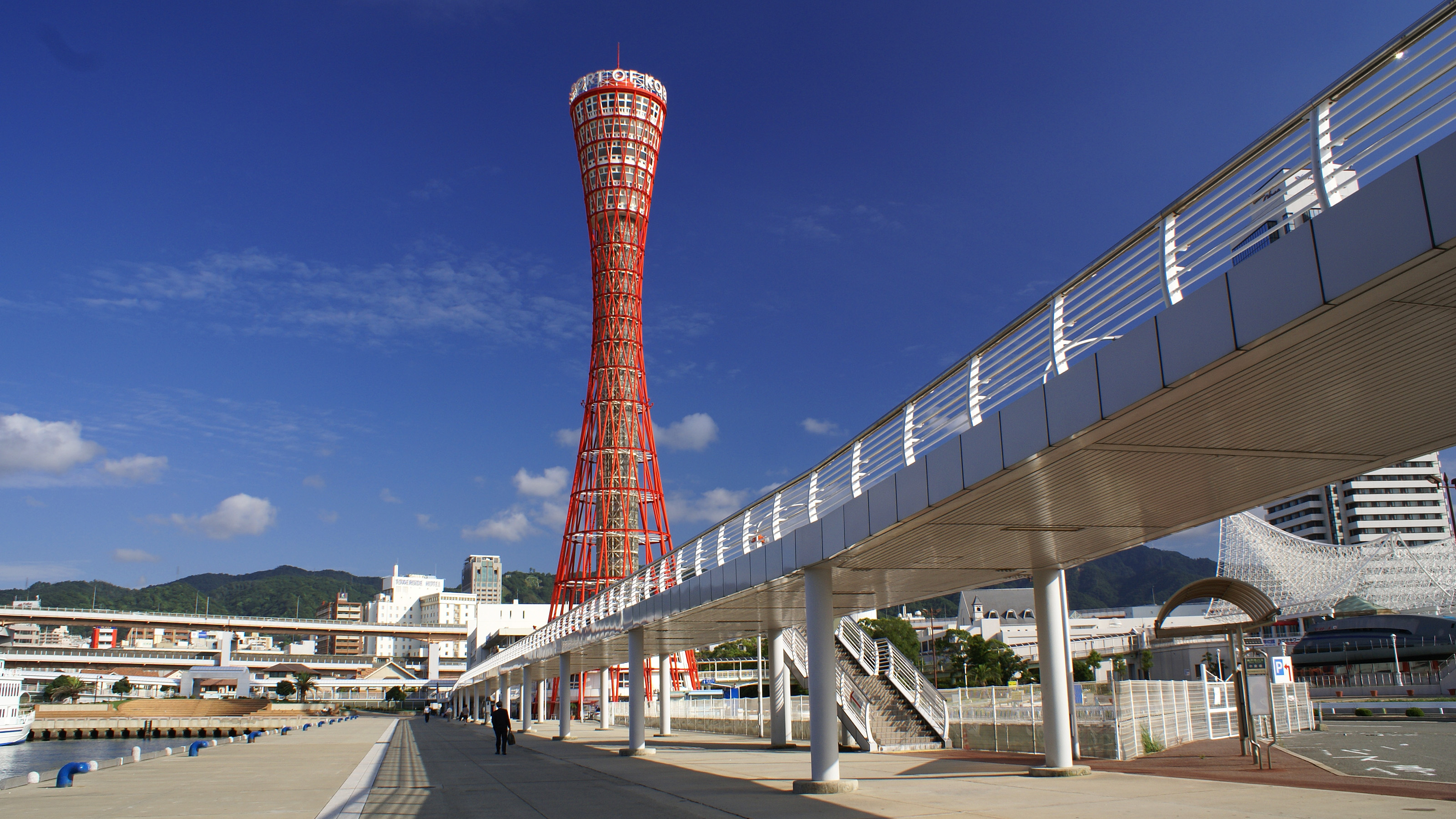
The Red Drum Above the Harbor
On the morning of January 17, 1995, the Great Hanshin-Awaji Earthquake tore through Kobe with 6.9 magnitude force, collapsing highways, igniting fires across entire neighborhoods, and killing more than 6,400 people. When the dust settled, one of the city's most recognizable structures was still standing. Kobe Port Tower, the 108-meter crimson lattice that had watched over the harbor since 1963, sustained only minor damage to its water and drainage pipes. Twenty-eight days later -- on Valentine's Day -- its nighttime illumination flickered back on. For a city navigating rubble and grief, that red glow above the waterfront became something more than a tourist attraction. It became proof that Kobe was still there.
A Drum Rendered in Steel
Designed by the Nikken Sekkei Company and completed in 1963, Kobe Port Tower introduced something the world had never seen: a pipe lattice structural framework for a sightseeing tower. Thirty-two red steel pipes curve outward from the base, narrow at the waist, and flare again toward the top, creating a shape modeled on the tsuzumi -- the hourglass-shaped hand drum used in traditional Japanese music and Noh theater. The design is not merely aesthetic. The lattice distributes structural loads across the entire surface, a principle that would prove its worth three decades later when the earthquake struck. The tower stands 108 meters tall in Kobe's Chuo-ku ward, rising from Meriken Park at the edge of the harbor. Its burnt-orange color has become so synonymous with Kobe's waterfront that the tower earned the nickname 'Steel Tower Beauty.'
Five Floors in the Sky
An elevator carries visitors to the observation levels, where five floors offer progressively wider views of Kobe and the Inland Sea. The lowest observation deck sits roughly 75 meters above the ground; the highest provides panoramic views stretching from Awaji Island and Osaka Bay to the south, across to Kansai International Airport on its own artificial island, and north to the forested ridgeline of Mount Rokko rising behind the city. The third observation floor holds a revolving cafe that completes a full 360-degree rotation every 20 minutes, letting visitors take in the entire panorama without leaving their seat. At night, the view shifts to city lights and harbor reflections -- a perspective made even more dramatic by the tower's own illumination: more than 7,000 LED lights installed during a 2010 renovation, cycling through 40 different lighting patterns.
Monster Magnet
Like Tokyo Tower, Kobe Port Tower has earned a place in Japanese popular culture as a target of cinematic destruction. The tower appears in Gamera vs. Barugon, where the giant turtle's nemesis wreaks havoc across Kobe's waterfront. It shows up again in Godzilla vs. SpaceGodzilla, enduring another fictional assault. The Ultra Series got in on the action too -- both Ultra Seven and Ultraman Mebius & Ultraman Brothers feature the tower as a backdrop for kaiju battles. There is something fitting about a structure designed to look like a musical instrument becoming a recurring set piece for giant monsters. In reality, the tower has proven far more resilient than its fictional counterparts suggest. It has weathered typhoons, the 1995 earthquake, and more than six decades of salt air from Osaka Bay.
Renewal and Resilience
The tower has closed twice for major renovations. The first, from late 2009 to April 2010, included the installation of the LED lighting system. The second, beginning in September 2021, was far more substantial: a comprehensive seismic retrofitting and modernization that kept the tower shuttered for nearly three years. It reopened on April 26, 2024, with a new open-air rooftop deck joining the existing observation floors. The renovations addressed the realities of building in one of Japan's most earthquake-prone regions, ensuring the same structural ingenuity that saved the tower in 1995 would hold for decades to come. From above, Kobe Port Tower remains the easiest way to locate the waterfront -- a slender red exclamation point against the blue of the harbor and the green of Mount Rokko, visible long before any pilot can make out the container cranes or ferry terminals below.
From the Air
Located at 34.683°N, 135.187°E in Kobe's Meriken Park along the harbor waterfront. The 108-meter tower is painted bright red-orange and is one of the most visible vertical landmarks along Osaka Bay. Best viewed at 1,500-3,000 feet AGL approaching from the south over the bay. Kobe Airport (RJBE) is approximately 4 nautical miles to the southeast on its artificial island. Osaka Itami Airport (RJOO) lies about 15 nautical miles northeast, and Kansai International Airport (RJBB) is roughly 25 nautical miles southwest. Mount Rokko (931 meters) forms the mountainous backdrop directly north of the city. The Port of Kobe's container terminals and the Great Hanshin-Awaji Earthquake Memorial stretch along the waterfront to the east.