
Kodok
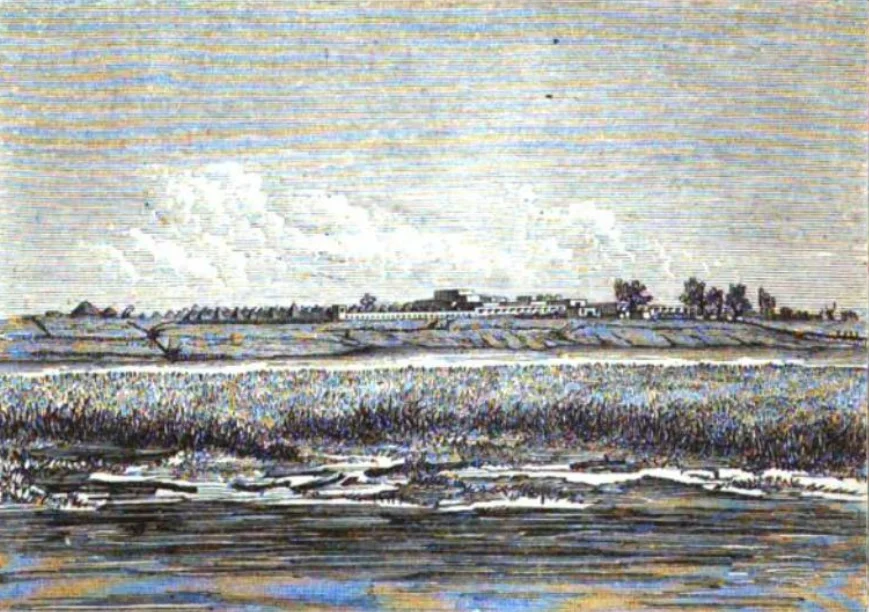
Before it was called Fashoda, the town had another name: Pachodo. Before Pachodo, it had been a sacred place for the Shilluk for longer than anyone outside the Shilluk particularly cared to measure. The kings of the Shilluk Kingdom had been crowned there for more than five centuries, in ceremonies that most of the outside world was never permitted to witness. Then in September 1898 a small French expedition arrived from the west, raised a tricolor over a mud-brick fort, and within weeks found themselves confronted by a much larger British force steaming up the Nile with gunboats. For a few tense months, a provincial Shilluk town on a riverbend in the southern Sudan held the attention of every foreign ministry in Europe, and the question of whether Britain and France would go to war was being decided on a bank of the White Nile where the local ruler had never agreed to surrender authority to anyone.
The Hidden City
In Shilluk belief, Kodok is not primarily a town. It is the mediating place where the spirit of Juok (God), the spirit of Nyikango (the founder of the Shilluk Kingdom), the spirits of all deceased Shilluk kings, and the spirit of the living king meet to hold the kingdom together. For over 500 years the town was kept closed to outsiders, a forbidden city where the business of kingship happened in quiet. Coronations took place here. Rains were summoned here. The elders and king would sit in stillness listening, because the sounds of Juok were said to be receivable only by those the town trusted. That the Shilluk permitted Egyptian and then European outposts to be built here at all is an artifact of military force rather than religious welcome, and the Shilluk Kingdom continues to exist today, with its Reth (king) still crowned in ceremonies whose full meaning has never been turned over to ethnographers.
An Imperial Standoff
In July 1898 Captain Jean-Baptiste Marchand's French expedition arrived at Fashoda after a fourteen-month trek across Africa from the Atlantic coast. Their goal was to plant the French flag across the Sahel and lay claim to the upper Nile before the British could close the ring from the south. Two months later, Lord Kitchener, fresh from crushing the Mahdist army at Omdurman, steamed south with five gunboats and a mixed Anglo-Egyptian force. He outnumbered Marchand by perhaps twenty to one. The two commanders met, shared champagne and whiskey, exchanged formal greetings, and then each signaled their governments and waited. For three months, from September to November 1898, Europe stood on the edge of a war that neither France nor Britain could afford. In the end France backed down. Marchand furled his flag and marched his men east to Djibouti. The event was the last flashpoint of the Scramble for Africa, and it passed through Kodok almost without touching it.
Famine, War, Return
For the Shilluk who actually lived here, the century after Fashoda brought a harder sequence. British rule followed Egyptian rule. Sudan's independence in 1956 brought a new southern marginalization. The first civil war (1955-1972) and the second (1983-2005) ground through the region. In the 1990s Kodok suffered a serious famine, one of many along the Nile basin during that decade, and the town depended heavily on Operation Lifeline Sudan to keep its children alive. Refugees drifted away and drifted back. Many returned in 2004 and 2005 at the cautious end of the Second Sudanese Civil War, though even then the security situation remained precarious. Today most of Kodok's inhabitants are subsistence farmers. Sorghum and millet in the fields. Cattle in the household. Gum arabic tapped from Acacia seyal trees and sold to Arab traders from the north, a trade that has survived wars, empires, and famines.
A Kingdom That Endures
The Shilluk Kingdom still exists. There is still a Reth. The coronation still takes place in Kodok, the spirit of Nyikango is still invoked, and the ceremonial stone where a goat was historically sacrificed for rain still sits where it has always sat. What changed in the twentieth century is that the outside world began to understand this as one of Africa's oldest surviving indigenous monarchies rather than as a curiosity. Disputes between the Shilluk and the Dinka over land and water rights south toward Malakal persist, old tensions inflamed by modern scarcity and modern politics. But for a traveler flying over the riverbend where the Nile makes its lazy southern sweep past Kodok, what is worth knowing is that the small scatter of roofs below has been a capital for longer than almost any capital on the planet, and that the people there have held onto their own story despite sixteen centuries of efforts by other people to tell it for them.
From the Air
Kodok lies at 9.89°N, 32.11°E on the west bank of the White Nile in South Sudan's Upper Nile State. At cruising altitude in clear weather the town appears as a small cluster of structures on a river bend. Nearest airport is Malakal Airport (HSSM) roughly 35 km south. The White Nile itself provides the primary navigation reference, curving broadly from south to north through flat, seasonally flooded plains. Visibility can be reduced by haze and dust during the dry season (December-March).
Nearby Stories
- Doleib Hill 35 km away
- Upper Nile University 57 km away
- 2025 Nasir clashes 124 km away
- 2012 Talodi Antonov An-26 crash 146 km away
- Nasir, South Sudan 154 km away
- Ruweng Administrative Area 181 km away
- Sudanese Conflict in South Kordofan and Blue Nile 245 km away
- Jebel Moya 374 km away