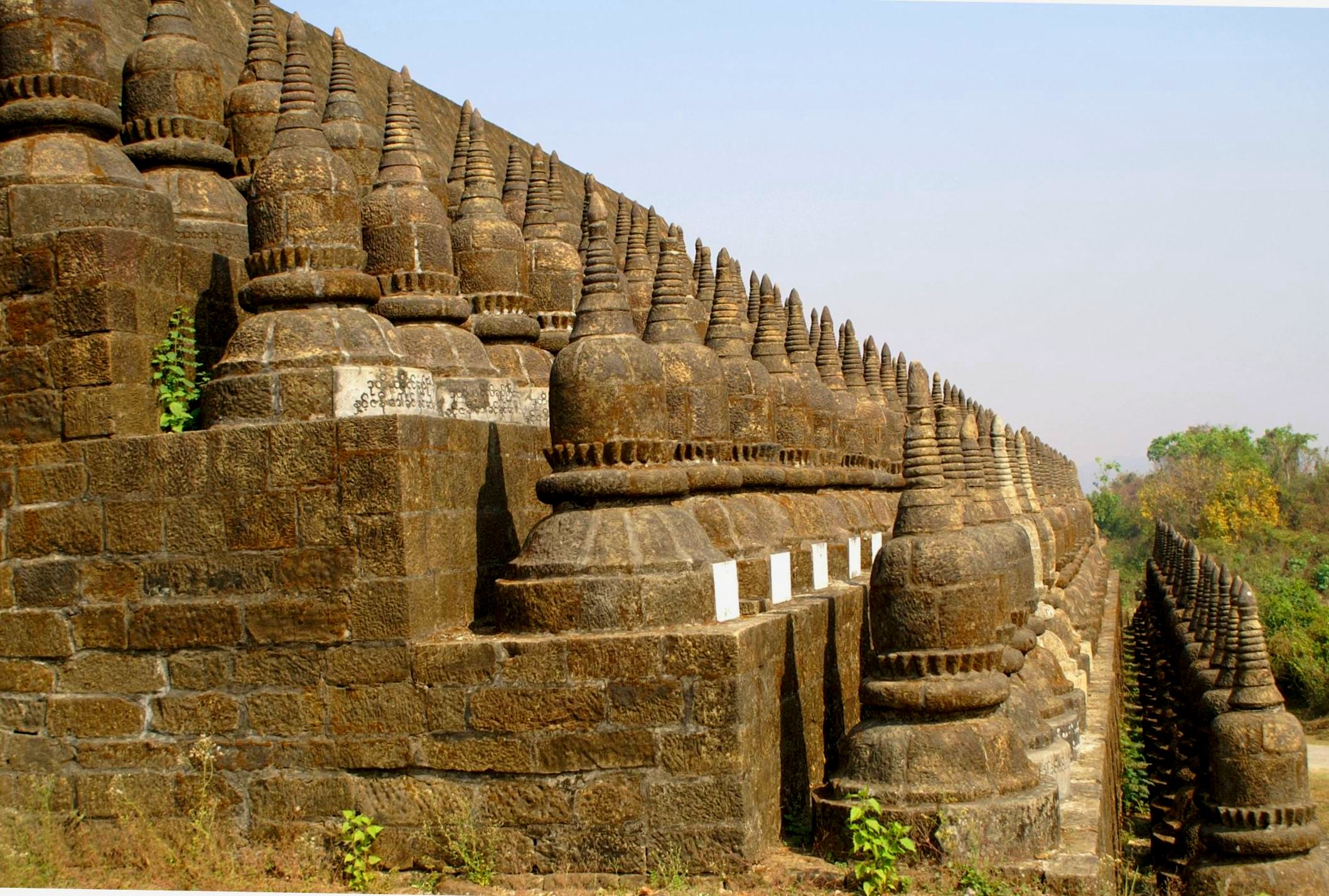
Koe-thaung Temple
Ninety thousand Buddhas sit in darkness. That is the claim embedded in the name of Koe-thaung, the largest temple complex in Myanmar's ancient capital of Mrauk U. Built between 1554 and 1556 by King Dikkha, the temple is less a single building than a stone labyrinth, its vaulted corridors spiraling inward past thousands of carved figures toward a central chamber where a great bell-shaped stupa rises in silence. Some call it the "Rakhine Borobudur," a comparison to Java's famous monument that flatters in ambition if not in scale. But Koe-thaung needs no borrowed grandeur. Its power lies in accumulation -- in the sheer, overwhelming repetition of devotion carved into every surface.
A King's Devotion in Stone
King Dikkha ruled the Mrauk U Kingdom during a period when Arakanese monarchs competed to outdo one another in religious patronage. His father's generation had already produced the Shite-thaung Temple, the Temple of 80,000 Images. Dikkha's answer was to build bigger: 90,000 images, a temple that would be the largest in the capital. The construction took just two years, a pace that may explain why Koe-thaung was built with a mixture of sandstone and brick rather than the pure sandstone of its predecessor. That choice of materials made the temple less refined but no less ambitious. Four entrances open on the cardinal points, and the main eastern gateway draws visitors into a long vaulted passageway that curves and spirals inward like the chambers of a nautilus shell.
The Corridors Within
Walking through Koe-thaung feels less like visiting a temple and more like entering a cave system that happens to be sacred. The structure resembles a rock tunnel, its passages dimly lit and close, the walls lined with thousands of small bas-relief Buddha figures. Larger seated statues occupy tiered stone pedestals along the main corridor, their hands in the Bhumisparsa mudra -- the earth-touching gesture that recalls the moment of the Buddha's enlightenment. The passageway spirals toward a central chamber where the great stupa stands, its bell shape rising in the confined space. Above it all, an octagonal main tower marks the temple's center from outside. The cumulative effect is intentional: devotion measured not in a single masterwork but in the patient, repeated act of carving one Buddha after another, ninety thousand times over.
Fortress of Faith in Rakhine
Koe-thaung stands among a constellation of temples that made Mrauk U one of the richest archaeological sites in Southeast Asia. The Shite-thaung Temple, the Htukkanthein ordination hall, the Andaw-thein, the Le-myet-hna -- each served a distinct purpose in the spiritual life of the Arakanese kingdom. Together they formed a sacred landscape rivaled in Myanmar only by the temples of Bagan, though Mrauk U's buildings were constructed from hewn stone rather than the mud and clay bricks of their central Burmese counterparts. An international commission urged Myanmar in 2017 to nominate Mrauk U for UNESCO World Heritage status, and archaeologists have been cataloguing and protecting the city's sites in preparation. For Koe-thaung, preservation is complicated by its dual-material construction, which weathers differently than pure sandstone, leaving it more vulnerable to the extreme monsoon rains that drench western Myanmar with over 3,600 millimeters of rainfall each year.
Where Silence Accumulates
Mrauk U today is a town transformed by conflict. The Arakan Army captured the city from the Tatmadaw in February 2024, and tourism has ceased. But the temples endure, as they have through centuries of conquest, monsoon, and neglect. Koe-thaung's darkness is its own form of protection; the corridors that once channeled pilgrims now simply wait, the thousands of carved Buddhas sitting in the same positions they have occupied since the sixteenth century. There is something almost geological about the patience of the place. The name promises 90,000 images, and whether anyone has counted them all is beside the point. What matters is the intention -- that a king and his artisans believed this landscape of devotion was worth building, one small carved figure at a time, until the walls themselves became a prayer.
From the Air
Located at 20.598N, 93.211E in the Kaladan River valley of western Myanmar's Rakhine State. The temple complex is visible as a large stone structure among the scattered ruins of Mrauk U. Best viewed at 3,000-5,000 feet AGL. The nearest airport is Sittwe (VYSW), approximately 65 km to the west. The surrounding terrain is hilly with marshes and mangroves. Monsoon season (May-October) brings heavy rainfall and reduced visibility.