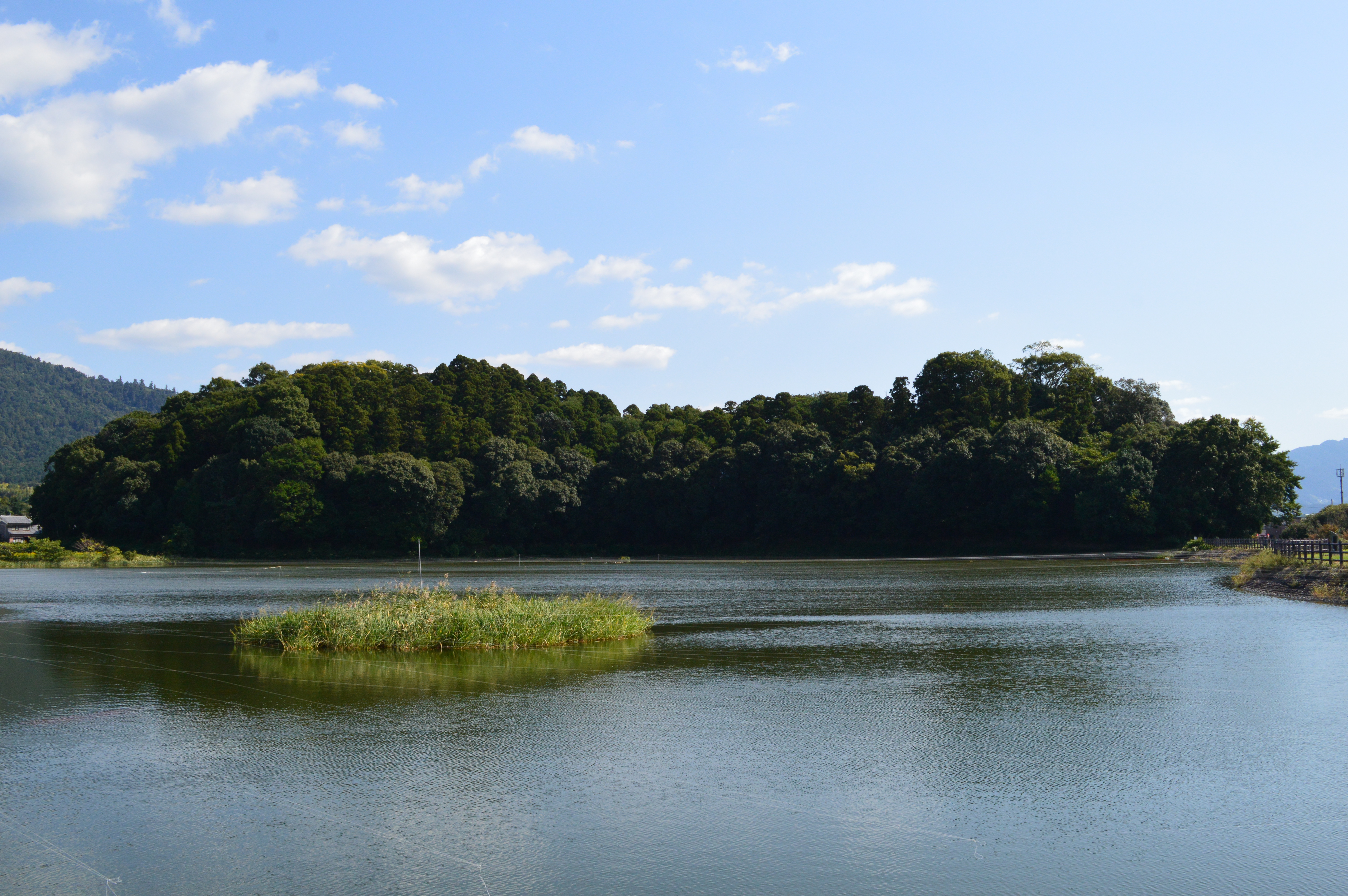
Kofun: The Keyhole Tombs That Shaped a Nation
From the air, they look like enormous keyholes pressed into the Japanese earth -- a round mound joined to a rectangular platform, surrounded by moats and tree cover, sitting in the middle of modern cities as if someone dropped a 1,600-year-old puzzle piece into the suburban grid. These are kofun, megalithic burial tombs built between the 3rd and 7th centuries AD, and Japan has over 161,000 of them. The largest, Daisen Kofun in Sakai, Osaka Prefecture, stretches over 400 meters long and is attributed to Emperor Nintoku. It is one of the biggest burial structures on Earth, rivaling the Great Pyramids in footprint. Yet most Japanese pass these mounds daily without a second glance -- tree-covered hills in parks, unassuming rises beside train stations, the ancient dead resting beneath commuter traffic.
Shapes Only the Sky Can Read
The most distinctive kofun are the zenpokoenfun -- keyhole-shaped mounds with a square front portion and a circular rear section connected by a narrowed middle. The burial chamber sat beneath the circular part, constructed from massive megaliths and containing stone coffins alongside bronze mirrors, iron swords, curved magatama beads, and clay vessels. Terracotta haniwa figures -- soldiers, horses, houses, and dancers -- lined the mound's surface in protective rows. But not all kofun share this shape. Circular enpun tombs, square zenpokohofun, and rare octagonal mounds reserved for emperors add variety to the landscape. Orientation varies too: in the Mozu kofun group at Sakai, some circular portions face north while others face east. The shapes evolved over centuries, growing larger and more elaborate as the Yamato court consolidated power, then abruptly shrinking when Buddhism introduced cremation and the age of monumental earth-moving ended.
From Yayoi Ditches to Imperial Mountains
Kofun did not appear from nothing. During the preceding Yayoi period, local chiefs were buried in square-shaped mounds surrounded by ditches -- modest compared to what followed. The turning point came in the mid-3rd century AD with Hashihaka Kofun in the Nara Basin, a keyhole mound 280 meters long and 30 meters high. Its scale dwarfed anything before it. Some scholars believe the person buried there was Himiko, the shadowy queen of Yamataikoku mentioned in Chinese historical texts that described Japan as a confederation of small tribes called Wa. Over the next three decades, about ten more kofun rose in the Makimuku area, forming the earliest known cluster. Bronze mirrors, iron swords, and jade ornaments filled undisturbed chambers. The construction of these enormous earthworks signaled something new: a centralized authority in the Nara Basin capable of commanding the labor of thousands -- possibly the origin of the Yamato polity and the Imperial lineage that continues to this day.
The Giants of the Fifth Century
During the 5th century AD, kofun construction reached its apex. The building shifted from the Nara Basin to Kawachi, where the truly colossal tombs appeared. Daisen Kofun, attributed to Emperor Nintoku, is the centerpiece of the Mozu kofun cluster in Sakai -- a keyhole mound stretching over 400 meters, ringed by three moats, visible only in its entirety from the air. The proliferation of keyhole kofun across the Japanese archipelago during this era is generally interpreted as evidence of the Yamato court's expanding influence, though some scholars argue it merely reflects cultural diffusion through trade networks rather than political conquest. Similar tombs from the mid-Baekje era have been found along the Yeongsan River basin in South Korea, built between the 5th and 6th centuries, raising questions about cross-strait connections and who exactly was buried in these distant keyhole mounds.
Painted Chambers and Robbed Graves
In 1972, archaeologists opened the unlooted Takamatsuzuka Tomb in Asuka, Nara Prefecture, and discovered something extraordinary. Inside the tightly fitted megalithic chamber, white lime plaster covered the walls, and vivid painted figures depicted the elegant 'Asuka Beauties' of the ancient court alongside star constellations. A stone coffin rested in the center, surrounded by accessories, swords, and bronze mirrors. The wall paintings were designated national treasures, the grave goods classified as important cultural property, and the tumulus itself a special historic site. Most kofun were not so lucky. Grave robbing in antiquity stripped many chambers bare. The imperial kofun remain closed to archaeological excavation by order of the Imperial Household Agency, which maintains them as the actual resting places of emperors. This means some of the largest and most significant kofun in the world have never been scientifically examined -- their secrets locked beneath trees and grass, protected by tradition older than any museum.
A World Heritage Landscape
The Mozu-Furuichi kofun clusters in Osaka Prefecture were inscribed on the UNESCO World Heritage List on July 6, 2019, recognizing them as outstanding examples of burial mound culture. The designation covers forty-nine component sites across the two clusters, including Daisen Kofun and surrounding satellite mounds. From the air, the Sakai area reveals its ancient geometry -- keyhole shapes, circles, and rectangles scattered among houses, roads, and baseball fields, the living city grown up around its dead. Hyogo Prefecture holds the national record with 16,577 kofun sites, followed by Chiba Prefecture with 13,112. These are not remote wilderness monuments but woven into daily Japanese life, their moats now fish ponds, their slopes now parks, their haniwa reproduced as mascots on municipal websites. The ancient tombs remain, quiet and tree-covered, holding the bones and bronze of people who built a civilization measured in earth and stone.
From the Air
The primary kofun concentration is centered at approximately 34.556N, 135.601E in the Sakai/Osaka area of Osaka Prefecture. The Mozu kofun cluster, including the massive keyhole-shaped Daisen Kofun, is unmistakable from altitude -- look for the distinctive keyhole outlines surrounded by moats and green tree cover within the dense urban grid of Sakai city. Best viewed at 3,000-6,000 feet AGL to appreciate the scale and distinctive shapes. Kansai International Airport (RJBB) lies approximately 15 nautical miles to the southwest. Osaka Itami Airport (RJOO) is about 15 nautical miles to the north. The kofun are scattered across a wide area, but the Mozu and Furuichi clusters provide the most concentrated aerial spectacle.