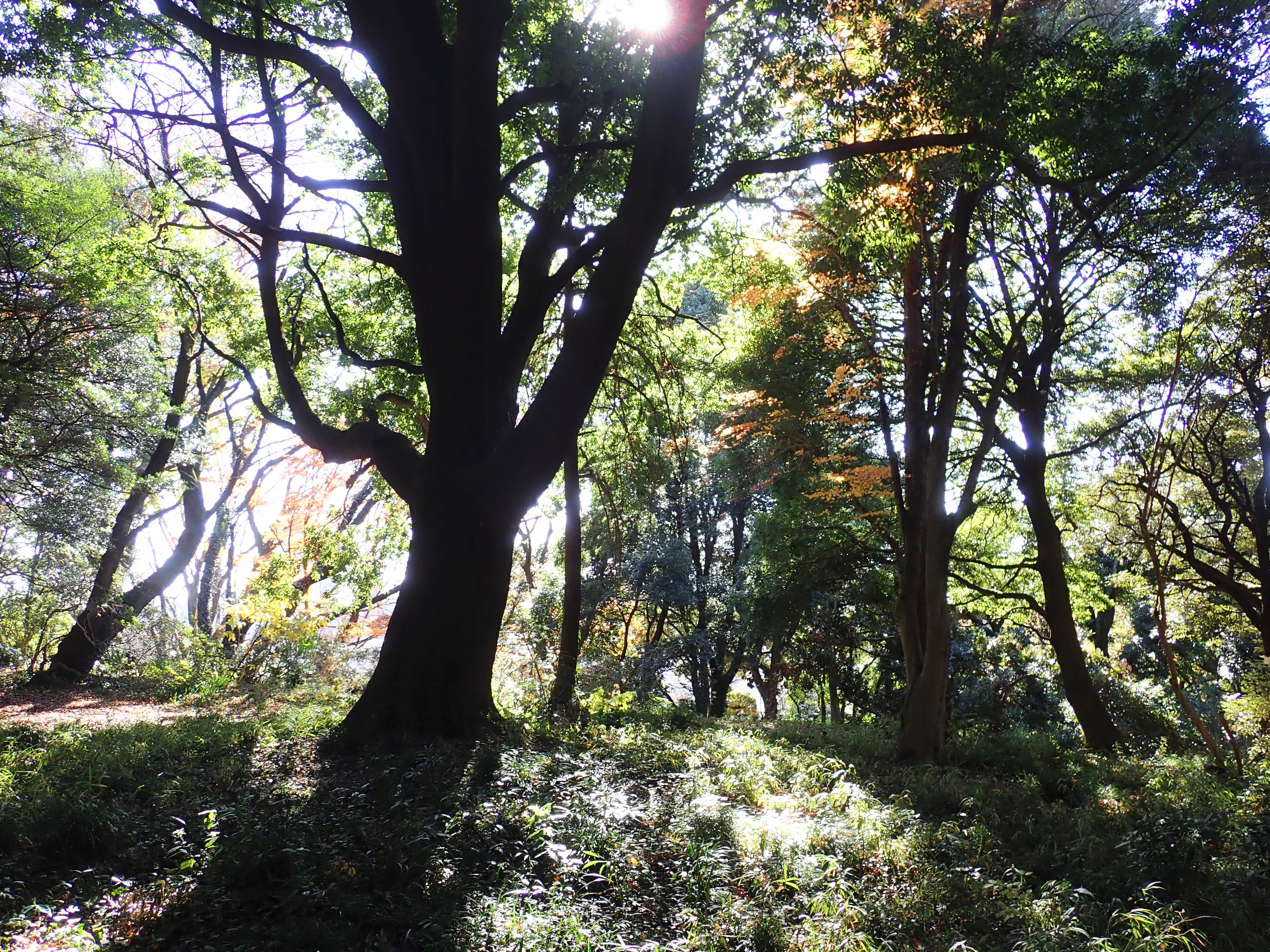
Koishikawa Botanical Garden
Somewhere in a quiet corner of Bunkyo ward, a gnarled apple tree grows that traces its lineage back to the very tree Isaac Newton watched in his garden at Woolsthorpe Manor. A few steps away, a grapevine descends from the plants Gregor Mendel used for his pioneering genetics experiments in Brno. These living relics share 16 hectares of green space with 4,000 plant species, ancient camellias, and a pond that once reflected the gaze of shoguns. The Koishikawa Botanical Garden is Japan's oldest botanical garden, a place where 17th-century feudal politics, Enlightenment-era medicine, and modern evolutionary science converge under the same canopy of leaves.
A Shogun's Pharmacy
In 1638, the Tokugawa shogunate established two medicinal herb gardens in the Azabu and Otsuka neighborhoods of Edo, the city that would become Tokyo. When the Azabu garden was abolished in 1684, the fifth shogun, Tokugawa Tsunayoshi, relocated it to Koishikawa, onto the grounds of his own villa. The herb garden thrived under subsequent rulers. The eighth shogun, Tokugawa Yoshimune, expanded it to cover nearly 15 hectares and turned it into a powerhouse of practical botany during the Kyoho period. Tons of herbal medicines were produced each year for the shogunate and the public. In 1735, a scholar named Aoki Konyo conducted experimental cultivation of sweet potatoes within the garden walls, a project that would eventually help save lives during Japan's frequent famines by establishing the crop across the country.
Medicine for the People
Yoshimune was known as the reformist shogun, and his famous suggestion box, placed at the entrance to Edo Castle, invited petitions from ordinary citizens. In 1722, a town doctor named Ogawa Tadafune submitted a plea for a medical clinic to treat the poor. Yoshimune ordered the Edo magistrate, the legendary Ooka Tadasuke, to establish the Koishikawa Yojosho within the garden grounds. The clinic became one of Edo's most important charitable institutions, providing medical care to commoners who could not afford private physicians. It was a radical act of public health in an era when feudal hierarchy rigidly separated social classes. The clinic operated for over a century, and its site within the botanical garden is still commemorated today.
Birthplace of Japanese Botany
After the Meiji Restoration in 1877, the garden was transferred to the newly founded Tokyo Imperial University, now the University of Tokyo. It became the birthplace of modern botanical research in Japan. Scientists cataloged, classified, and studied the rich collections that the shogunate had spent two centuries assembling. Today the garden's research focuses on the evolution, phylogenetic systematics, and physiology of higher plants. Its herbarium holds 1.4 million specimens, and its library contains 20,000 books and journals. The living collections include 1,400 hardy woody species, 1,500 hardy herbaceous species, and 1,100 tropical and subtropical species, with particular strength in wild-collected specimens from Japan, Korea, Taiwan, and China.
Monuments in Leaf and Branch
The garden's most beloved curiosities are its memorial trees. Newton's apple tree arrived through a chain of scientific generosity: in 1964, Dr. Sutherland, Director of England's Institute of Physics, gave a grafted branch to Dr. Yuji Shibata of the Japan Academy. The cutting was infected with a virus and had to be quarantined and treated at the garden before finally being planted in 1981. Mendel's grapevine carries an even more poignant story. Japanese scientists in the 1980s discovered that the original vine had disappeared from the monastery in Brno where Mendel conducted his genetics experiments. A cutting from the Koishikawa vine was sent back to the Czech Republic to restore the species at its birthplace. In 2012, the Japanese government designated the entire garden as both a National Place of Scenic Beauty and a National Historic Site, ensuring that this layered landscape of science, medicine, and power endures.
From the Air
Located at 35.720N, 139.745E in Bunkyo ward, Tokyo. From the air, the garden appears as a distinctive rectangle of dense greenery surrounded by the urban grid, roughly 500 meters north of the Tokyo Dome complex. Nearest airports: Tokyo Haneda (RJTT) 16 km south, Narita International (RJAA) 60 km east. Best viewed at 2,000-3,000 ft, though Tokyo airspace is heavily restricted. Look for the contrast between the garden's canopy and the surrounding rooftops.