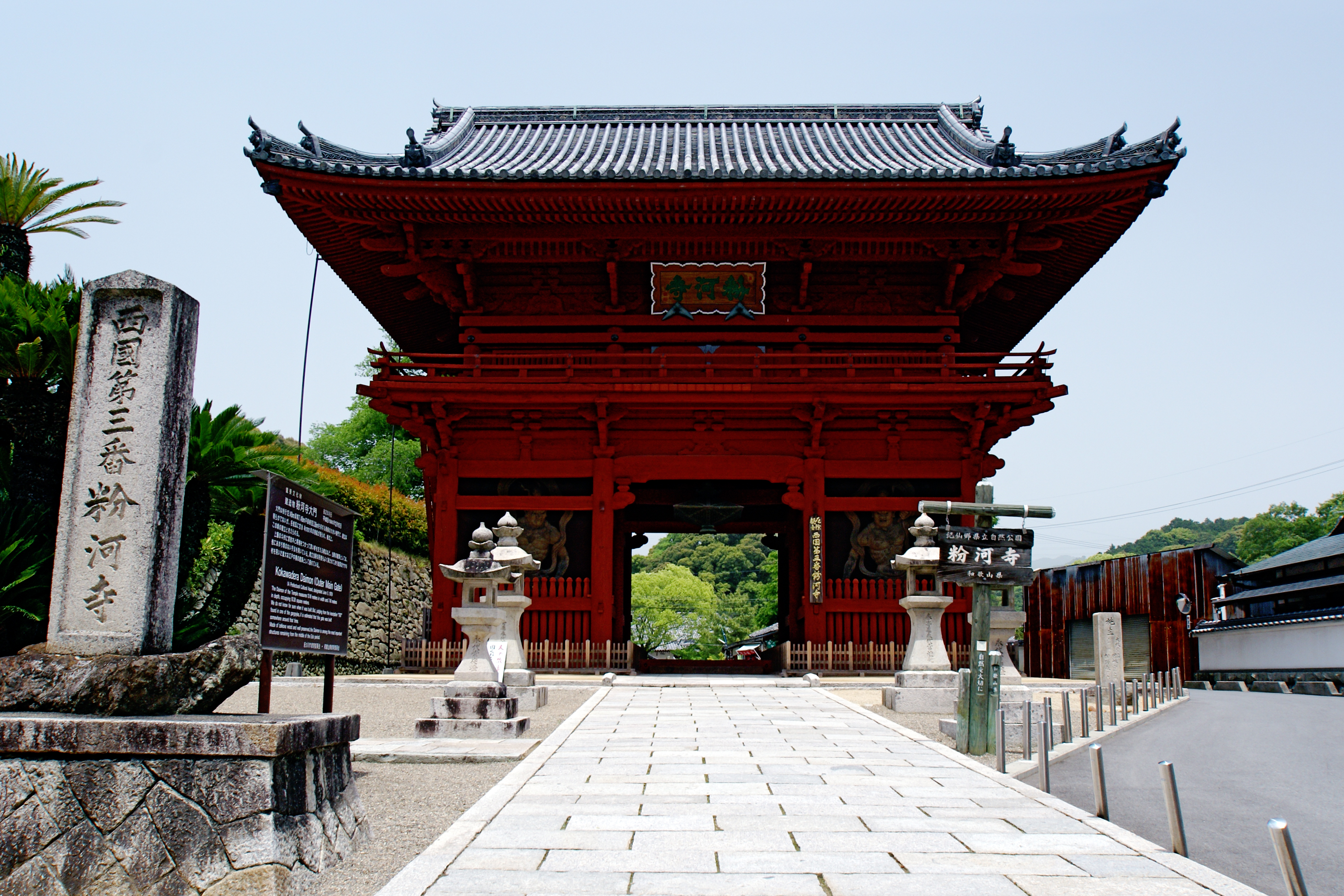
Kokawa-dera
No one alive has ever seen the principal image of Kokawa-dera. The statue of Senju Kannon Bosatsu is said to be buried in a container beneath the main hall to protect it from fire. In most Japanese temples, a substitute figure called an omaetachi stands in for hidden images, but at Kokawa-dera, the substitute is also a secret. It is opened exactly once each year, on December 31, and only for monks to clean it. Lay visitors never see it. This double concealment captures something essential about this Wakayama Prefecture temple: a place where mystery is not a marketing strategy but a genuine article of faith, maintained for over twelve centuries on the forested slopes above the Kinokawa River.
A Hunter's Light in the Mountains
The temple's origin story, preserved in the Kokawa-dera Engi documents, begins in 770 with a hunter named Otomo Koshiko from Kii Province. One day he spotted a mysterious light emanating from a place in the mountains and built a small hermitage on the spot. Soon after, a young ascetic appeared at Koshiko's home asking for lodging. The boy spent seven days carving a statue of the Juichimen Kannon. On the morning of the eighth day, Koshiko woke to find the boy gone and a golden statue standing in his place. The hunter stopped killing and devoted himself to Kannon. A second legend tells of a wealthy man in Kawachi Province whose gravely ill daughter was healed by a mysterious ascetic who refused all payment, taking only the girl's sash and scarlet hakama before vanishing with the words, 'I'm in Naka County, Kii Province.' The family tracked the ascetic to Koshiko's hermitage and found the Kannon statue holding their daughter's garments. Realizing the healer had been Kannon incarnate, they entered holy orders on the spot.
Famous Before the First Millennium
Whether or not the legends hold, Kokawa-dera was clearly important by the Heian period. Sei Shonagon listed it among Japan's notable temples in her Pillow Book around the year 1000. The twelfth-century poetry anthology Ryojin Hisho named it alongside Kiyomizu and Ishiyama as a place where 'Kannon signs are seen.' The poet Saigyo referenced it in his Sankashu, and it appears in the fictional Utsubo Monogatari and Sagomo Monogatari. By the tenth century at the latest, Kokawa-dera was recognized as a major Kannon sacred site. It became the third stop on the Saigoku Kannon Pilgrimage, a circuit of thirty-three temples across western Japan that remains one of the oldest active pilgrimage routes in the country. The temple flourished under the patronage of the imperial court and aristocracy throughout the Heian period, accumulating wealth and prestige.
Warrior Monks and Warlords
By the Kamakura period, Kokawa-dera had grown enormous: seven main halls, 550 sub-temples, a large force of warrior monks, and vast shoen estates totaling 40,000 koku of landholdings. It rivaled the great temple-fortresses of Negoro-ji and Kongobu-ji. That military dimension brought catastrophe. In 1573, Saruokayama Castle was built on a mountain south of the temple grounds to defend the complex. But in 1585, Toyotomi Hideyoshi swept through Kii Province, and Kokawa-dera's warrior monks could not hold. The entire mountain burned. The Kokawa-dera Engi emaki, an illustrated scroll of the temple's founding legends, was destroyed in the flames. The temple was rebuilt, only to burn again in a major fire in 1713 that destroyed everything except the main gate. Most of the structures standing today date from the reconstruction that followed.
Resilience and Independence
The setbacks kept coming. On September 21, 1934, the Muroto Typhoon sent heavy rains crashing through the grounds, toppling trees that crushed the bell tower. But Kokawa-dera endured. After the Pacific War, the temple made a bold institutional move, declaring independence from the Tendai sect and establishing itself as the head temple of its own Kokawa Kannon sect. Today the compound spreads across the hillside above Kokawa Station on the JR West Wakayama Line, about a ten-minute walk from the platform. The massive Daimon gate, the Middle Gate, and the main hall create a procession through layers of history. Among the temple's designated cultural properties is a National Treasure painting from the Kamakura period, now housed at the Kyoto National Museum. The main hall dates to the Edo period rebuilding of 1713. Other Important Cultural Properties include structures from the Azuchi-Momoyama period. Through fire, typhoon, and war, Kokawa-dera has kept its most precious secret literally underground -- and the faithful keep coming, even knowing they will never see what they came to venerate.
From the Air
Located at 34.281N, 135.406E in the Kinokawa River valley of Wakayama Prefecture. The temple sits on forested slopes northeast of the city of Kinokawa. The Kinokawa River is a useful visual reference running east-west through the valley below. Nearest major airport: Kansai International Airport (RJBB) approximately 20nm to the northwest. The terrain rises sharply to the south toward the Kii Mountains. Visibility is generally good except during summer humidity and the typhoon season (August-October).