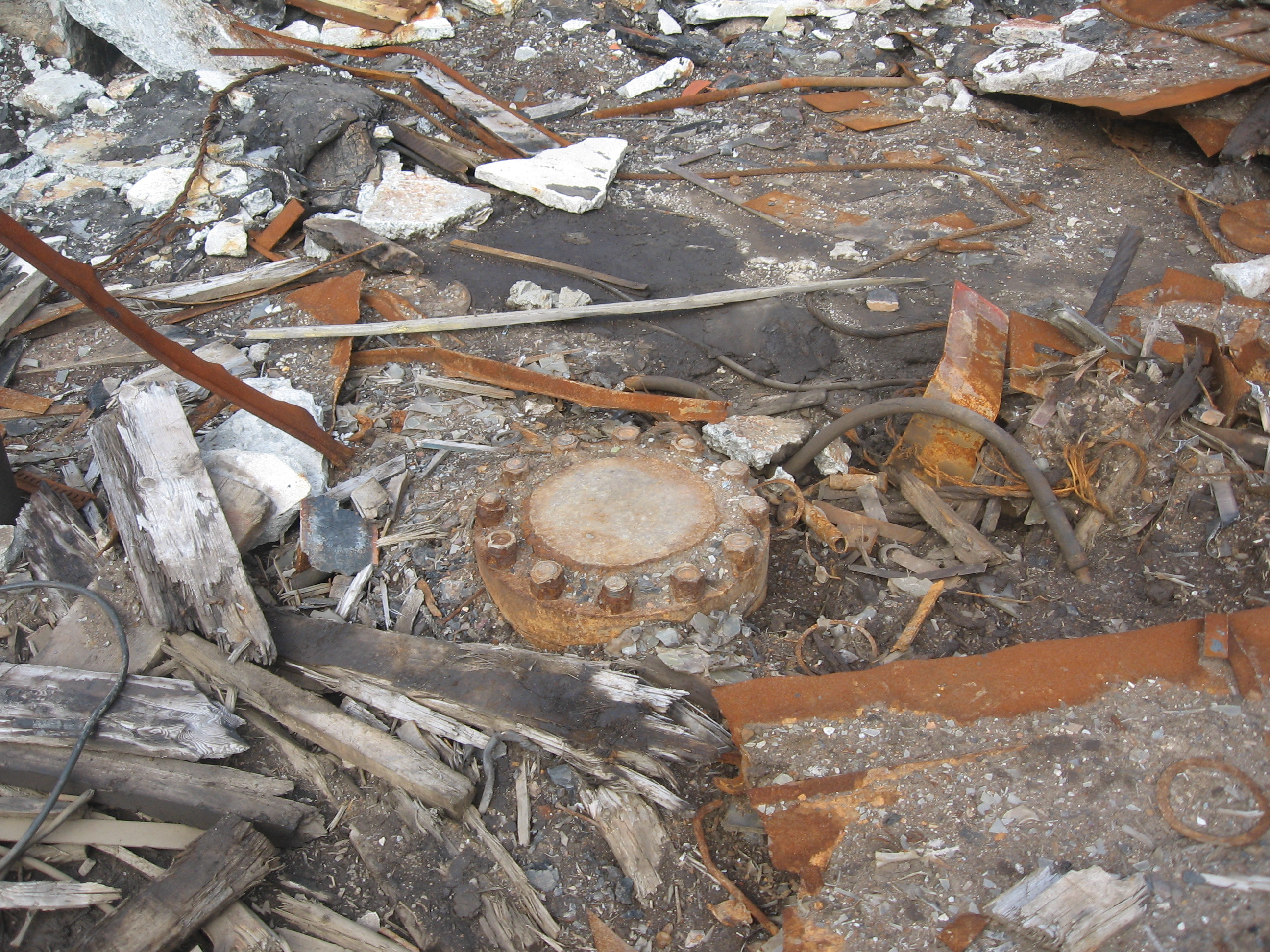
Kola Superdeep Borehole
Somewhere on the Kola Peninsula, near the Norwegian border, a rusted metal cap bolted to the ground is all that marks the deepest point humans have ever reached into the Earth. Twelve kilometers and 262 meters straight down. That is deeper than the ocean's deepest trench is deep, deeper than Mount Everest is tall. The Kola Superdeep Borehole began as a Soviet scientific drilling project in 1970 with a modest target of 7,000 meters, then kept going for two decades, and what it found along the way contradicted nearly everything geologists thought they knew about the structure of the continental crust.
Drilling Into the Unknown
Work began on May 24, 1970, using the Uralmash-4E, a standard oil well drilling rig slightly modified for the job. By 1974, ambitions had grown: a purpose-built Uralmash-15000 rig was installed, named for the new target depth of 15,000 meters. On June 6, 1979, the borehole broke the world depth record previously held by the Bertha Rogers hole in Washita County, Oklahoma, which had reached 9,583 meters. By October 1982, the first hole had pushed to 11,662 meters. But drilling at these depths was a battle against physics. The second hole branched off at 9,300 meters in January 1983. In June 1990, the third hole suffered a breakdown at 12,262 meters -- the maximum depth the project would ever achieve. A fourth attempt, started in 1991, was halted in 1992 at 11,882 meters when temperatures reached 180 degrees Celsius, far beyond what had been predicted. Five boreholes were drilled in total, branching from one another like the roots of a tree growing downward.
Everything the Textbooks Got Wrong
The scientific discoveries were as remarkable as the engineering. Geologists had predicted, based on seismic data, that a layer of basalt would appear at roughly seven kilometers depth. It never did. Instead, the drill kept cutting through granite far deeper than anyone expected. The seismic discontinuity that had been interpreted as a transition between rock types turned out to be a metamorphic change within the granite itself -- same rock, different physical state. Water was found at depths where none was thought possible, having percolated up through the granite until it hit an impermeable layer and pooled there. It did not vaporize despite the heat, held in liquid form by the immense pressure. Perhaps most startlingly, microscopic plankton fossils were discovered six kilometers below the surface, preserved in rock that was billions of years old. The borehole was rewriting geology with each additional meter.
The Heat That Won
Temperature was the project's ultimate adversary. At 12,262 meters, rock temperatures reached approximately 180 degrees Celsius -- significantly hotter than models had predicted. At these temperatures, the rock itself behaved less like a solid and more like a plastic substance, causing the borehole walls to close in on the drill. Equipment failed repeatedly. Drill bits wore out in hours. The deeper the project pushed, the more the physics of the deep crust fought back. The original goal of 15,000 meters, which planners had hoped to reach by 1993, proved physically unattainable with existing technology. Funding shortages compounded the technical problems: the fifth and final drilling attempt, started in April 1994 from a depth of 8,278 meters, was abandoned in August of that year at just 8,578 meters when money ran out entirely.
Abandoned but Unmatched
The project officially ended in 1995. The scientific team was downsized and given the task of studying the data already collected. The site was eventually abandoned. Visitors who make the journey to the remote spot in Russia's Pechengsky District report that the structure over the borehole has been partially destroyed or removed. What remains is a monument to ambition and its limits. The Kola Superdeep Borehole has been the world's deepest since 1979, and no one has come close to its true vertical depth. Its record for total measured length was surpassed in 2008 by a curved oil well in Qatar's Al Shaheen field, which reached 12,289 meters in total length but only 1,387 meters in actual depth. China began drilling a 10,000-meter scientific borehole in the Tarim Basin in 2023. But the Kola borehole, sealed under its rusted cap on a treeless peninsula above the Arctic Circle, remains the deepest humans have ever gone.
From the Air
Located at 69.40°N, 30.61°E in the Pechengsky District of Murmansk Oblast, Russia, near the Norwegian border. The site is on the Kola Peninsula in flat, treeless terrain. Kirkenes Airport Hoybuktmoen (ENKR) in Norway is approximately 50 km to the northwest. Murmansk Airport (ULMM) is approximately 170 km to the southeast. The borehole site itself is not visible from the air, but the surrounding area is characterized by sparse tundra and small lakes. Best viewed at 3,000-5,000 ft AGL.