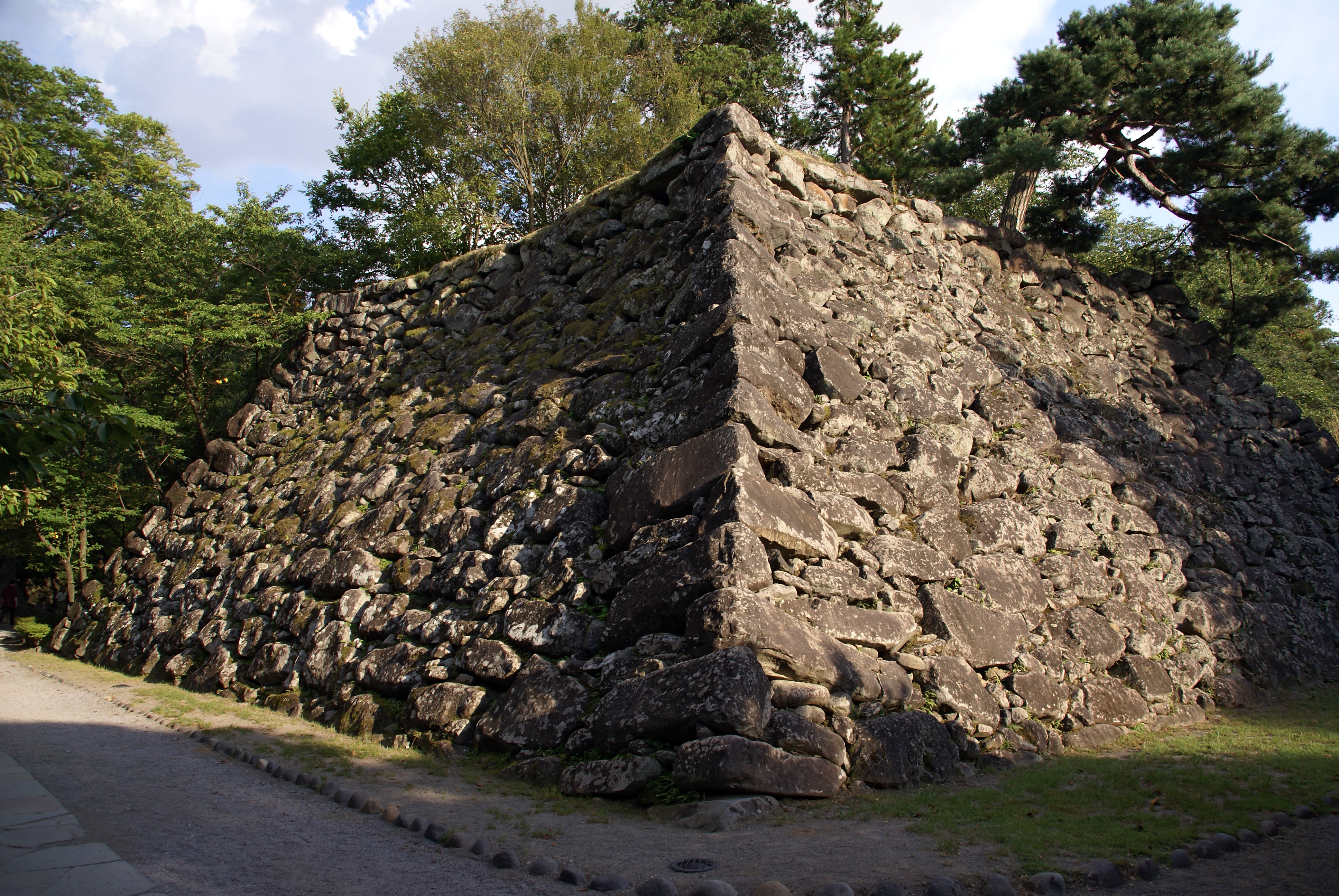
Komoro Castle: The Fortress Built in a Hole
Most Japanese castles command the high ground. Komoro Castle sits in a hole. Known as ana-jiro -- literally "hole castle" -- it was built on terrain lower than the surrounding castle town, a design so unusual it confounds visitors expecting the typical hilltop fortress. The castle occupies a bluff above the Chikuma River in central Nagano Prefecture, but the town grew up on even higher ground around it, making Komoro one of the rarest castle layouts in Japan. The man who designed it had his reasons. When Takeda Shingen seized this area in 1554, he dispatched his master strategist Yamamoto Kansuke to rebuild the local fortification into a proper castle. Kansuke saw what the terrain offered: steep river bluffs on one side, natural ravines for defense, and a layout that would force any attacker approaching from the town to descend into unfamiliar ground. What looked like a disadvantage was, in Kansuke's hands, a trap.
Warlords at the Crossroads
Before Takeda Shingen arrived, the site was a simple fortification built by a local warlord named Oi Mitsutada during the Muromachi period. Shingen's redesign through Kansuke transformed it into a strategic stronghold controlling a vital mountain corridor. But Shingen's Takeda clan fell to Oda Nobunaga in 1582, and Komoro passed to Takigawa Kazumasu, one of Nobunaga's generals. When Nobunaga was assassinated in the Honno-ji incident that same year, the castle briefly fell to the Later Hojo clan of Odawara. After 1590 and the Battle of Odawara, Tokugawa Ieyasu claimed the region and assigned Komoro to Sengoku Hidehisa as a 50,000 koku domain. Hidehisa reinforced the walls and reorganized the layout around a central bailey flanked by north and south baileys. His son, Sengoku Tadamasa, improved the castle further, adding the foundation for a three-story tenshukaku -- the main tower that would become the castle's crown.
Lightning, Flood, and Eight Clans
In 1626, lightning struck the donjon and it burned to the ground. It was never rebuilt. That absence defines Komoro today -- a castle whose most prominent feature is the stone foundation of a tower that hasn't stood for four centuries. The domain passed through a procession of ruling clans: the Hisamatsu branch of the Matsudaira from 1624 to 1648, the Aoyama from 1648 to 1662, the Sakai from 1662 to 1679, the Nishio from 1679 to 1682, and the Ishikawa from 1682 to 1702. In 1702, a junior branch of the Makino clan took control and held Komoro until the end of the Edo period. In 1742, severe flooding damaged the castle. The San-no-mon gate, one of the castle's key defensive structures, had to be rebuilt in 1765 after that flood. Following the Meiji Restoration, Komoro Castle was abandoned. In 1871, with the abolition of the feudal han system, most remaining structures were demolished or donated to nearby Buddhist temples.
The Nostalgic Park
What survived is now Kaikoen -- the "nostalgic park" -- and the name captures the spirit of the place. Two original gates still stand: the Otemon, dating from the early Edo period, and the rebuilt San-no-mon, both designated Important Cultural Properties of Japan. Two additional gates survive at Buddhist temples within the city, and a portion of the central palace structure is in private hands in the nearby city of Tomi. The Shinano Railway Line cuts directly through the former castle grounds, isolating the Otemon from the other structures -- a modern railway bisecting feudal ruins. Within the park, the castle grounds host a small zoo that has operated since 1926, an amusement park, and a museum dedicated to the novelist Shimazaki Toson, who spent a formative period teaching in Komoro and set portions of his work in the area. In 2006, the Japan Castle Foundation recognized Komoro as one of the 100 Fine Castles of Japan.
Blossoms on the Battlements
Kaikoen is designated as one of Japan's Top 100 Cherry Blossom Viewing Sites, and in spring the park transforms. Some of the cherry trees are said to be centuries old, their gnarled branches spreading over stone walls and defensive embankments. The Komoro-yae-benishidare, a weeping cherry variety found only in Komoro, blooms in a deep purplish red that gradually fades as the petals open. The blossoms arrive later here than in the lowlands -- the castle sits at an elevation where spring comes slowly -- and visitors who have already seen the season pass through Tokyo and Kyoto make a second pilgrimage to catch the late display. In autumn, the maples take over, and the park's canopy turns red and gold against the old stone foundations. From the bluffs, the Chikuma River is visible below, and on clear days the mountains of Nagano rise beyond. The hole in the ground where Kansuke built his fortress has become a garden.
From the Air
Located at 36.33°N, 138.42°E in the city of Komoro, Nagano Prefecture, on a bluff above the Chikuma River. The castle ruins and Kaikoen park are visible as a wooded area within the town, with the Shinano Railway Line cutting through the grounds. Best viewed at 3,000-5,000 feet AGL. The surrounding terrain is mountainous highland. Matsumoto Airport (RJAF) lies approximately 25 nautical miles to the southwest. Mount Asama (2,568 m) is visible to the northeast. The castle's unusual low-lying position relative to the town may be apparent from moderate altitude.