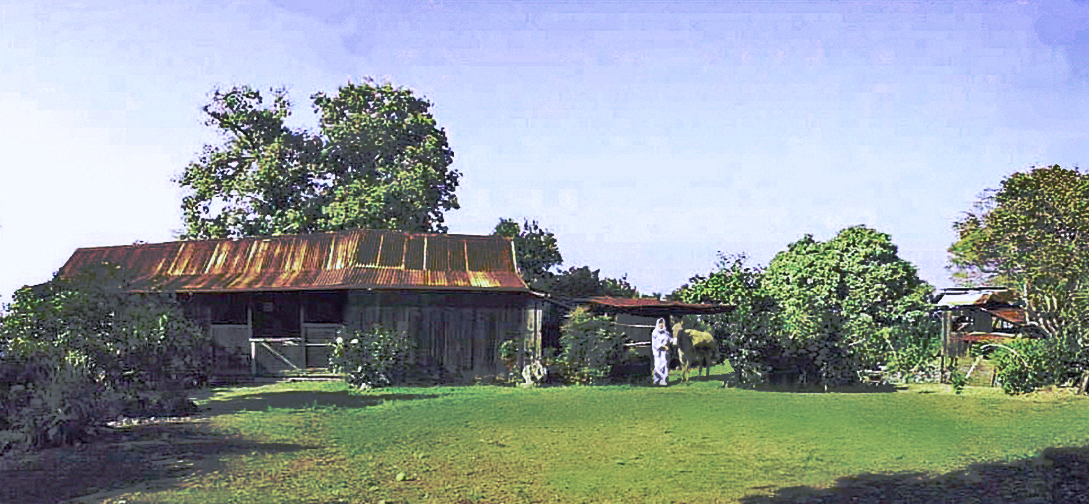
Kona Coffee Living History Farm
Daisaku Uchida arrived in Hawaii from southern Japan on September 27, 1906, nineteen years old and bound by a three-year sugar contract at Lihue Plantation on Kauai. When the contract expired, he did what tens of thousands of Japanese immigrants did: he left the plantation and started over. On 5.5 acres of Kona hillside, leased from the Greenwell family, he built a coffee farm, a farmhouse, and a life that lasted nearly a century. He died in 1986 at the age of 99. Today his farm is a living history museum, and the coffee trees still produce.
Contracts and New Beginnings
Between 1868 and 1924, more than 140,000 Japanese workers came to Hawaii under labor contracts with sugarcane plantations. The work was grueling, the pay minimal, and the contracts binding. But when those contracts expired, many workers chose to stay -- not on the plantations, but on their own terms. The Kona District offered something the sugar lowlands could not: independence. Coffee grows in a narrow elevation band along the western slopes of the Big Island, where afternoon clouds roll in to shade the cherries and volcanic soil feeds the roots. Small plots, too steep for large-scale sugar cultivation, could be leased and worked by a single family. Daisaku Uchida came to Kona after his time on Kauai, married his cousin Shima Maruo in 1912, and moved onto the farm in 1913.
A Family Rooted in Volcanic Soil
The Uchidas expanded the farm and built a new house in 1925. Six children were born on the property -- three in the original house and three in the replacement. The land belonged to the Greenwell family, whose patriarch Henry Nicholas Greenwell had been trading in Kona coffee since the 1870s, winning honors at the 1873 World's Fair in Vienna. The Uchidas were part of a broader pattern: immigrant families working small plots on land owned by established haole families, producing coffee whose quality came from the microclimate as much as from the labor. Shima Uchida died in 1966 at age 73. Their eldest son Masao continued farming the property until he and his wife Masako retired to Honolulu in 1994.
Where the Orchard Tells the Story
The farm is now an open-air museum operated by the Kona Historical Society, depicting daily life during the 1920-1945 period. Visitors walk through the coffee orchard, the original farmhouse, and the hand-operated coffee mill. Costumed interpreters bring the era to life at scheduled times. The property sits in the area now called Captain Cook, within the traditional Hawaiian land division known as Kealakekua. It was listed on the Hawaii Register of Historic Places in 1994 and added to the National Register of Historic Places on February 9, 1995. Nearby, the original Henry Greenwell Store -- also on the National Register -- houses the Kona Historical Society. Both sites sit along the Mamalahoa Highway, the historic road that rings the Big Island. What makes this museum different from most is that nothing was reconstructed or relocated. The Uchida farm is exactly where it was, doing what it always did, a working testament to the immigrant labor that built Kona's reputation one harvest at a time.
From the Air
Located at 19.49°N, 155.91°W along the Mamalahoa Highway near Captain Cook on the Kona Coast. The farm sits in the coffee belt, visible as a green strip between the dry coast and the volcanic uplands. Nearest major airport is Ellison Onizuka Kona International (PHKO). Best viewed at 3,000-5,000 ft AGL. Kealakekua Bay, where Captain Cook was killed, is visible just to the west.