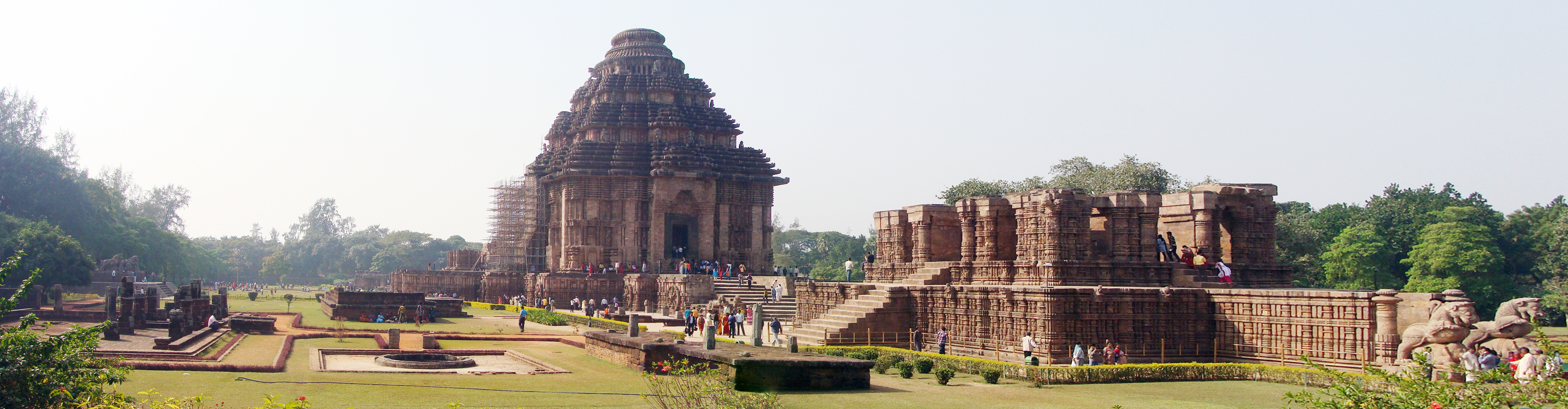
Konark Sun Temple
Sailors in the Bay of Bengal once steered by two landmarks on the Odisha coast. The Jagannath Temple in Puri, whitewashed and gleaming, they called the White Pagoda. Thirty-five kilometers to the northeast stood something darker and more imposing -- a massive temple built from oxidized stone, its silhouette unmistakable against the dawn sky. They called it the Black Pagoda. What those sailors were using as a navigation aid was, in fact, a 100-foot-tall stone chariot built to carry the Hindu sun god Surya across the heavens. Constructed in 1250 CE by King Narasimhadeva I of the Eastern Ganga dynasty, the Konark Sun Temple translated Vedic cosmology into architecture on a scale that still astonishes. Twenty-four elaborately carved wheels, each nearly 12 feet in diameter, line the temple's base. Seven stone horses strain at the front, frozen mid-gallop. At dawn, when the first light catches the temple from the east, the entire structure seems to lurch forward out of the sea.
A Chariot Carved from the Calendar
The temple's design is not merely decorative -- it encodes time itself. Each pair of wheels corresponds to one of the twelve months of the Hindu calendar, divided into the Shukla and Krishna cycles. The spokes function as sundials, capable of marking time to the minute when shadows fall across their carved faces. The seven horses pulling the chariot take their names from the seven meters of Sanskrit prosody: Gayatri, Brihati, Ushnih, Jagati, Trishtubh, Anushtubh, and Pankti. Even the temple's ground plan follows the sacred geometry described in Odisha's own Silpasarini texts, built on interlocking squares and circles. The name itself holds meaning -- Konark combines the Sanskrit words Kona, meaning corner or angle, and Arka, the sun. It was a place where angle and light converged, where architecture became astronomy.
Stone That Speaks of Daily Life
Walk the terraces and the 13th century opens up in sandstone relief. The lower platform tells stories that have nothing to do with gods. Girls wring wet hair after bathing. A family takes leave of their elderly grandmother, who appears dressed for a pilgrimage. Students sit with a teacher. A yogi holds a standing pose. Somewhere a monkey snatches at a woman's belongings while she tries to chase it away. Above these domestic scenes, musicians process across the walls -- their instruments, their postures, and their expressions captured with a specificity that borders on portraiture. The erotic sculptures that scandalized Victorian-era visitors occupy their own panels, depicting couples in courtship and intimacy with the same matter-of-fact directness the sculptors brought to every other aspect of human experience. As the art historian Ernest Binfield Havell wrote, the carvings express "as much fire and passion as the greatest European art."
Centuries of Ruin and Rescue
For at least a century after its completion, the temple functioned as intended. A copper plate inscription from 1384 CE confirms it remained an active site of worship. But sometime between the late 16th and early 17th centuries, the temple suffered catastrophic damage. Kalapahad, a Muslim convert general, is believed to have attacked around 1568. Whether the destruction came from deliberate assault, structural failure, or some combination remains debated -- but by the time a Maratha holy man found the site in the 18th century, the temple stood abandoned and swallowed by forest. The Marathas relocated the 33-foot Aruna Stambha, a monolithic chlorite pillar dedicated to the sun god's charioteer, to the Jagannath Temple in Puri. Conservation requests from the Asiatic Society of Bengal in 1838 were denied. It took until 1906 for the first real protective measures -- the planting of casuarina and tamanu trees as a windbreak against sand-laden coastal gales.
Where Language Fails
Rabindranath Tagore, after visiting Konark, wrote a line that has become inseparable from the temple: "Here the language of stone surpasses the language of human." The colonial reaction was more conflicted. Andrew Sterling, the Commissioner of Cuttack, grudgingly admitted to finding "an air of elegance, combined with massiveness" in the structure, while Victorian moralists puzzled over what they perceived as the mingling of spirituality and sensuality. They missed the point that Alan Watts later articulated -- there was no reason to separate devotion from the fullness of human experience. Today Konark anchors one corner of Odisha's Golden Triangle, alongside the Jagannath Temple in Puri and the Lingaraja Temple in Bhubaneswar. UNESCO designated it a World Heritage Site in 1984. The temple appears on the reverse of India's ten-rupee note, a small rectangle containing what was once a colossal act of faith -- an entire civilization's understanding of time, divinity, and desire, carved into stone and aimed at the rising sun.
From the Air
Located at 19.887N, 86.095E on the Bay of Bengal coastline, approximately 35 km northeast of Puri and 65 km southeast of Bhubaneswar. The nearest airport is Biju Patnaik Airport (VEBS) in Bhubaneswar. From cruising altitude, the temple complex is visible near the coast surrounded by vegetation. Best approached from the east over the Bay of Bengal at dawn for the most dramatic perspective. The coastal setting makes it identifiable -- look for the cluster of stone structures near the shoreline amid green canopy.