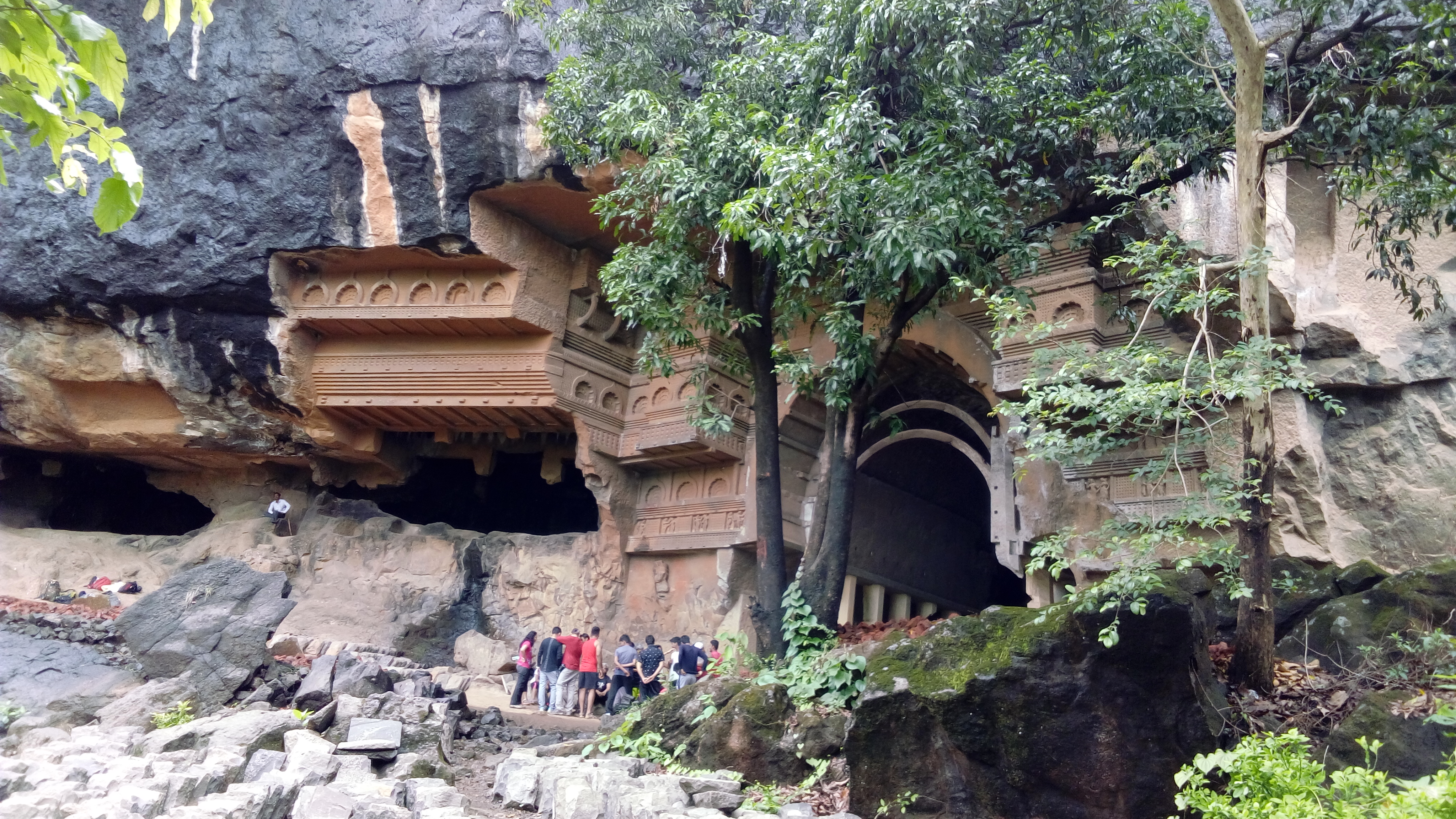
Kondana Caves
Water has been both architect and enemy here. The Kondana Caves sit in the face of a steep scarp near the village of Kondhane, 33 kilometers north of Lonavala, and even during the dry season, moisture trickles down the rock face above them. Over two thousand years, that water has eaten away at pillars, dissolved the bases of columns, and eroded details that once matched the finest work in the region. The damage is so extensive that scholars have debated for more than a century whether Kondana or the nearby Bhaja Caves came first -- the two are so similar in plan and so close in age that their construction periods may have overlapped. What survives at Kondana is less a finished monument than a fragment, and the fragment is extraordinary.
Hidden Behind the Forest
The caves were first brought to European attention in the 19th century by Vishnu Sastri, and soon after visited by Mr. Law, the collector of Thane. They are carved into the face of a cliff at the base of the old hill fort of Rajmachi, about 14 kilometers from Karjat station on the Central Railway. Thick forest screens them from view, and approaching the site even today requires navigating dense vegetation and uneven terrain. This remoteness has protected the caves from some forms of damage while exposing them to others -- the relentless moisture, the creeping roots, the slow collapse of unsupported stone. The 16 caves were excavated in the 1st century BCE, and their construction on wooden patterns -- imitating timber structures in permanent rock -- is one of their most distinctive features.
A Prayer Hall in Ruin and Wonder
Cave No. 1, the Chaitya, is the complex's most significant structure. It measures 66.5 feet from the front pillars to the back of the apse, 26 feet 8 inches wide, and 28 feet 5 inches high to the crown of its arched roof. The nave stretches 49 feet before a dagoba -- a stupa -- 9.5 feet in diameter, its relic casket unusually tall, carved with the Buddhist rail pattern. Of the 30 columns that once surrounded the nave, only the remains of seven on the left side and six on the south survive; the others have decayed entirely. The columns that do remain rake inward, a characteristic shared with Bhaja and Bedse that marks them as very early work. Wooden rafters once spanned the arched ceiling, as at Karla, but they are gone. Only a fragment of latticed screen in the front arch remains as evidence of the original woodwork.
The Sculptor's Signature
On the left side of the facade, partially destroyed, is a fragment of sculpture in high relief: the head of a single figure, about twice life-size. The features are gone, but the details of the headdress show careful, meticulous finishing. Over the left shoulder, a single line in Brahmi characters reads: "Kanvasa antevasina Balakena katam" -- "Made by Balakena, the pupil of Kanha." It is one of the few surviving artist attributions from this period of Indian cave architecture. Above the head, a broad belt of sculpture divides into seven compartments alternating lattice patterns with human figures: a solitary man, couples, a man with a bow flanked by two women. The corresponding belt on the right side of the facade is badly damaged where the rock has fallen away.
Where Monks Slept in Stone Beds
Cave No. 2, a Vihara or monastic residence, lies a short distance to the northeast. Its veranda, 18 feet long and supported by the unusual number of five octagonal pillars, is mostly destroyed except at the left end. Inside, a hall 23 feet wide by 29 deep holds 15 pillars arranged about 3 feet from the walls. The roof imitates a structural timber hall, with beams 19 inches deep running across the pillar heads and smaller false rafters filling the spaces between. Along the sides, 12 cells open off the main hall, each containing a stone bed carved for a monk. The first cell on each side has two beds. Over 14 of these doorways, Chaitya arches are carved and connected by a projecting string course decorated with the rail pattern. Cave No. 3 is a plainer Vihara with nine cells, much ruined, and Cave No. 4 has nine more cells backing onto what appears to be a natural hollow beneath the cliff, with a mud-filled tank and a small cistern beyond.
From the Air
Located at 18.84N, 73.38E, about 33 km north of Lonavala at the base of Rajmachi Fort. The caves are hidden in thick forest on a steep scarp and are not visible from altitude, but Rajmachi Fort on the hilltop above is a clear landmark. Recommended viewing altitude: 3,000-5,000 ft AGL. Nearest rail: Karjat station (Central Railway), 14 km away. Nearest airports: Pune Airport (VAPO) to the southeast, Mumbai (VABB) to the northwest. The terrain is steep Western Ghats escarpment with heavy monsoon vegetation.