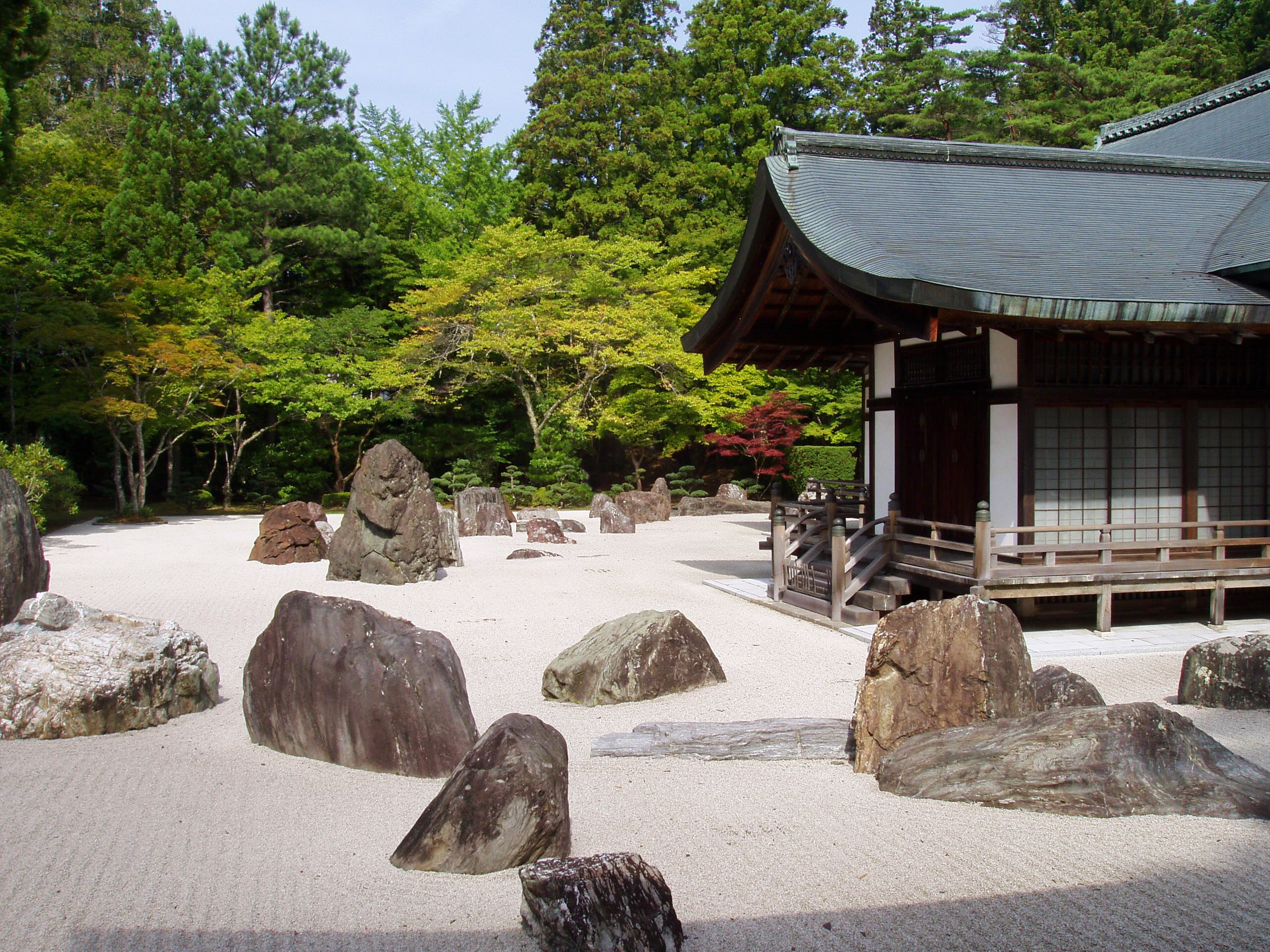
Kongobu-ji
One hundred forty granite boulders, hauled from the island of Shikoku, lie arranged in a sea of raked white gravel to form two dragons emerging from clouds. This is the Banryutei, Japan's largest rock garden at 2,340 square meters, and it sits behind the most important building in Shingon Buddhism. Kongobu-ji -- the Temple of the Diamond Mountain Peak -- crowns Mount Koya in Wakayama Prefecture, the ecclesiastic headquarters of a tradition that has occupied this remote mountain plateau for over twelve hundred years. The temple is part of the UNESCO World Heritage Site "Sacred Sites and Pilgrimage Routes in the Kii Mountain Range," and everything about it -- the painted screens, the meditation halls, the sheer weight of accumulated centuries -- communicates the authority of a faith that has never left the mountain where it was planted.
A Warlord's Mourning Gift
Kongobu-ji owes its existence to grief. In 1593, Toyotomi Hideyoshi -- the peasant who rose to become Japan's supreme military ruler -- commissioned the construction of a memorial temple on Mount Koya following the death of his mother. The building was originally named Seigan-ji. It was rebuilt in 1861 after fire, and in 1869, following the Meiji government's reorganization of religious institutions, it was merged with a neighboring temple and renamed Kongobu-ji, becoming the formal head temple of the entire Koyasan Shingon school. The current structure preserves the scale and grandeur of that lineage. Inside, visitors walk past room after room of fusuma -- sliding screen doors -- painted by Kano Tan'yu (1602-1674) and artists of the Kyoto Kano school, their landscapes and mythological scenes unfolding in gold leaf and mineral pigments across hundreds of panels.
The Mountain Kukai Chose
The deeper history of Koyasan reaches back to 816, when the monk Kukai -- posthumously known as Kobo Daishi -- received imperial permission from Emperor Saga to establish a monastic center on this remote, forested plateau. Kukai had studied esoteric Buddhism in Tang dynasty China and returned to Japan determined to create a place where its rituals and teachings could be practiced in isolation from the court. Mount Koya, surrounded by eight peaks said to resemble a lotus flower, fit his vision. The community he founded has operated continuously for over twelve hundred years. Today more than fifty sub-temples cluster around Kongobu-ji, many offering overnight lodging to pilgrims. The ancient cedar forests that blanket the mountain shelter Okunoin, Japan's largest cemetery, where over 200,000 gravestones line a two-kilometer path leading to Kukai's mausoleum.
Dragons in the Gravel
The Banryutei rock garden was created in 1984 to mark the 1,150th anniversary of Kukai's death -- or rather, his entrance into eternal meditation, as Shingon tradition holds that Kobo Daishi did not die but entered a state of deep contemplation from which he continues to watch over the faithful. The garden's 140 granite stones were sourced from Shikoku, Kukai's birthplace, and their arrangement evokes two protective dragons coiling through a bank of clouds. Unlike the austere minimalism of Kyoto's famous rock gardens, the Banryutei embraces scale: it wraps around the rear of the temple's Shin Betsuden annex, and its sheer expanse gives the dragon forms a sense of motion that smaller compositions cannot achieve. The white gravel ripples outward from each stone cluster like waves, reinforcing the impression of creatures in flight.
Meditating on the Letter A
Kongobu-ji is not a museum. The 414th abbot, Reverend Kogi Kasai, serves as both head priest and archbishop of the Koyasan Shingon school, and the temple remains an active center of practice. Visitors can attend sermons by the resident monks or participate in ajikan meditation sessions -- a fundamental Shingon breathing technique centered on contemplating the Sanskrit letter "A" written in the Siddham alphabet, the first sound and the origin of all creation in esoteric Buddhist philosophy. The practice is deceptively simple: sit, breathe, and focus on a single syllable. But within Shingon doctrine, that syllable contains the entirety of the universe. It is a fitting exercise for a temple whose name invokes the indestructible clarity of a diamond and whose mountain perch feels, on a clear morning, as close to the sky as any place on earth.
From the Air
Located at 34.214N, 135.584E on Mount Koya (Koyasan), a high plateau in the northern Kii Mountains of Wakayama Prefecture. The temple complex is nestled among dense cedar forests at approximately 800 meters elevation. From the air, Koyasan appears as a cluster of rooftops and clearings on a wooded mountain plateau surrounded by eight peaks. Nearest major airport: Kansai International Airport (RJBB), approximately 40nm northwest. Nanki-Shirahama Airport (RJBD) lies approximately 50nm to the south. The mountain terrain creates localized weather patterns; expect morning fog in the forested valleys. Best visual approach from the west, following the Kii Mountains ridgeline.