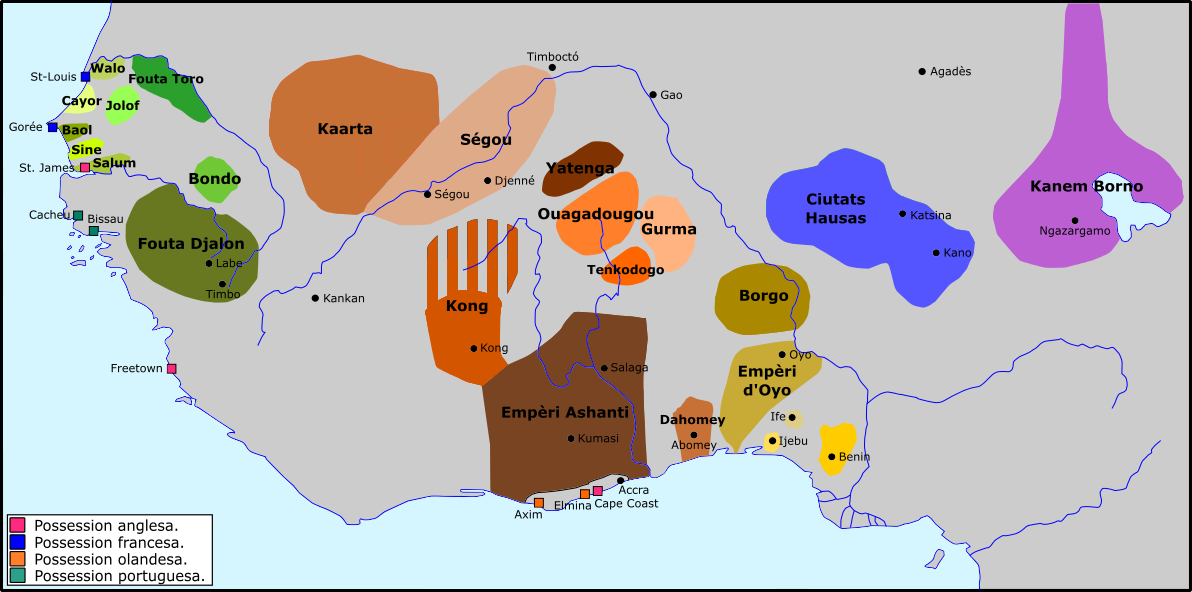
Kong Empire
Seku Watara was a scholar before he was a conqueror. A Dyula merchant who had studied the Quran, engaged in long-distance trade, and claimed descent from the Malinke Keita lineage of the old Mali Empire, he became a warrior out of ambition rather than desperation. In the early 1700s, he united Dyula leaders across the region, deposed the ruler of Kong -- a trading town in what is now northeastern Ivory Coast -- and built an empire not on territory alone but on something more durable: control of the routes that connected West Africa's gold, kola, and salt to the wider world.
Merchants Before Monarchs
Long before Seku Watara seized power, the area around Kong had been shaped by commerce. Starting in the 14th century, Mande merchants known as the Dyula migrated southward from the Mali Empire, founding trading cities at Begho, Bouna, Bondoukou, and Kong. These immigrants were largely Muslim, while the local Senufo and Tyefo populations -- Gur-speaking agriculturalists who had farmed the land for generations -- practiced animist traditions. The two groups coexisted more than they merged. Over time, the route running from the Niger River south to the goldfields and onward to European trading posts on the Gold Coast became increasingly valuable, and the towns along it grew wealthy. Recurring conflicts with the Gonja and Dagomba states to the east produced military leaders known as Fagama, men whose power rested on their ability to protect the trade that enriched everyone.
An Empire of Routes, Not Borders
The Kong Empire that Seku built after taking power in the early 1700s was unlike European states of the same era. It was decentralized by design -- a network of merchant houses linked by family ties, commercial agreements, and shared interest in keeping the trade routes open. Kong's forces did not seek to govern every village. They sought to control every crossroads. Seku and his allied war leaders pushed north across the Leraba River, conquering the Tiefo people. His son Kere-Mori and his brother Famagan Watara secured the Mouhoun River bend. At its height, the empire stretched across what is now northeastern Ivory Coast, much of Burkina Faso, and parts of Mali and Ghana -- four modern nations whose borders mean nothing to the trade routes that connected them.
Famagan's Western Campaign
The most ambitious military operation in Kong's history came in November 1739, when Famagan Watara launched a massive westward push. His forces captured Sofara on the Bani River, where he defeated an army sent by the Pashalik of Timbuktu to defend Djenne. Despite the victory, the river crossing proved impossible, and Djenne held. Undeterred, Famagan pressed further west and attacked Segou, the capital of the Bambara Empire. His first assault failed. He retreated south to Bela, rebuilt his forces, and returned to besiege Segou for nine months. The city was on the verge of falling when a Fula relief column arrived, resupplied the defenders, and broke the siege. It was the furthest Kong's military reach would ever extend -- a high-water mark that revealed both the empire's ambition and the limits of a commercial state waging wars of conquest far from its base.
The Fire and What Survived
By the late 19th century, a new force was reshaping West Africa. Samori Ture, the Wassoulou Empire's ruler, was fighting the French for control of the region while simultaneously demanding loyalty from smaller states. Kong's merchants, caught between Samori's demands and French offers, tried to play both sides. Some intercepted arms caravans; others opened channels to the colonial power. When the discontent broke into open revolt against Samori, he responded with devastation. In May 1898, Samori's forces burned Kong to the ground, scattering the royal house into exile along the Black Volta. The French eventually rebuilt the city, but it never recovered its former importance. The trade routes that had made Kong powerful were rerouted by colonial administrators, and the merchant networks that had sustained the empire for nearly two centuries dissolved into the new political order. What survived was memory -- oral traditions among the Dyula, place names on maps, and the outlines of a state that proved commerce could build an empire as surely as conquest.
From the Air
Located at 9.15N, 4.61W in present-day northeastern Ivory Coast. The modern town of Kong sits in the savanna landscape south of the Leraba River and north of the forested zone. From altitude, the region is characterized by dry savanna and scattered settlements connected by roads that roughly follow the old trade routes. The nearest significant airport is Bouake (DIBK) to the south or Bobo-Dioulasso (DFOO) in Burkina Faso to the north. The Black Volta River, important in the empire's history, is visible curving through the landscape to the east.