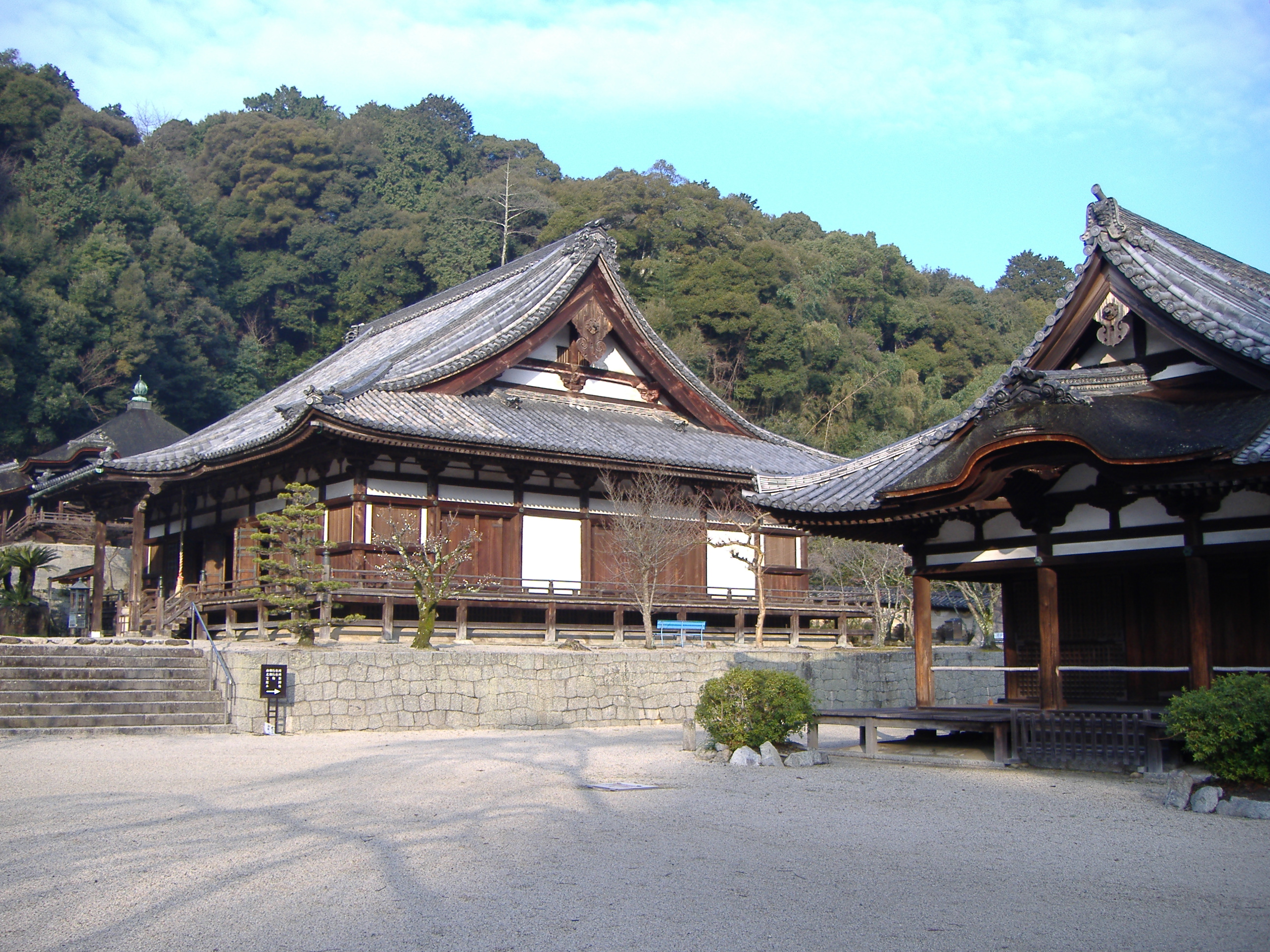
Kongō-ji
Somewhere in the archives of Kongo-ji lies a letter written in haste by Kusunoki Masashige, the fourteenth-century warrior whose name has become synonymous with hopeless loyalty. In the letter, Masashige pledges to help defend the temple against an expected attack by the Kamakura shogunate. The attack came, the shogunate eventually fell, and Masashige died fighting for an emperor who did not deserve him. But his letter survived, along with an astonishing collection of art, scripture, and documents that makes this temple in the hills of Kawachinagano one of the most important cultural repositories in Japan -- five National Treasures and twenty-nine Important Cultural Properties, held in a compound where cedar bark still serves as roofing material and incense smoke has darkened wood for a thousand years.
The Hall and the Three Who Guard It
The main hall, built in 1320, is itself a National Treasure. Inside sits the temple's central object of worship: a sculpture of Dainichi Nyorai, the Cosmic Buddha of Shingon Buddhism, flanked by Fudo Myoo on one side and Trailokyavijaya on the other. Together, this triad of figures has been designated a National Treasure. The grouping is deliberate and symbolic: Dainichi Nyorai represents supreme enlightenment, while the two fierce guardian figures embody the wrathful energy needed to overcome obstacles to awakening. In front of the main hall stands a three-bay treasure pagoda, or tahoto, originally built during the Heian period between 1086 and 1184. It is the oldest structure on the grounds, though it was substantially restored in 1606-1607. Its roof is shingled in cedar wood. Behind the main hall, a Kamakura-period bell tower features a distinctive flared lower section called a hakamagoshi, shaped like the traditional divided skirt of the same name.
The Oldest Pages of Japanese Law
Among Kongo-ji's five National Treasures, two are copies of the Engishiki, a compendium of Japanese laws and customs originally compiled between 905 and 927. The original Engishiki has been lost. What survives at Kongo-ji are transcriptions made in 1127 -- the oldest extant copies of the work. One, known as the Kongo-ji edition, consists of three scrolls containing volume 12 and fragments of volumes 14 and 16. The other is a single scroll of volumes 9 and 10, which contain a register of shrines across Japan. These documents are not merely old; they are irreplaceable. Without them, entire sections of the Engishiki -- a foundational text for understanding Heian-period governance, ritual, and administration -- would exist only as references in later works. That they survived the centuries in a mountain temple rather than a capital city archive speaks to the role temples played as guardians of knowledge through Japan's turbulent middle centuries.
A Treasury Across the Ages
The range of Kongo-ji's collection is staggering. An Asuka-period bronze standing image of Kannon Bosatsu, now held at the Nara National Museum, dates to the earliest centuries of Japanese Buddhism. Heian-period wooden sculptures of the Five Great Buddhas sit in the Gobutsu-do hall. A silk painting of Kobo-Daishi from the Heian period hangs alongside Kamakura-period mandalas. The crafts collection includes a gilded copper censer now at the Tokyo National Museum, its lid decorated with Japanese morning glory. A small Heian-period lacquer box, now at the Kyoto National Museum, features sparrows in a field rendered in the maki-e technique, with plum blossoms decorating the interior. There are suits of haramaki armor from the Muromachi and Nanbokucho periods. A cupronickel mirror from the Kamakura period bears a design of flowers and birds. Written treasures include a Heian-period Lotus Sutra scroll with gilt letters on deep blue paper, dated 1148 and attributed to Fujiwara no Motohira.
Ink and Survival
Perhaps the most evocative item in the collection is the letter from Kusunoki Masashige. Written in the warrior's own hand, it expresses his desire to help defend Kongo-ji, which was rumored to be targeted by the Kamakura shogunate after Emperor Go-Daigo's failed attempt to seize power from the bakufu. Masashige would go on to become the most celebrated loyalist of the Kenmu Restoration, fighting and dying for the Southern Court at the Battle of Minatogawa in 1336. His letter at Kongo-ji is a rare direct connection to the man behind the legend -- not a chronicle or a memorial, but his own words on paper, preserved in the temple he promised to protect. Among the other written materials is an excess copy of the Chinese seventh-century novel You Xian Ku, produced in 1320, noted as the oldest existing manuscript from the late Kamakura period. The collection spans from the sixth century to the fourteenth, a paper trail through eight hundred years of Japanese civilization, kept safe under cedar roofs in a valley south of Osaka.
From the Air
Located at 34.429N, 135.529E in the Amanosan mountain area of Kawachinagano, Osaka Prefecture. The temple compound is surrounded by dense forest in a valley on the western side of the Kongo-Ikoma mountain range. From the air, look for the distinctive ridgeline running north-south with the temple clearing on its western slopes. Nearest major airport: Kansai International Airport (RJBB) approximately 22nm to the southwest. Osaka Itami Airport (RJOO) is roughly 22nm to the north. The area is prone to low clouds and morning fog in the valleys during autumn months.