Kongsberg Silver Mines
Two children, an ox, and a scrape of hoof against rock. That is the romanticized origin story of Kongsberg Silver Mines -- how, sometime between July 1 and 5 of 1623, young Helga and Jacob spotted something shining where their ox had scratched the hillside of Gruveaasen. Their father melted the silver and tried to sell it in the town of Skien, where his suspiciously low asking price got him arrested. Given a choice between revealing his source or facing hard labor, he pointed the authorities toward Southern Sandsvaaer -- the old name for what would become Kongsberg. The truth, as usual, is more complicated. Silver mining at Gruveaasen appears in a Latin source from 1532, and German miners were working the hills under King Christian III by 1539.
Silver and the Tides of Global Trade
The early mines shut down in the 1540s when silver flooding in from Spanish Latin America crashed prices across Europe. Recovery came decades later, driven by Chinese demand for currency as Portuguese traders established Macau in 1555 and commerce with the Far East intensified. When Admiral Ove Gjedde returned from establishing a Danish trading outpost at Trankebar on India's Coromandel Coast in 1622, King Christian IV redirected him to Norway to revive the mining industry. Gjedde restarted silver extraction in 1623, and the following year the king himself visited, founded the town of Kongsberg, and established the operation by royal charter as Kongsberg Soelvverk. A remote Norwegian hillside had become entangled with the global currents of colonial trade.
The Kingdom Beneath the Mountain
At its peak in the 1770s, over 4,000 workers labored across more than 80 mine sites, making Kongsberg the largest pre-industrial workplace in Norway. The operation contributed over ten percent of the gross national product of the Danish-Norwegian union -- a staggering figure for a single enterprise. The King's Mine, the largest and richest shaft, eventually reached more than 1,000 meters in depth. Significant new ore discoveries in the 1830s and 1860s extended the operation's life, and across its full 335-year history, more than 450,000 man-years of labor produced over 1.3 million kilograms of silver. The mines finally closed in 1957, but by then they had shaped everything about the town above them.
A Thousand Meters Down
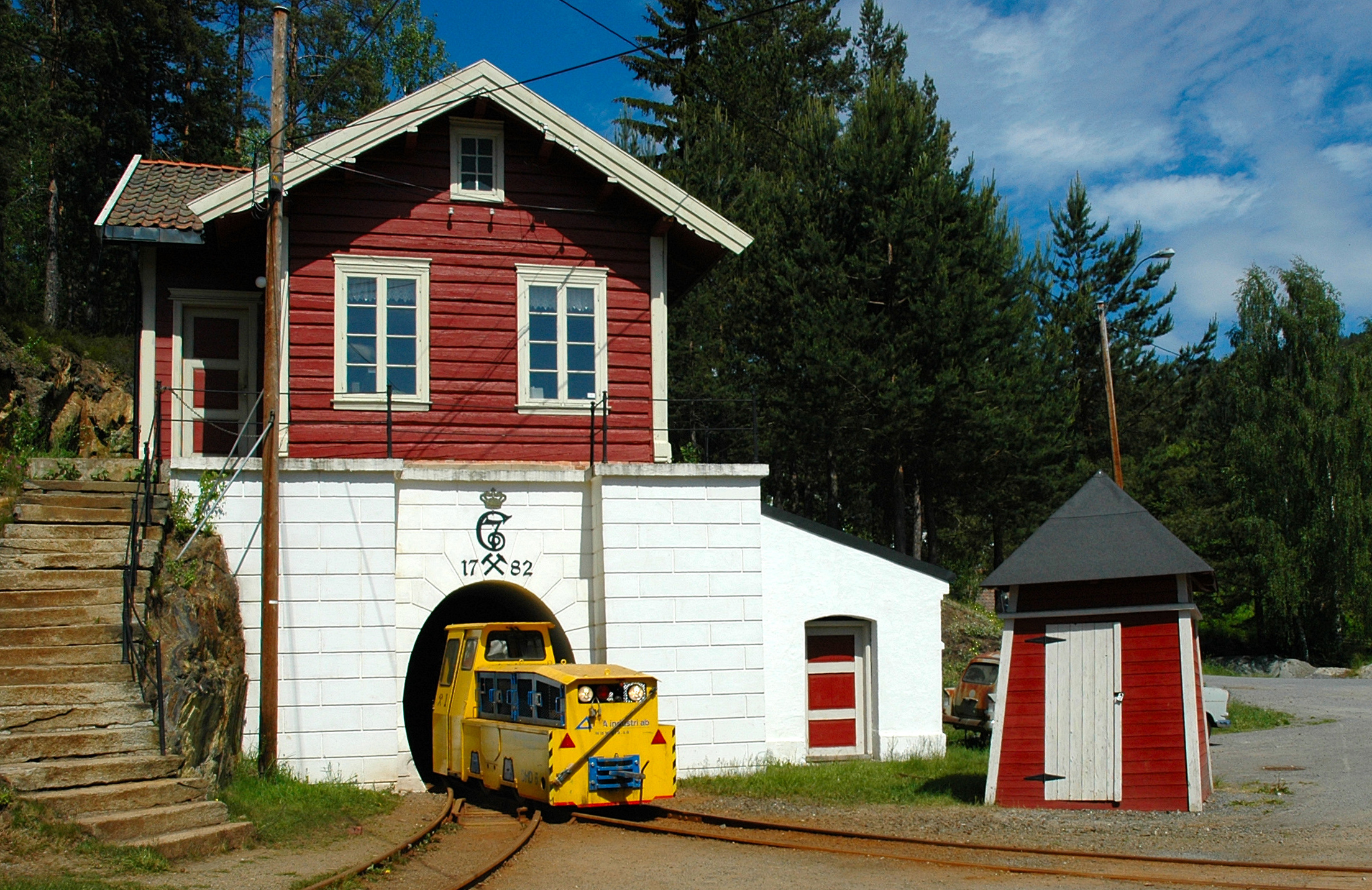
Today the Norwegian Mining Museum at Kongsberg offers visitors something few museums can: the chance to board a mining train and ride 2,300 meters through the Christian VII Adit into the mountain itself. The bottom of the mine sits 1,070 meters below the surface -- 560 meters below sea level. The space now called the Banquet Hall of the King's Mine began its life in 1943 as an emergency storage vault for the National Archives of Norway, built to hold 2,000 shelf-meters of documents and books safe from wartime threats. Around 40,000 visitors make the underground journey each year, and the tour includes a working man engine, the mechanical lift system that once carried exhausted miners back to daylight.
Where Geology Met Ambition
From above, the landscape around Kongsberg reveals little of the labyrinth below. The forested hills of Buskerud county roll gently toward the Numedalslaagen river, and the town itself sits in a valley with a quiet, prosperous feel. But for three centuries, this was one of the most important industrial sites in Scandinavia -- a place where the geological accident of silver-bearing rock intersected with the ambitions of Danish-Norwegian kings, the rhythms of global commodity markets, and the labor of tens of thousands of workers. The silver is gone, but the tunnels remain, carrying visitors into a darkness that once produced a nation's wealth.
From the Air
Located at 59.63N, 9.60E in Buskerud county, southern Norway. The town of Kongsberg sits along the Numedalslaagen river in a forested valley. Nearest significant airport is ENGM (Oslo Gardermoen), approximately 130 km to the northeast. Torp Sandefjord Airport (ENTO) is about 100 km southeast. At cruising altitude, the area appears as a forested valley landscape with no obvious surface indication of the extensive mine workings below. Best viewed at 3,000-5,000 feet AGL for valley and town detail.