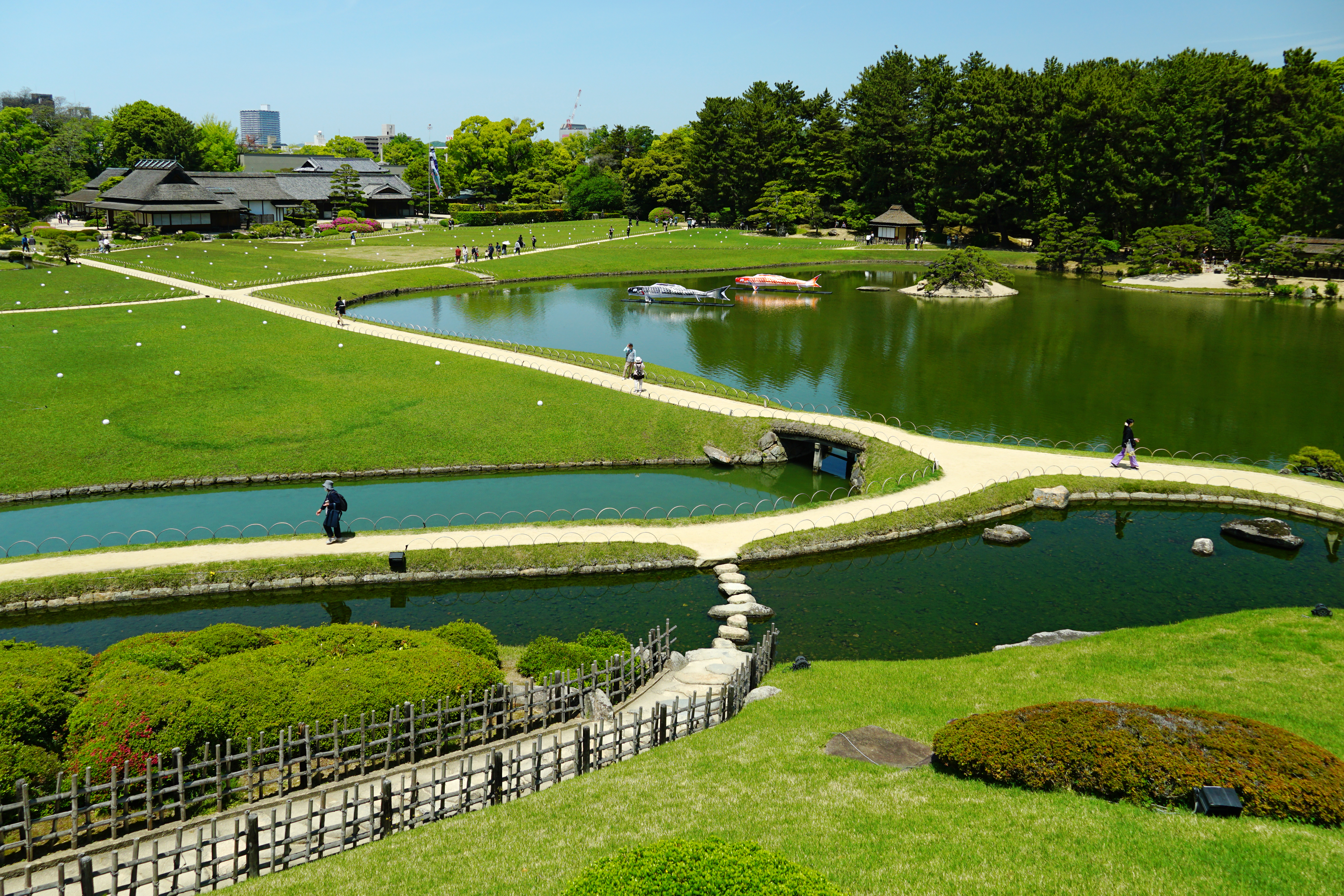
Koraku-en
The garden's name contains a philosophy. Koraku-en -- literally "garden of later enjoyment" -- takes its meaning from a Chinese maxim by the Song dynasty scholar Fan Zhongyan: "Grieve earlier than others, enjoy later than others." The idea is that a wise ruler carries the burdens of the people before partaking in pleasures. When the daimyō Ikeda Tsunamasa ordered construction of this garden in 1687, he was building a place of leisure, but the name -- adopted in 1871 -- reframed it as something nobler. Today, Koraku-en stands as one of the Three Great Gardens of Japan, alongside Kenroku-en in Kanazawa and Kairaku-en in Mito, and its 133,000 square meters of lawns, ponds, and tea houses remain a living expression of Edo-period garden design.
Thirteen Years of Construction
In 1687, Ikeda Tsunamasa charged his retainer Tsuda Nagatada with building a garden on an island in the Asahi River, just north of Okayama Castle. The work took thirteen years. When the garden opened in 1700, it was originally called Koen -- "later garden" -- because it was built behind the castle. The design followed the kaiyu style, a scenic promenade where the path itself creates the experience: every turn reveals a new composition of water, hill, tree, and sky. A central pond called Sawa-no-ike, or Marsh Pond, contains three islands designed to echo the scenery around Lake Biwa near Kyoto. The Chinese scholar Zhu Zhiyu, one of the greatest Confucian intellectuals of the Ming dynasty who had settled in Edo-era Japan, helped redesign portions of the garden, lending it a cross-cultural depth unusual for its time.
A Garden for Lords and Commoners
Koraku-en served multiple purposes for the Ikeda lords. It was a venue for entertaining important guests, a private retreat, and -- on designated days -- a place where ordinary people could enter and experience the grounds. This partial openness was unusual for daimyo gardens, and the Ikeda family maintained detailed records and commissioned numerous paintings of the garden throughout the Edo period. Those documents now serve as an invaluable resource: Koraku-en is one of the few provincial daimyo gardens where historians can trace exactly how the landscape changed over centuries. In 1884, ownership was transferred to Okayama Prefecture, and the garden was fully opened to the public for the first time.
Destruction and Restoration
Koraku-en has been devastated twice. Severe flooding in 1934 damaged much of the garden's infrastructure. Then, on June 29, 1945, allied bombing during World War II scarred the landscape further. In both cases, restoration relied on the Edo-period paintings and diagrams that the Ikeda family had carefully preserved. The rebuilt garden hews closely to its historical appearance, and in 1952 it was designated a Special Scenic Location under Japan's Cultural Properties Protection Law -- a status that mandates its preservation as a historical cultural asset for future generations. The stream that winds through the garden runs for 640 meters, the grassed areas cover approximately 18,500 square meters, and Okayama Castle's black tower rises behind the eastern boundary, providing the same borrowed-scenery backdrop that Ikeda Tsunamasa intended over three centuries ago.
Walking the Promenade
The kaiyu design means Koraku-en is meant to be walked, not viewed from a single vantage point. Paths connect lawns, ponds, artificial hills, tea houses, and streams in a sequence that rewards slow movement and attention. The Enyo-tei House and Kakumei-kan stand as resting points along the circuit, while the island of Mino-shima rises from the central pond. Cherry trees bloom in spring, irises in summer, and maples flame in autumn, ensuring that the garden presents a different face in every season. The landscape architect Kawase Hasui captured the garden in a woodblock print in 1934, just before the floods would alter it. His image -- serene water reflecting dark pines -- preserves a moment in the garden's long life, one frame in a continuous composition that has been evolving since 1700.
From the Air
Located at 34.67N, 133.94E in central Okayama city, on an island in the Asahi River just north of Okayama Castle. The garden and castle together form a distinctive green space visible from altitude. Nearest airport is Okayama Airport (RJOB), approximately 18 km to the northwest. The dark tower of Okayama Castle (the 'Crow Castle') is adjacent to the garden's southern edge. Recommended viewing altitude: 3,000-5,000 feet for river island and castle context.