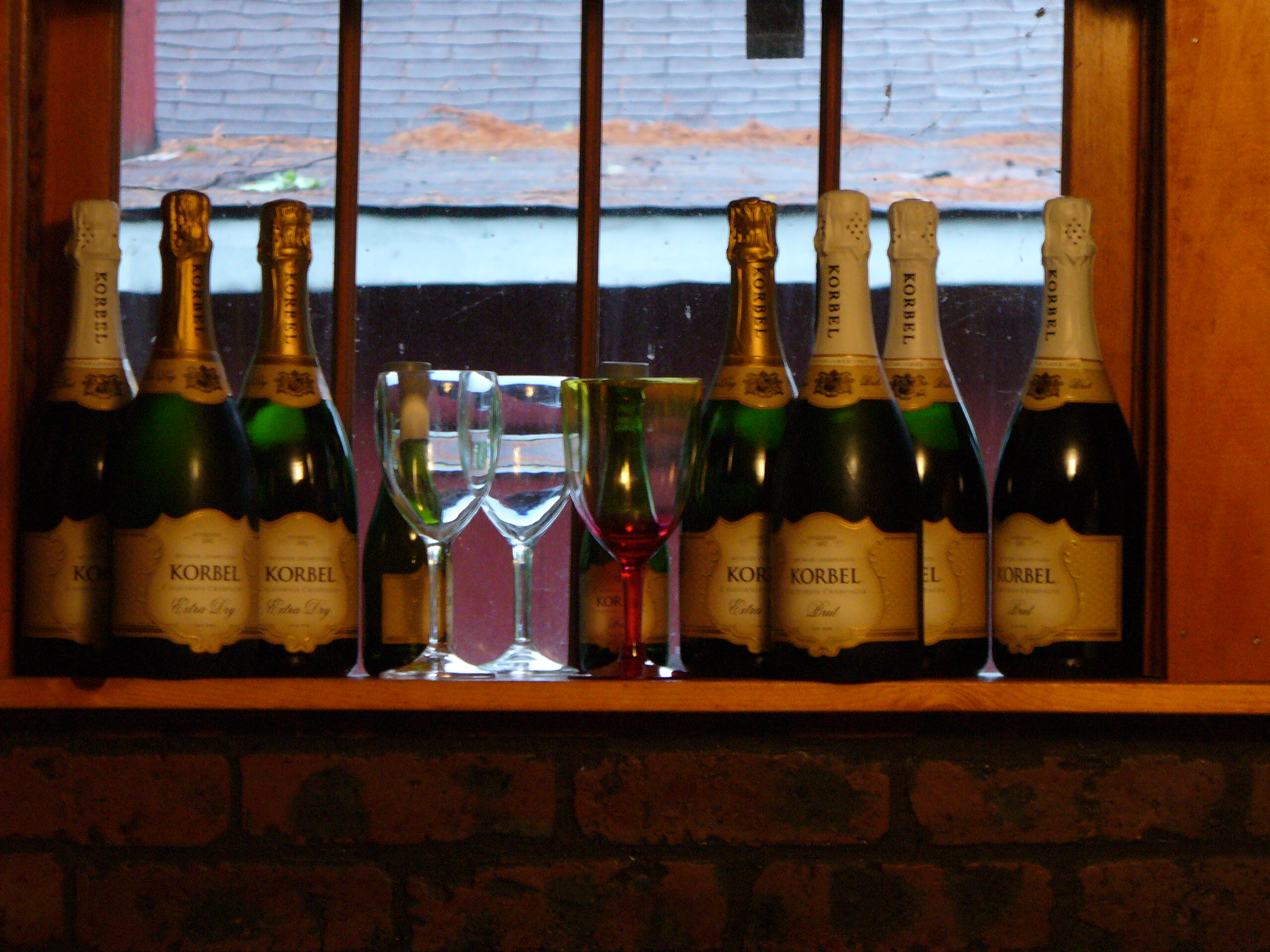
Bohemian Bubbles on the Russian River
Eleven times, a newly sworn president of the United States has raised a glass of Korbel at the inaugural celebration. The wine in that glass was made using methode champenoise, the same process used in the Champagne region of France, but it came from a winery tucked into the redwood forests along the Russian River in Guerneville, California. Korbel Champagne Cellars has occupied this unlikely location since 1882, when three brothers from Bohemia decided that the cool, foggy climate of Sonoma County could produce sparkling wine worthy of the name on its label. Whether that name should include the word "champagne" has been debated ever since, but the bubbles themselves have settled the argument for most of the Americans who drink them.
The Korbel Brothers' Wager
The three Korbel brothers were Czech immigrants who arrived in California during the latter half of the nineteenth century and recognized something familiar in the terrain along the Russian River. The climate was cool and maritime, shaped by the same Pacific fog that sustains the nearby redwood groves, and the soil could support the grape varieties they knew from Central Europe. In 1882, they established their winery and committed to the methode champenoise, a labor-intensive process in which sparkling wine undergoes its second fermentation inside the same bottle from which it will eventually be served. It was a bold choice. The method requires patience, precision, and skilled hands for the riddling and disgorging steps. But it produces a finer, more complex effervescence than bulk carbonation, and the Korbels were not interested in shortcuts. They also produced brandy and still wines, diversifying in a way that would prove critical to the brand's longevity.
The Wisconsin Connection
Korbel's brandy has a following so geographically concentrated it borders on the absurd: more than half of the company's entire brandy production is consumed in Wisconsin. The popular origin story traces this devotion to the 1893 Chicago World's Fair, where the Korbel brothers supposedly offered samples of their brandy to Central European immigrants from Milwaukee, who carried it home and began mixing it into old fashioned cocktails. The tale is appealing but almost certainly false. Historians point instead to a more prosaic explanation: during post-World War II liquor shortages, brandy was available when whiskey was not, and Wisconsinites developed a taste for it out of necessity. Whatever the cause, the result is a cultural peculiarity that endures. Order an old fashioned in most of the country and you get bourbon. Order one in Wisconsin and you get brandy, and a fair chance it is Korbel's.
What's in a Name
The word "champagne" on Korbel's label has irritated the French for over a century, and the legal history behind it is as layered as the wine itself. In the 1930s, the U.S. Department of the Treasury established regulations classifying terms like champagne, sherry, and port as semi-generics, names of geographical significance that also designate a class or type of wine. American producers could use these terms so long as they appeared alongside an appropriate appellation of origin and the wine met the standard of identity for that class. Korbel has operated under these rules since their inception. In 2006, the Bilateral U.S.-EC Trade Agreement on Wine, signed by all 27 EU member countries, reaffirmed this arrangement. The agreement halted new American brands from adopting semi-generic terms but grandfathered producers like Korbel who had made substantial long-term investments in their trademarks. The French may object, but the law is clear.
A Family Enterprise in the Redwoods
Adolf Heck purchased Korbel in 1954, and his son Gary took the helm in 1982, exactly a century after the founding brothers opened their doors. Under Gary Heck's leadership, production grew from 150,000 cases per year to 1.6 million, making Korbel the sixteenth-largest wine producer in the United States as of 2022. The company remains a private, family-operated business, a rarity in an industry increasingly dominated by corporate conglomerates. Brown-Forman handled Korbel's marketing and sales from 1965 until ending the partnership in 2025, leaving winemaking decisions to the family throughout that period. The winery still sits along the Russian River, surrounded by the same redwoods that shaded the original Korbel brothers. Fog still rolls through the canyon each summer morning. The bottles still ferment one at a time, each one carrying forward a bet three Bohemian immigrants placed on California soil more than 140 years ago.
From the Air
Coordinates: 38.5078°N, 122.967°W. The winery sits along the Russian River west of Guerneville in the redwood-covered hills of western Sonoma County. From the air at 2,000-3,000 feet AGL, look for the clearing along River Road where the winery buildings and vineyards break through the surrounding forest canopy. The Russian River provides a winding visual reference through the valley. Nearest airports: KSTS (Charles M. Schulz-Sonoma County Airport, 15 nm east), KDVO (Gnoss Field, Novato, 30 nm southeast). Summer fog often fills the river canyon below 1,000 feet in the morning, typically burning off by midday.