Korean Air Lines Flight 902
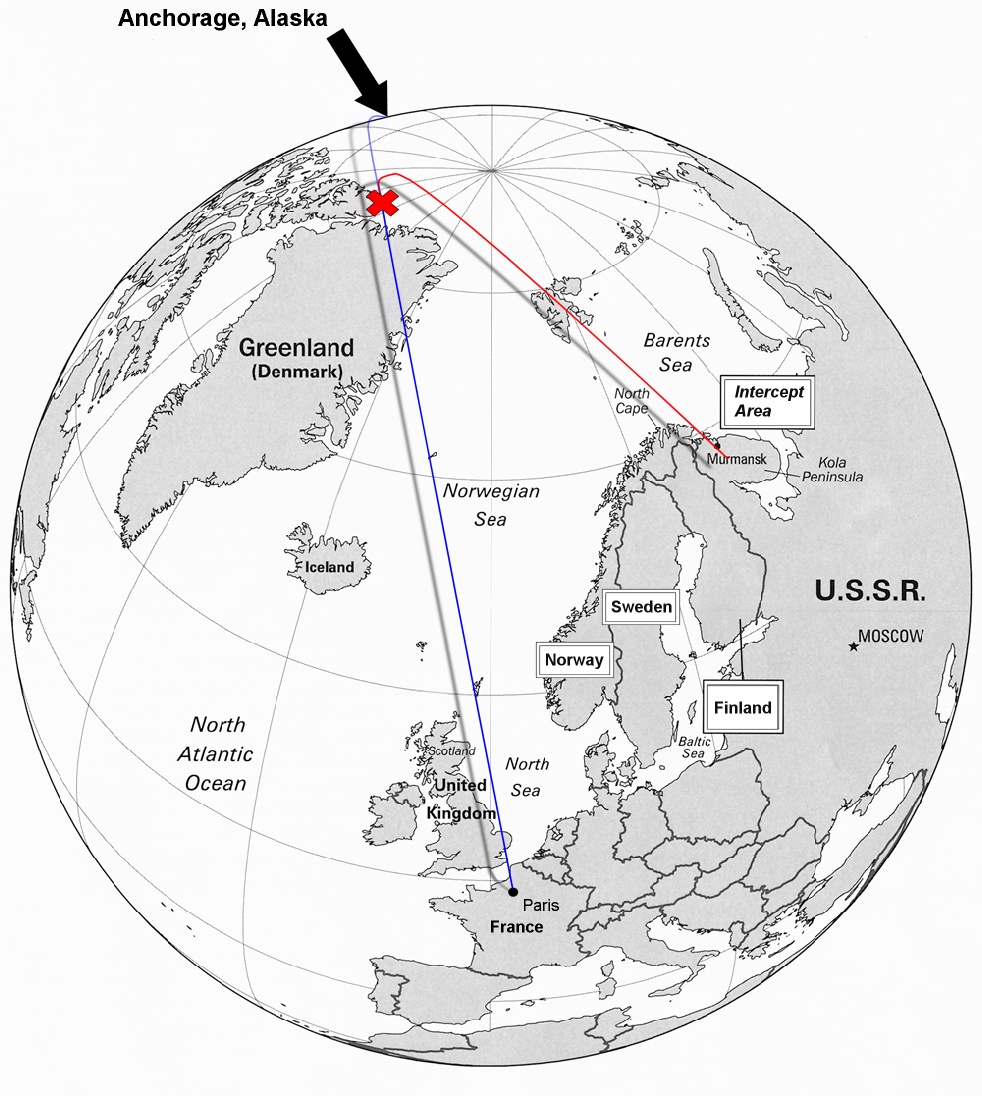
Captain Kim Chang-kyu had a problem he could not explain. His Boeing 707, bound from Paris to Seoul via Anchorage with 109 souls aboard, was supposed to be arcing over the North Pole on the evening of 20 April 1978. Instead, a malfunctioning compass had been quietly dragging the aircraft off course for hours, bending its path from the polar route into some of the most heavily defended airspace on Earth — the Soviet Union's Kola Peninsula, home to the Northern Fleet's nuclear submarine bases.
A Compass Spinning Wrong
Flight 902 departed Paris-Orly at 13:39 local time, crewed by Captain Kim, Co-pilot Cha Soon-do, and Flight Engineer Lee Khun-shik. The route to Seoul via Anchorage threaded close to the magnetic north pole, where compass navigation becomes treacherous — magnetic variation shifts rapidly and instruments can behave erratically. At some point during the transpolar crossing, the aircraft's directional gyro began feeding the crew false headings. Kim would later tell passengers he suspected the navigation equipment was working incorrectly but followed it anyway, trusting the instruments over his instincts. By 21:19, the Boeing had crossed into Soviet airspace over the Kola Peninsula, hundreds of miles from where it should have been. The crew did not know it yet, but they were now flying directly over one of the most sensitive military zones in the Soviet Union.
Wings Waggling in the Dark
Soviet air defense scrambled a Sukhoi Su-15 interceptor, piloted by Alexander Bosov. The international protocol for intercepting a wayward aircraft is precise: approach from the left, waggle your wings, and the target follows you to a designated airfield. Bosov waggled his wings multiple times. According to Captain Kim, however, the interceptor approached from the right side — the wrong side under International Civil Aviation Organization rules — and did not respond to the Korean crew's radio calls. What happened next depends on whose account you trust. Soviet controllers saw KAL 902 make a sharp 90-degree turn toward the Finnish border, which they interpreted as an escape attempt. Bosov radioed Air Defence Command Officer Vladimir Tsarkov, arguing that the plane was not a military threat. Tsarkov, following internal instructions, ordered Bosov to shoot it down.
Shrapnel and a Frozen Lake
Bosov fired. The missile strike tore into the fuselage, killing two passengers — the only fatalities among the 109 people on board. Shrapnel shredded the left wing and punctured the cabin. Captain Kim put the crippled 707 into a steep emergency descent, dropping from cruising altitude while searching for somewhere to set down in the vast, snow-covered wilderness below. According to the diary of one passenger, corroborated by others, an agonizing hour and forty minutes passed between the attack and the landing. Kim brought the Boeing down on the frozen surface of Korpijärvi Lake, a feat of airmanship that saved 107 lives. The survivors stepped out onto ice and snow in one of the most remote corners of Soviet Karelia, with no idea when — or whether — rescue would come.
Captivity and Confession
Soviet authorities evacuated the passengers and held the crew. On 29 April, nine days after the shootdown, Captain Kim and Flight Engineer Lee were released. TASS, the official Soviet news agency, announced that the two men had confessed to violating Soviet airspace and disregarding orders from the intercepting aircraft. The confession carried the unmistakable stamp of coercion — the crew's consistent story, before and after, blamed the malfunctioning compass. Flight Engineer Lee reiterated after his release that the directional gyro had failed. Moscow, meanwhile, refused to cooperate with international investigators and withheld all data from the aircraft's black box. The wreckage was dismantled, its components flown by helicopter to a barge in the Kandalaksha Gulf. Yevgeny Savitsky, deputy chief of Soviet air defense, personally inspected the cockpit — suggesting the military valued intelligence from the aircraft far more than transparency.
A Warning Unheeded
The shootdown of KAL 902 exposed a dangerous gap between Cold War military doctrine and civilian aviation safety. A commercial airliner, identifiable by its size, speed, and transponder, had been destroyed because it wandered into the wrong airspace — and because the chain of command prioritized protocol over judgment. Bosov himself tried to argue for restraint and was overruled. The incident should have been a turning point, a moment when the world's superpowers agreed on clearer rules for intercepting civilian aircraft. It was not. Five years later, on 1 September 1983, Soviet fighters shot down Korean Air Lines Flight 007, another off-course Korean Air Boeing — this time a 747 — over Sakhalin Island, killing all 269 people aboard. The frozen lake where Kim saved his passengers now sits as a quiet reminder of the near-miss that preceded a far greater tragedy.
From the Air
The emergency landing site is at approximately 66.05°N, 33.07°E, on frozen Korpijärvi Lake in Russia's Murmansk Oblast, near the Kola Peninsula. The nearest major airport is Murmansk (ULMM), approximately 120 km to the north. The area remains heavily restricted military airspace due to the Northern Fleet's bases at Severomorsk and Polyarny. From cruising altitude, the landscape is a patchwork of boreal forest, lakes, and tundra. The Kola Peninsula's fjord-cut northern coastline is visible on clear days. Modern flights avoid this corridor; the transpolar routes now used by commercial aviation pass well clear of the area where KAL 902 strayed.