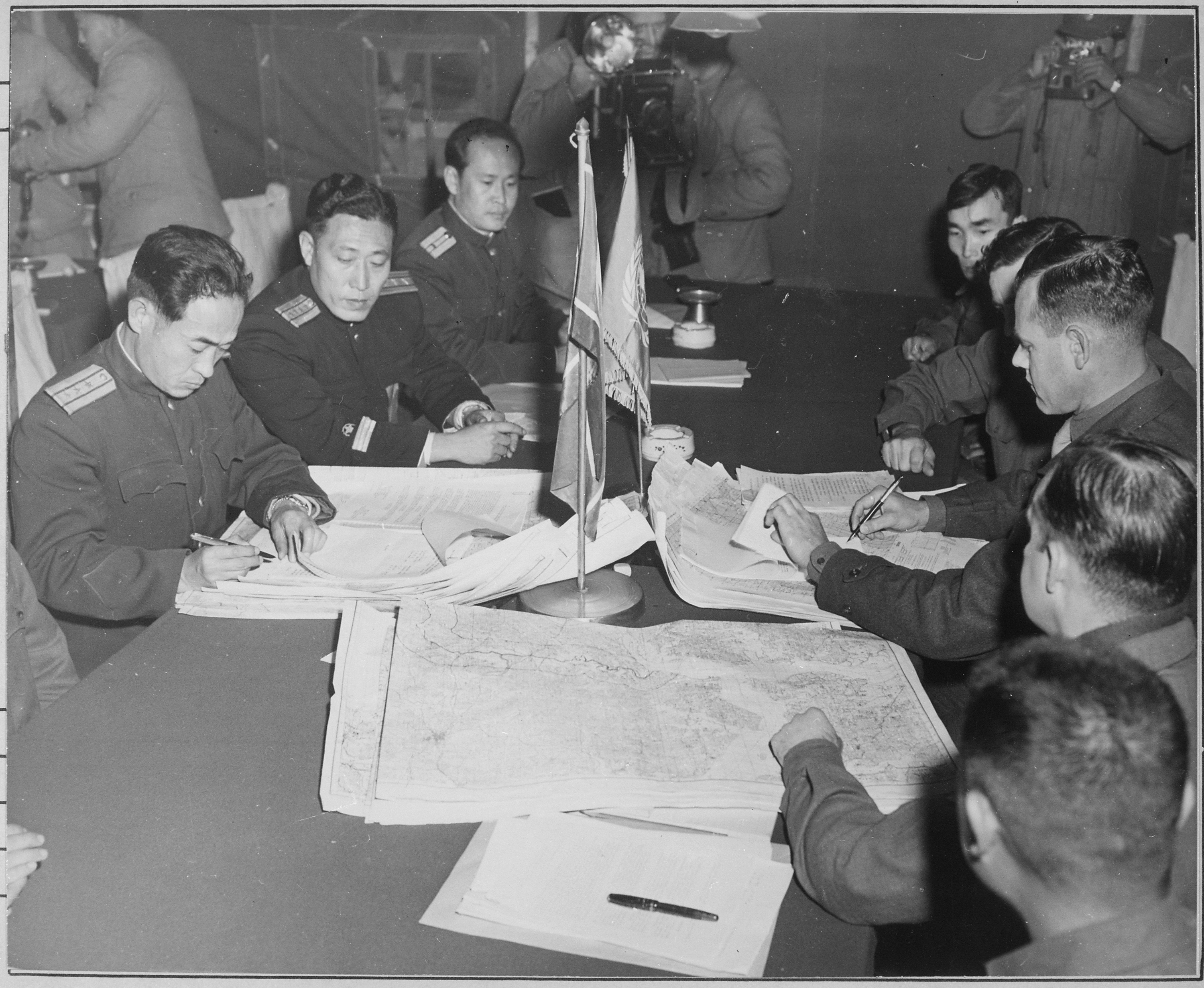
Korean Armistice Agreement
At 10:00 a.m. on July 27, 1953, in a building hastily constructed for the purpose at Panmunjom, delegates signed a document that stopped three years of fighting and started seven decades of waiting. The Korean Armistice Agreement was not a peace treaty. It was designed, in its own words, to "ensure a complete cessation of hostilities and of all acts of armed force in Korea until a final peaceful settlement is achieved." That settlement has never come. South Korea never signed the armistice at all -- President Syngman Rhee refused, unwilling to accept anything short of the unification he had failed to win by force. What remains is the longest-running ceasefire in modern history, governing a border that both sides have repeatedly declared void and then quietly continued to observe.
Two Years of Talking While Fighting
Armistice negotiations began on July 10, 1951, in Kaesong, while soldiers on both sides continued killing and dying. The talks moved to Panmunjom after North Korea claimed -- with evidence that appeared manufactured -- that the original conference site had been bombed. The longest gap between sessions stretched from August to October 1951. Five agenda items were agreed upon: a demarcation line, ceasefire arrangements, prisoner-of-war repatriation, and recommendations to the governments involved. Each item became a battlefield of its own. The most intractable issue was prisoners. The United Nations Command held 150,000; the Communists held 10,000. Many Chinese and North Korean prisoners refused to go home, which Beijing and Pyongyang found unacceptable. It took two years and a Neutral Nations Repatriation Commission, chaired by Indian General K.S. Thimayya, to resolve the impasse.
Deaths That Changed the Calculus
Two deaths broke the deadlock, neither on the battlefield. In March 1953, Joseph Stalin died in Moscow. The new Soviet leadership issued a statement two weeks later calling for a quick end to hostilities -- a shift that surprised even China's Mao Zedong. Meanwhile, newly elected U.S. President Dwight Eisenhower, who had visited Korea in December 1952, reportedly communicated through back channels that the United States might use nuclear weapons if talks did not conclude. Whether the threat was decisive remains debated, but the combination of Soviet pressure and American ultimatum compressed what might have taken years into months. By July 19, 1953, delegates had reached agreement on all five agenda items. Eight days later, the armistice was signed.
Drawing the Line
The armistice created the Korean Demilitarized Zone, a fortified buffer roughly four kilometers wide that follows the Kansas Line -- the actual front line where the two armies faced each other at the time of signing, rather than the 38th parallel that had divided Korea before the war. China and North Korea initially expected the border to return to the 38th parallel, but within weeks they accepted the Kansas Line, which in some places runs well north of the old boundary and in others falls south of it. The DMZ became the most heavily defended national border in the world. The armistice also established the Military Armistice Commission to oversee compliance and the Neutral Nations Supervisory Commission to monitor the agreement from outside. South Korea's refusal to sign left an awkward legal reality: the armistice technically binds the United Nations Command, North Korea, and China, but not the country whose territory it most directly governs.
A Ceasefire Without an Ending
North Korea has declared the armistice void on multiple occasions -- in 2003, 2009, and 2013 -- though the United Nations has maintained that the agreement remains in force regardless of unilateral statements. In 1994, China withdrew from the Military Armistice Commission, leaving North Korea and the UN Command as the only active participants. By 2011, South Korea reported that North Korea had violated the armistice 221 times. In April 2018, Moon Jae-in and Kim Jong Un pledged to replace the armistice with a formal peace treaty. The pledge joined a long list of similar promises that have not materialized. The armistice's genius, if that is the right word, is its deliberate incompleteness. By refusing to settle anything permanently, it created a framework elastic enough to survive seven decades of provocations, violations, and diplomatic failures. The war has not ended. But thanks to a document signed in a temporary building at Panmunjom, neither has the ceasefire.
From the Air
The signing site is located at approximately 37.961N, 126.664E at Panmunjom within the Korean DMZ. The building where the armistice was signed now houses the North Korea Peace Museum on the northern side of the demarcation line. Strict flight restrictions apply throughout the DMZ corridor. Nearest accessible airports: Gimpo International (RKSS, ~50 km south), Incheon International (RKSI). Military installations including Osan Air Base (RKSO) and Kunsan Air Base (RKJK) are in the broader region.