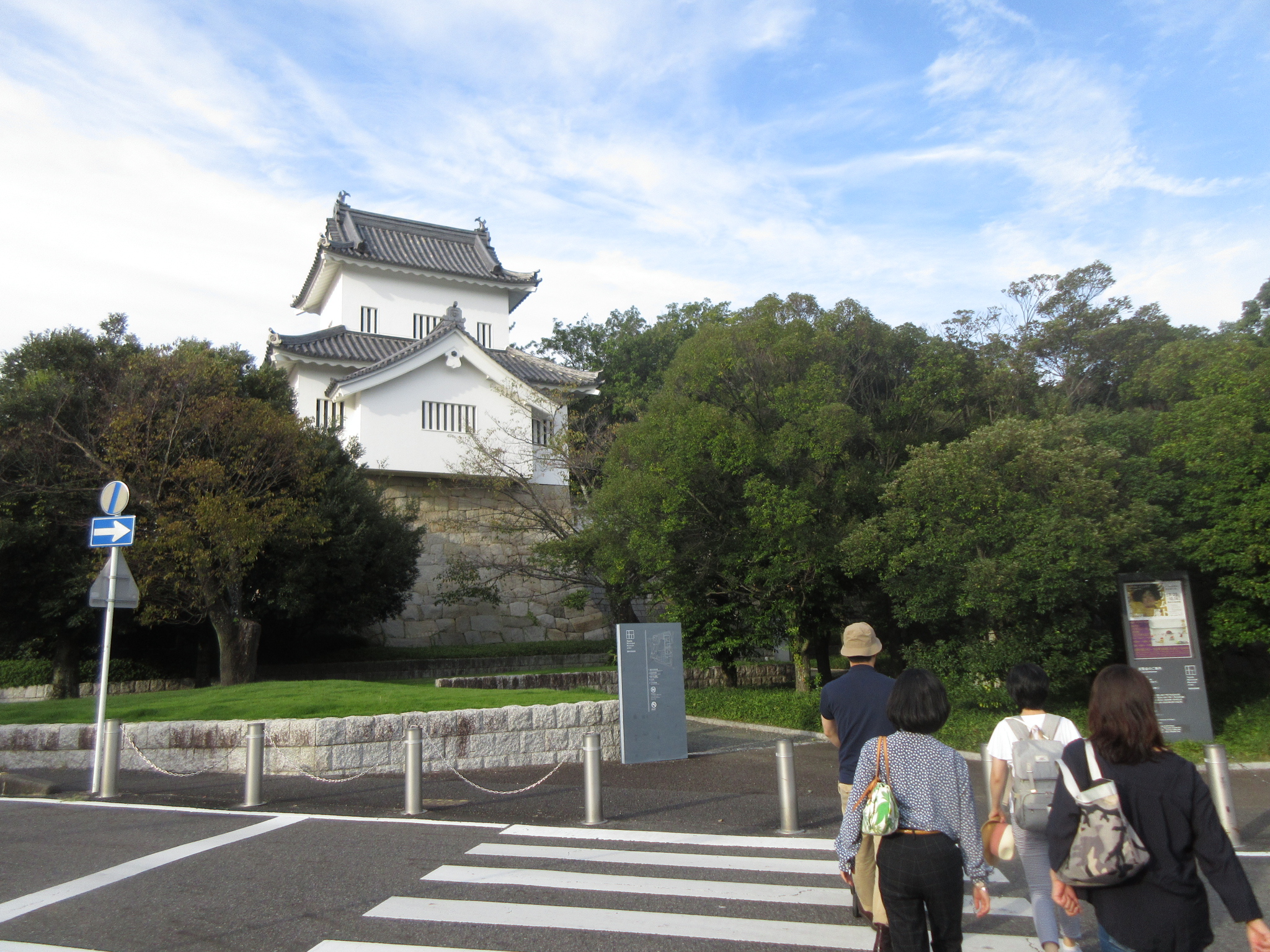
Koromo Castle
They called it Shichishu-jo -- the Castle of Seven Provinces. From the top of its modest donjon, perched on 65-meter Mount Doji in what is now Toyota City, a lord could gaze across Mikawa, Owari, Mino, Shinano, Totomi, Ise, and Omi -- a panorama spanning much of central Honshu. The castle that earned this grand name was itself rather small, a compact fortification completed in the 1780s for a minor daimyo clan. But Koromo Castle's story stretches far deeper than its final form suggests, winding through centuries of clan warfare, political reassignment, and the quiet stubbornness of building what floods and politics tried to prevent.
Contested Ground
Fortifications stood near this site long before the Koromo Castle that survives in memory. During the Kamakura period, a defensive position was established in the area, and through the violent upheaval of the Sengoku period, the land changed hands as the Imagawa clan and the Oda clan clashed for control of Mikawa Province. This was frontier territory, caught between the ambitions of rival warlords whose struggles would eventually produce the unification of Japan. After the Tokugawa shogunate consolidated power at the turn of the seventeenth century, the violence subsided and the Miyake clan -- formerly of Tahara -- were permitted to return to Mikawa with a modest 10,000-koku domain. In 1600, Miyake Yasusada built a jin'ya, a fortified residence, roughly a kilometer from the old defensive site. He planted sakura trees all around it, and the residence earned the affectionate nickname of the Cherry Blossom Fortress.
A Castle Born from Flooding
The castle that gave Mount Doji its place in history came about through bureaucratic transfer and natural disaster. In 1749, the Naito clan received control of Koromo Domain when Naito Masamitsu was reassigned from Kozuke Province. His rank entitled him to build a proper castle rather than merely inhabit a jin'ya, and the shogunate even financed the construction. The original plan called for a castle in what is now central Toyota, but the Yahagi River had other ideas -- repeated flooding destroyed the construction site and forced the project's abandonment. Undeterred, Masamitsu chose Mount Doji instead, and by 1782 he had erected a small-scaled donjon with two yagura watchtowers and several gated approaches. The Yasaku River protected one flank naturally. The castle was finally completed in 1785, and it was from this hilltop perch that the famous seven-province view inspired the castle's enduring name.
From Fortress to Parkland
The Naito clan held Koromo Castle through the final decades of the Edo period, a time of increasing tension between the shogunate and the forces pressing for imperial restoration. When the Meiji Restoration swept away the feudal order in 1868, the castle's military purpose evaporated. By 1871, all buildings had been demolished. The hilltop that once commanded seven provinces was given over to more peaceful uses -- first a high school, then parkland and eventually the Toyota Municipal Museum of Art, which now occupies the slopes below the former castle grounds. A remnant of the original moat can still be traced, a grassy depression that hints at the fortification's former footprint. The corner yagura that stands today is a 1978 reconstruction, a concrete echo of what Masamitsu built from timber and stone two centuries earlier. It serves as the castle's most recognizable visual landmark, a three-story tower rising above the trees.
The Name Beneath the Name
There is an irony in Koromo Castle's setting that deepens with time. The town of Koromo -- whose name meant "garment," reflecting the region's textile heritage -- was renamed Toyota in 1959 after the automobile company that had transformed the local economy. The castle that once defined this hilltop now shares its neighborhood with corporate headquarters and factory complexes. Yet the old stone walls remain, and the reconstructed yagura still catches the afternoon light in a way that no office building quite manages. The seven-province view that awed Naito Masamitsu has been partly obscured by modern development, but on clear days, the surrounding mountains still frame a horizon that stretches deep into central Japan. Koromo Castle is a reminder that Toyota City had a history long before it had an assembly line.
From the Air
Located at 35.08N, 137.15E on 65-meter Mount Doji in central Toyota City, Aichi Prefecture. The reconstructed corner yagura (watchtower) is the most visible landmark, a three-story structure rising above the wooded hilltop. The Toyota Municipal Museum of Art complex sits immediately adjacent on the hillside. The surrounding urban landscape of Toyota City provides contrast to the green hilltop. Nearest airports: Chubu Centrair International Airport (RJGG) approximately 55km to the southwest, Nagoya Komaki Airport (RJNA) about 40km northwest. The Yahagi River system is visible to the west and south. The castle site is in a densely developed urban area, so look for the wooded hilltop park amid the city grid.