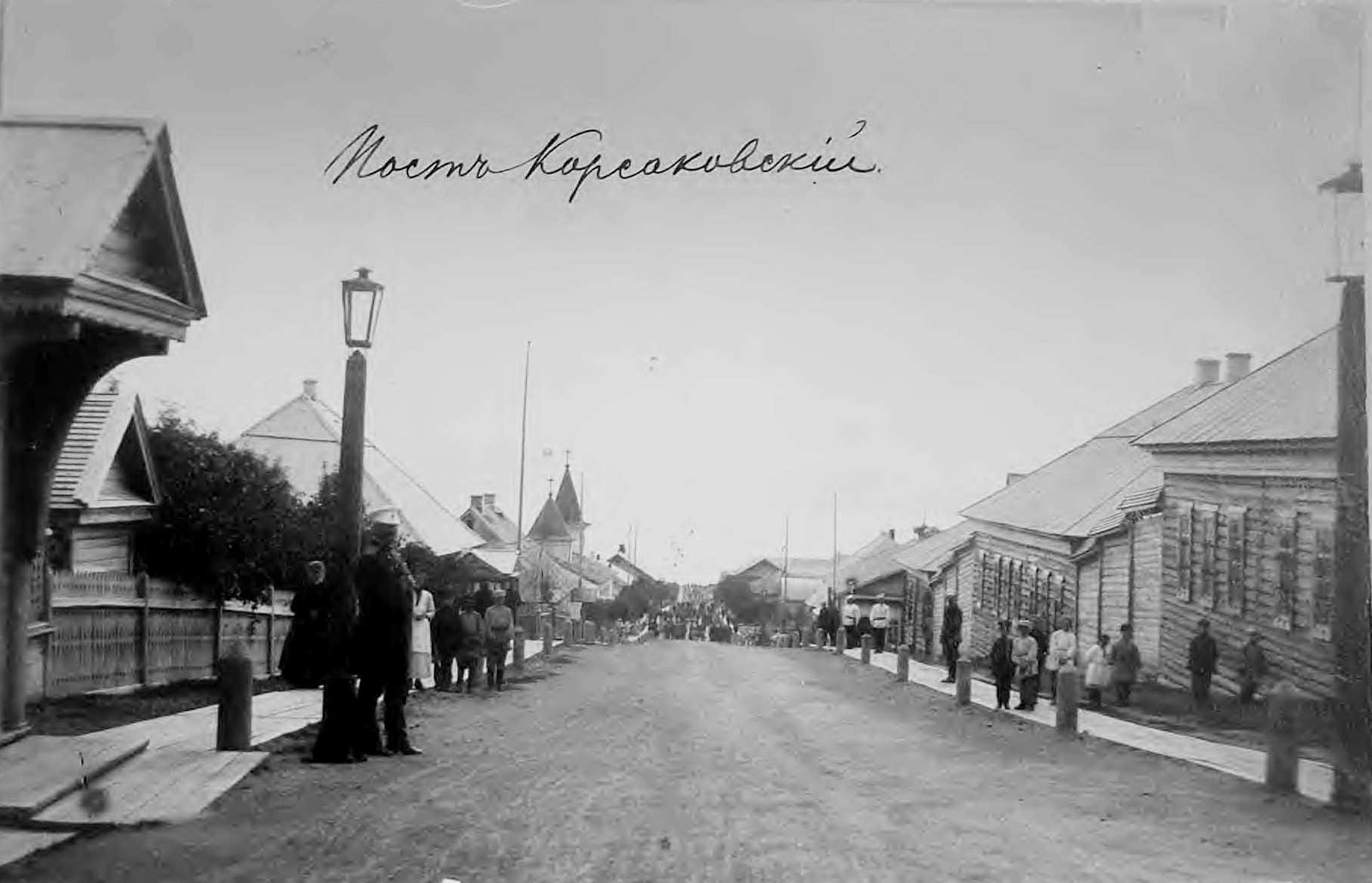
Korsakov
In 1897, the population records for Korsakov showed 1,510 men and 192 women. The imbalance was not a mystery -- this was a prison town. The men were inmates and their keepers on an island the Russian Empire used as a dumping ground for political dissidents, criminals, and anyone else it wanted to forget. Today, Korsakov is a quiet port of about 33,000 people on the southern tip of Sakhalin, still haunted by the demographic echoes of that penal past and the three flags that have flown over it in less than two centuries.
Before the Flags
Long before Russia or Japan claimed Korsakov, the site was home to an Ainu fishing village called Kushunkotan. Traders from the Matsumae clan on Hokkaido had been visiting since at least 1790, conducting commerce with the indigenous people who had lived along these shores for centuries. On September 22, 1853, a Russian expedition under Captain Gennady Nevelskoy landed, raised the Russian flag, and renamed the settlement Fort Muravyovsky after the Governor-General of Eastern Siberia. Nevelskoy encountered a predominantly Ainu population of at least 300 to 600 people. The Russians abandoned the settlement the following year when the Crimean War raised fears of an Anglo-French naval attack, but returned in 1869 and rechristened it Fort Korsakovsky, after the new Governor-General, Mikhail Korsakov.
Colonial Ping-Pong
Korsakov's fate has been decided by treaties signed in distant capitals. After the Russo-Japanese War, the 1905 Treaty of Portsmouth handed southern Sakhalin to Japan, and Korsakov became Odomari, a port in Karafuto Prefecture linked by rail to Toyohara, the colonial capital. The Japanese built sake factories, fish processing plants, a salt extraction facility, and timber mills. A ferry service connected the port to Wakkanai on Hokkaido, integrating Korsakov into Japan's national rail network. When Soviet forces reclaimed the island in August 1945, they inherited this Japanese infrastructure and a population that included Korean laborers deported by the Japanese in the 1930s. The Soviets renamed the town once more, back to Korsakov, and converted it into a base for the Far Eastern fishing fleet.
Crab, Cash, and Collapse
Through the Cold War decades, Korsakov thrived as a fishing port. Its population peaked at just over 45,000 in the late 1980s. Then the Soviet Union collapsed, and the institutional fishing fleet -- the Base for Ocean Shipping, known as BOR -- went bankrupt. Thousands of fishermen who had worked the regulated fleet shifted to private companies operating small boats close to shore, often without licenses. Their primary catch was crab, sold for hard currency in Wakkanai. In return, they bought Japanese electronics and used cars. This semi-illicit barter economy injected cash into Korsakov but also fueled organized crime. The town's cardboard box factory, a relic of the Japanese era identifiable by its tall chimney, went bankrupt too. The chimney still stands, no longer belching smoke, a monument to an economy that evaporated.
The Port at the End of the Line
Today, Korsakov is the closest town to the massive Sakhalin-2 liquefied natural gas plant, one of the largest energy projects in Russia's Far East. A seasonal ferry runs to Wakkanai between June and September, and the old narrow-gauge Japanese railway still traces the scenic coastline with sporadic service. The town museum documents frontier history and the Japanese occupation, while the market on Sovetskaya Street sells strawberries in summer and Korean kimchi and paporotnik year-round -- culinary evidence of the ethnic Korean minority that has been part of Korsakov's fabric since the 1930s. The town has produced Olympians, too: fencer Alexander Romankov won five medals across three Games, and swimmer Georgi Kulikov competed in 1968 and 1972. For a place that started as a fishing village, became a prison, became a colony, and became a port, Korsakov carries its layered history with a roughness that feels honest rather than charming.
From the Air
Located at 46.63°N, 142.77°E on the southern coast of Sakhalin Island, on Aniva Bay. The port is visible from altitude as a harbor settlement on the bay's western shore. Nearest airport is Yuzhno-Sakhalinsk (UHSS), approximately 30 km to the north. The LNG plant at Prigorodnoye is visible to the south along the coast. The narrow-gauge railway line following the coastline is a distinctive feature from moderate altitudes.