Kota Formation
Somewhere beneath the red soil of Telangana, roughly 200 million years ago, a freshwater lake teemed with coelacanths. These ancient fish, often called living fossils, swam alongside sharks and gar-like predators in warm shallows bordered by alluvial fans. The Kota Formation preserves this vanished world in limestone and sandstone layers up to 590 meters thick, stretching across the Pranhita-Godavari Valley of peninsular India. It is one of the subcontinent's richest windows into Jurassic life, a place where paleontologists have unearthed not only fish and insects but some of India's earliest known dinosaurs and mammals.
Gondwana's Hidden Lake
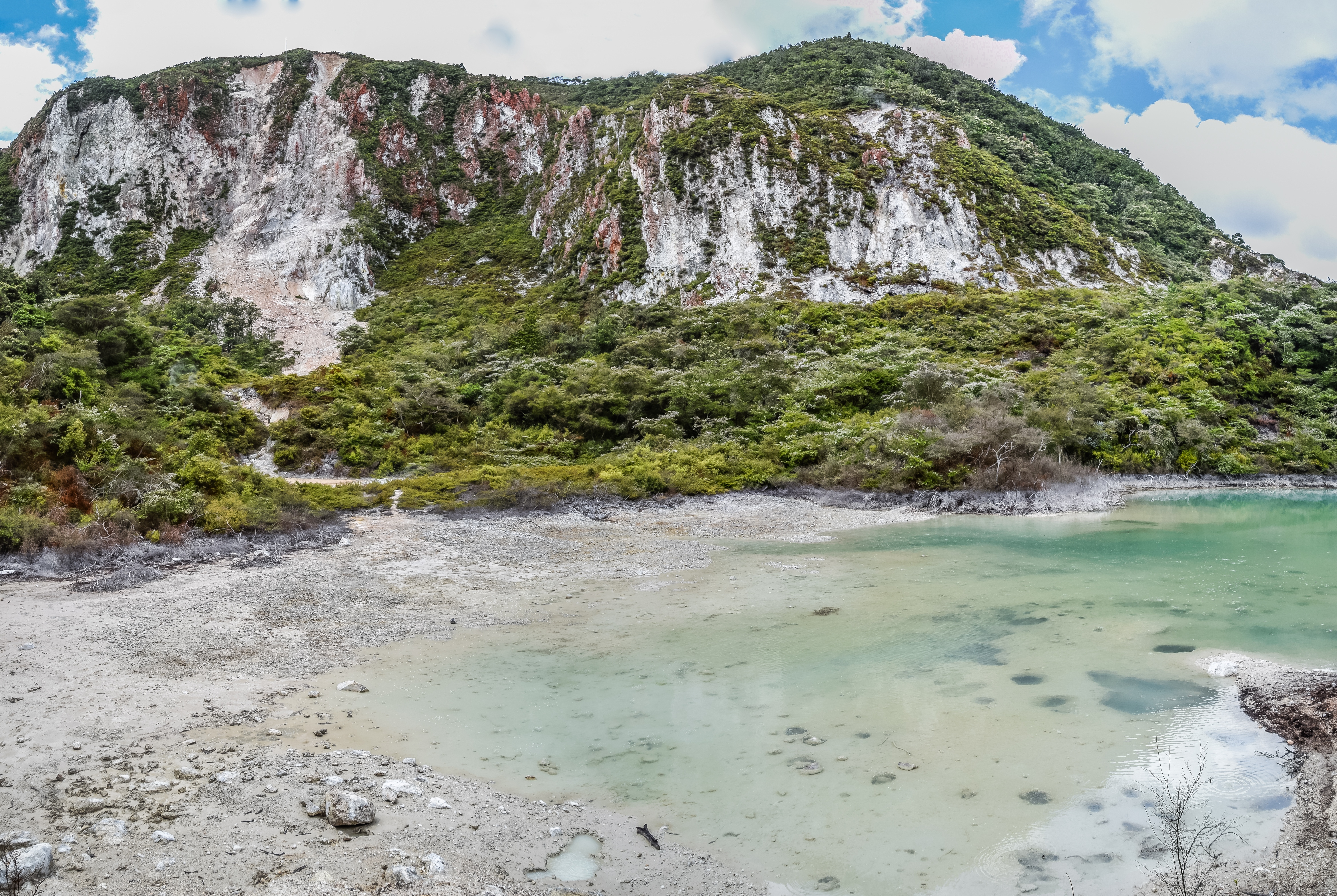
During the Early Jurassic, India was still locked into the supercontinent Gondwana, and the Pranhita-Godavari basin was an active continental rift slowly pulling apart. The Kota Formation records the sediments that filled this rift: mudstones from floodplains, sandstones from rivers, and a distinctive band of freshwater limestone near the base of the upper unit, deposited in a carbonate wetland. Iron-oxidizing microbes cemented the sediment, and when seasonal floods washed through, they carried iron-rich coatings into deeper water. Freshwater bivalves thrived in these alkaline shallows, in conditions strikingly similar to modern geothermal pools in New Zealand. Stromatolites and oncolites, the layered structures built by cyanobacteria, grew in the quieter margins, recording some of the oldest known freshwater algal deposits on the Indian subcontinent.
A Bestiary in Stone
The formation's fossil catalogue reads like a census of Jurassic life. Indocoelacanthus robustus, a freshwater coelacanth measuring up to 70 centimeters, is the largest animal found here and belongs to the same family as the famous Latimeria, which still survives in the Indian Ocean. Freshwater sharks of the genus Lonchidion patrolled these waters alongside gar-like Lepidotes and the disc-shaped Paradapedium. Above the waterline, cockroaches, crickets, and flies left their wings in the sediment. The formation has yielded specimens of Protogryllus lakshmi, one of the oldest crickets known from Gondwana, and Taschigatra, a genus of snipe flies found nowhere else on Earth. Even the tiny ostracod crustaceans tell a story: the genus Darwinula, dominant here in both river and lake sediments, is an ancient lineage that still exists today.
Where Dinosaurs Met Their First Mammals
The Kota Formation is one of the few places on Earth where Early Jurassic dinosaurs and mammals have been found together. Kotasaurus yamanpalliensis, a primitive nine-meter sauropod discovered at Yamanapalli village, is among the most basal sauropods known. Remains of at least twelve individuals have been recovered, and a 2024 study identified possible tail clubs among the nearly 400 bones collected. Alongside these giants, paleontologists have found the teeth and jaws of some of the world's earliest mammals, including Kotatherium, a tiny shrew-like creature from the family Kuehneotheriidae, and Indobaatar, described as a possible multituberculate. The genus Dyskritodon, known otherwise only from the Early Cretaceous of Morocco, has complicated dating efforts. If the identification holds, it would push the upper age of the formation forward by tens of millions of years.
A Puzzle of Deep Time
The Kota Formation's age remains one of Indian paleontology's persistent debates. Most researchers place it in the Early Jurassic, around 190 to 180 million years ago, constrained by the Hettangian or Sinemurian age of the underlying Dharmaram Formation. But palynological studies by Vijaya and Prasad in 2001 argued for a much broader range, from the Middle Jurassic Callovian to the Early Cretaceous Barremian. The Moroccan connection through Dyskritodon, proposed by Prasad and Manhas in 2002, further muddied the picture. What is not in dispute is the formation's importance: it records a critical moment when Gondwana was fragmenting, when the ancestors of modern mammals were diversifying, and when sauropod dinosaurs were beginning the evolutionary journey toward becoming the largest animals ever to walk the Earth.
Reading the Rocks Today
The Kota Formation outcrops along limestone ridges near the villages of Boraigudem, Kota, and Paikasigudem in what is now Telangana state. The terrain is gently rolling, with red laterite soils giving way to pale limestone exposures along stream cuts. At Paikasigudem, the Upper Member's bone beds have produced the richest mammal assemblages, yielding tooth after tiny tooth to patient fieldwork. The formation's remoteness has been both a blessing and a challenge. It has protected the sites from commercial quarrying, but it has also limited the kind of large-scale excavation that might reveal complete skeletons. For now, the Kota Formation continues to yield its secrets slowly, one fragment of Jurassic India at a time.
From the Air
Located at approximately 18.9°N, 80.0°E in the Pranhita-Godavari Valley of Telangana, central India. The formation outcrops along low limestone ridges and stream cuts in gently rolling terrain. Nearest airport is Warangal (VOWA) approximately 200 km to the southwest; Hyderabad (VOHS) is about 300 km south. The red laterite soils and pale limestone exposures may be visible at lower altitudes. Best viewed below 5,000 feet in clear conditions.