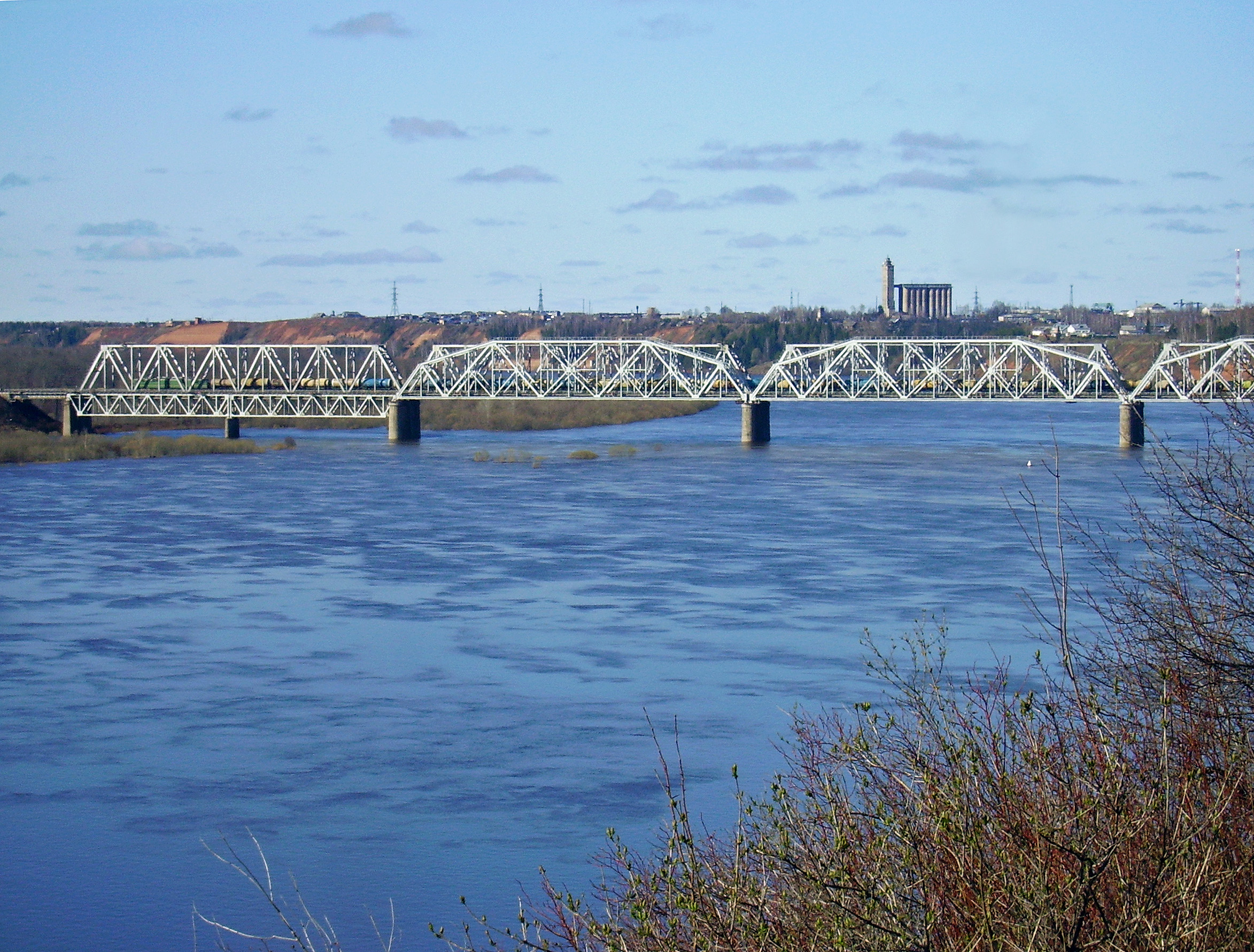
Kotelnich
Most passengers on the Trans-Siberian Railway see Kotelnich for exactly as long as it takes the train to stop and start again. A platform, a station building that looks better from inside than outside, and then the town slides past the window and disappears into the Kirov Oblast countryside. Those who actually step off the train discover something unexpected: a small city of roughly 20,000 people that sits on dinosaur bones, was rebuilt from ashes in the Soviet Constructivist style, and has been holding a trade fair since the tsars ruled Russia.
Chronicles and Commerce
Kotelnich first appears in written records in 1459, though settlement along this stretch of the Vyatka River almost certainly predates the chronicles. The town's early identity was shaped by trade. The Alexeyevskaya Fair, held annually, drew merchants from across the region for nearly 300 years, lasting until the mid-19th century when changing trade routes and the rise of industrial commerce diminished its relevance. A revived version of the fair still takes place each March, more cultural festival than commercial exchange, but the tradition itself is remarkable -- few Russian towns of Kotelnich's size can claim a continuously remembered market tradition spanning half a millennium. The town's location at the Vyatka made it a natural gathering point long before the railway arrived to confirm its significance as a crossroads.
Where the Trans-Siberian Branches
In the early 20th century, the railway transformed Kotelnich from a river town into a junction. Two branches of the Trans-Siberian Railway converge here -- one from Nizhny Novgorod, the other from Yaroslavl -- before continuing east toward Kirov, Perm, Ekaterinburg, and the vast distances of Siberia. Kotelnich-1, the main station a kilometer north of the town center, handles both long-distance and local trains. The journey from Moscow takes 13 to 15 hours, from Saint Petersburg 19 to 20, from Kirov just an hour or so. Kotelnich-2 exists but barely functions, serving only infrequent local trains toward Nizhny Novgorod. For a town this small to sit at the junction of two transcontinental rail lines gives it an outsized role in Russia's transportation geography, even if most through-passengers never notice.
Ashes and Angles
Walk through Kotelnich today and you are walking through the aftermath of a catastrophe. In 1926, a fire swept through the town and leveled nearly every wooden building -- which, in a Russian town of that era, meant nearly every building period. What rose from the ashes was not a reconstruction but a reimagining. The Soviet authorities rebuilt Kotelnich in the Constructivist style of the 1920s, producing a streetscape of minuscule geometric buildings that remain easily recognizable a century later. The department store at 103 Sovetskaya Street and the post office at 90 Karla Marksa Street are among the best-preserved examples. Along Sovetskaya, Lenina, and Oktyabrskaya streets, a few 19th-century buildings that survived the fire stand alongside their angular Soviet successors, creating an architectural timeline that spans from imperial Russia to revolutionary modernity in the space of a single block.
Bones Along the Vyatka
Kotelnich's most improbable attraction lies along the banks of the Vyatka River, where excavations have unearthed pareiasaur fossils -- large, herbivorous reptiles from the Permian period, roughly 260 million years ago. These are not dinosaurs in the strict sense, but the town's paleontology museum does not let taxonomic precision diminish the spectacle. Skeletons of these ancient creatures are displayed alongside other finds from the riverbank excavations, making Kotelnich one of the few small towns in Russia where you can step off a Trans-Siberian train and stand face-to-face with a creature that predates the dinosaurs by tens of millions of years. The Vyatka's erosion continues to expose new fossils, and the excavation sites remain active. A dinosaur park in town offers life-sized models for visitors who prefer their prehistoric reptiles with a bit more flesh on the bones.
From the Air
Located at 58.31°N, 48.35°E on the Vyatka River in Kirov Oblast, Russia. Kotelnich is visible as a compact town at the confluence of railway lines -- the junction of two Trans-Siberian branches is clearly identifiable from altitude. Nearest significant airport is Kirov (Pobedilovo), ICAO: USKK, approximately 120 km east-northeast. The Vyatka River meanders prominently through and past the town. At 3,000-5,000 ft AGL, the railway junction geometry and river are the key visual landmarks. Terrain is flat river valley surrounded by mixed forest.