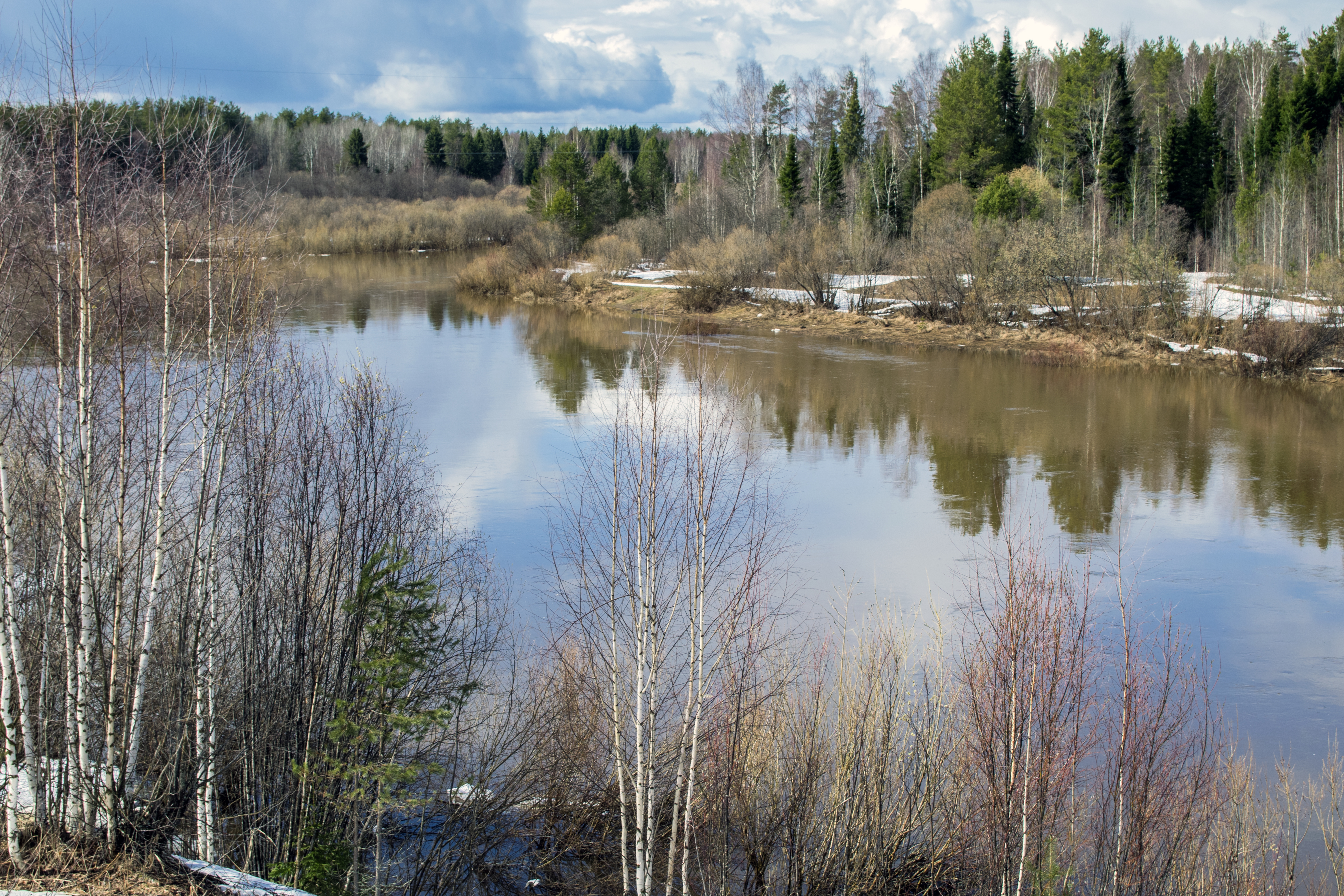
Koygorodsky National Park
Somewhere in the Komi Republic, 900 kilometers northeast of Moscow, there exists a forest that has never been logged. No roads cut through it. No stumps interrupt the carpet of fern and moss. The spruce trees here have grown for centuries in unbroken succession, their canopy so dense that the forest floor exists in permanent twilight. Koygorodsky National Park, established in 2019, protects one of the last great expanses of virgin southern taiga remaining anywhere in Europe — a landscape so flat and so saturated with water that rivers here cannot decide which ocean to seek.
A Continental Divide in Miniature
The terrain at Koygorodsky barely qualifies as terrain at all. The highest and lowest points within the park differ by only 50 meters, creating a nearly level expanse of meandering floodplains and waterlogged ground. Because precipitation consistently exceeds evaporation, water collects everywhere — pooling in bogs, threading through mossy channels, feeding a network of rivers and lakes that spread across the landscape like capillaries. What makes this seemingly monotonous topography remarkable is the continental divide that runs through it. The Sedka River flows north from the park, its water eventually reaching the White Sea and the Arctic Ocean. Other small rivers drain south into tributaries of the Caspian Sea. Standing in Koygorodsky, you stand on a watershed between two of the world's great drainage basins, though nothing in the flat, sodden ground suggests anything so dramatic.
Forests That Remember the Ice Age
The old-growth fern-green moss spruce forests of Koygorodsky are the park's defining feature, and they are exceedingly rare. This particular type of taiga — dark, dense, draped in moss and fern — develops only where human activity has been absent for very long periods. Logging, fire, or even sustained grazing resets the clock, replacing these ancient stands with younger, simpler ecosystems that take centuries to recover their former complexity. The park also harbors extensive old-growth aspen groves, their white trunks a striking contrast to the dark spruce. Together, these forests represent what much of northeastern Europe looked like before human settlement pressed northward. The park sits on the southern edge of the Komi Republic, bordering Kirov Oblast, and it adjoins the Nurgush-Tulashor nature reserve, which extends the protected zone considerably. Within the broader Scandinavian and Russian taiga ecoregion, the climate is subarctic — only one to three months above 10 degrees Celsius, with long, cold, snowy winters.
Wings, Fur, and Cold-Blooded Survivors
For a place with no settlements and almost no human presence, Koygorodsky teems with life. Scientists who began field inventories in 2021 have documented 118 species of birds within the park, 14 of which carry conservation designations ranging from near-threatened to critically endangered. Among them is the yellow-breasted bunting, a small songbird whose populations have collapsed across much of its range, and the greater spotted eagle, classified as vulnerable globally. Mammals of note include the Eurasian otter, which hunts the park's abundant waterways, and the pond bat, a species rarely encountered this far north. Perhaps the most unexpected resident is the Siberian salamander, a cold-blooded creature capable of surviving temperatures that would kill most amphibians. It thrives in the park's wet, boggy terrain, a living relic of the same harsh conditions that have preserved these forests from the chainsaw.
The Youngest Park in Old Country
Koygorodsky was formally established as a national park by Russian federal decree in December 2019, making it one of the newest protected areas in a country that spans eleven time zones. By 2021, scientific teams were actively working to catalog what exactly the park contains — a task complicated by the sheer remoteness of the area and the difficulty of moving through saturated, trackless forest. The park's youth as a legal entity belies the age of what it protects. These forests have persisted through centuries of Russian expansion, survived the Soviet era's appetite for timber, and outlasted the economic pressures of the post-Soviet period. Their survival owes less to deliberate conservation than to geography: the park lies in a region so flat, so wet, and so far from major population centers that exploiting it was never quite worth the effort. Now, that accidental preservation has become intentional.
From the Air
Located at 59.80°N, 49.80°E on the East European Plain in the Komi Republic, Russia. The park sits on the border with Kirov Oblast. Terrain is extremely flat with dense taiga canopy visible as unbroken dark green forest from altitude. Nearest significant airport is Syktyvkar (UUYY), approximately 200 km to the north. Best viewed at moderate altitude where the contrast between the virgin forest and surrounding managed landscape is apparent. The continental divide between Arctic and Caspian drainage basins is invisible from the air but runs through the park.