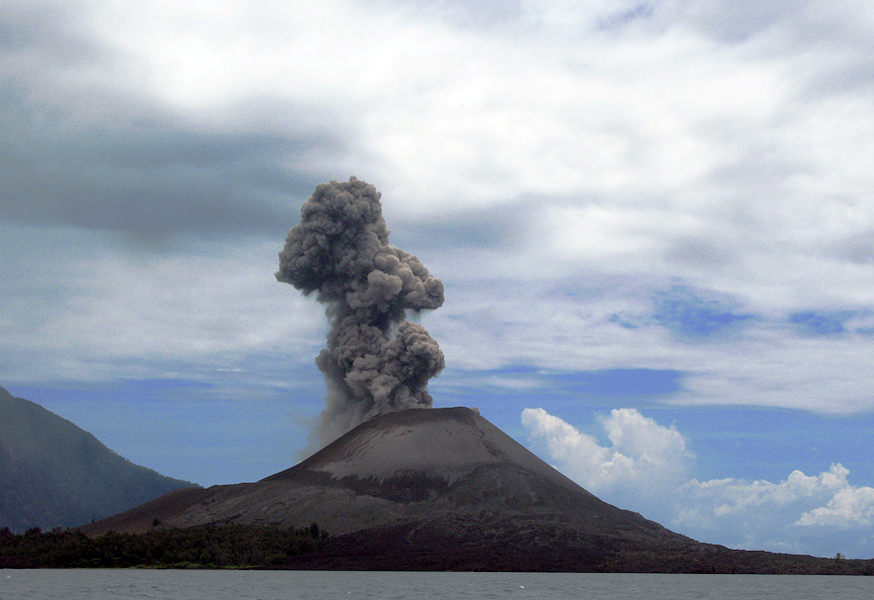
Krakatoa: The Eruption Heard Around the World
On August 27, 1883, the volcanic island of Krakatoa in the Sunda Strait between Java and Sumatra exploded with a force equivalent to 200 megatons of TNT - four times the largest nuclear bomb ever tested. The eruption was heard 3,000 miles away in Australia. The pressure wave circled the Earth seven times. Tsunamis reaching 120 feet high killed over 36,000 people on nearby coasts. Volcanic ash darkened skies for days. And for years afterward, the particles lofted into the stratosphere colored sunsets blood red across the world - effects so vivid that they may have inspired Edvard Munch's 'The Scream.'
The Explosion
Krakatoa had been rumbling since May 1883, but nothing prepared the region for what happened that August morning. At 10:02 AM local time, the volcano produced the loudest sound in recorded history - a detonation audible across 10 percent of the Earth's surface. People in Australia, 2,000 miles away, heard what they thought was distant cannon fire. In Rodrigues Island, 3,000 miles across the Indian Ocean, the sound was still audible.
The explosion was so violent that two-thirds of the island collapsed into the emptied magma chamber below, forming a 4-mile-wide underwater caldera. The collapse generated tsunamis that swept across the Sunda Strait. Coastal towns on Java and Sumatra were obliterated. Ships at sea were tossed onto land. The colonial administration recorded 36,417 dead, though the true count may have been higher.
The Global Effects
Krakatoa's eruption pumped 25 cubic kilometers of rock and ash into the atmosphere, reaching heights of 50 miles. Fine particles spread around the world, creating spectacular optical effects that lasted for years. Sunsets turned brilliant red and orange. The sun and moon appeared blue and green. Global temperatures dropped by an average of 1.2 degrees Celsius.
The pressure wave from the explosion was recorded on barographs worldwide, circling the globe multiple times over five days. Tidal gauges as far away as the English Channel registered the sea-level disturbance. Krakatoa became the first global event recorded instrumentally across the planet.
The Science
Krakatoa's eruption became a founding event for modern volcanology. The Royal Society of London compiled a massive report analyzing data from around the world - the first comprehensive study of a volcanic event's global effects. Scientists learned how ash clouds behave in the stratosphere, how pressure waves propagate, how tsunamis form and travel.
The eruption also demonstrated how interconnected the Earth system is. Particles from one island affected weather patterns, crop yields, and visual phenomena worldwide. Krakatoa was a lesson in global consequences from local events - a lesson that would find new relevance in the age of climate change.
Anak Krakatau
Krakatoa itself was largely destroyed in 1883, but the volcano didn't die. In 1927, a new volcanic cone emerged from the caldera - Anak Krakatau, 'Child of Krakatoa.' The new island has been growing ever since, currently reaching about 400 meters above sea level, its frequent eruptions a reminder that the forces beneath remain active.
In December 2018, a flank of Anak Krakatau collapsed into the sea during an eruption, generating a tsunami that killed over 400 people on the coasts of Java and Sumatra - an echo of 1883's devastation. The child is following in its parent's destructive footsteps.
Krakatoa in Culture
Krakatoa became a byword for catastrophic destruction, entering popular culture in ways few geological events have. The phrase 'east of Krakatoa' (or west - Hollywood got the geography wrong in its 1969 film title) became shorthand for the exotic and dangerous. The 1883 eruption inspired novels, paintings, and scientific inquiry.
Most intriguingly, the blood-red skies of 1883-1884 may have influenced art. Edvard Munch's 'The Scream' depicts a figure against a sky of swirling reds and oranges. Munch created the work in 1893, a decade after the eruption, but the skies he saw in Norway in the years following Krakatoa were exactly as he painted them. The scream may have begun with a volcano.
From the Air
Krakatoa (6.10S, 105.42E) lies in the Sunda Strait between Java and Sumatra in Indonesia. The nearest airports are Soekarno-Hatta International (WIII/CGK) in Jakarta, 150km east, and Sultan Mahmud Badaruddin II (WIPP/PLM) in Palembang. Anak Krakatau (the current active cone) is visible as a volcanic island with frequent activity. The original Krakatoa's remnants form a crescent of islands around the caldera. The strait is heavily trafficked by shipping. Weather is tropical - hot and humid year-round with monsoon patterns.