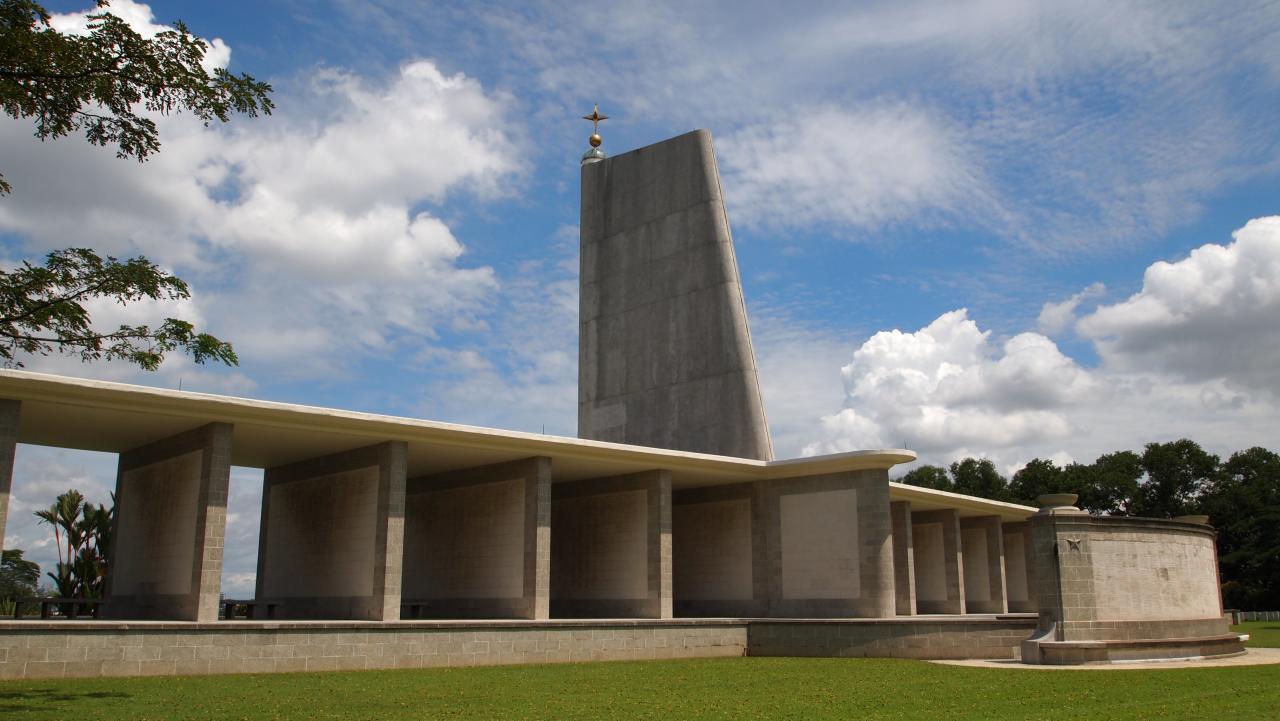
Kranji War Cemetery
More than 850 of the headstones carry no name. They read simply: "A Soldier of the 1939-1945 War, Known Unto God." On a quiet hillside in Kranji, northern Singapore, these unnamed dead lie alongside thousands of identified servicemen from Britain, Australia, India, Canada, New Zealand, and Malaya -- soldiers, sailors, and airmen who fought and died during the Battle of Singapore and the brutal Japanese occupation that followed. The cemetery is manicured and still, a place where tropical heat gives way to the particular hush that settles over ground consecrated by loss.
From Ammunition Dump to Sacred Ground
Before the war, Kranji was a military camp with an ammunition magazine. When Singapore fell to the Japanese 25th Army in February 1942, the occupiers established a prisoner-of-war camp here and a hospital nearby at Woodlands. The dead accumulated in a small burial ground. After Japan's surrender in 1945, British authorities faced a grim logistical challenge: Allied graves were scattered across the island in makeshift cemeteries at Buona Vista, Changi, and other locations. In 1946, the decision was made to consolidate them all at Kranji. Bodies were exhumed and transported across Singapore, and the modest wartime burial ground was expanded into a permanent war cemetery, its rows of white headstones climbing the hillside in careful, symmetrical lines.
Names Carved in Stone
Adjacent to the cemetery stands the Singapore Memorial, designed by architect Colin St Clair Oakes. Its 12 columns carry over 24,000 names on both sides -- Allied soldiers, sailors, and airmen whose remains were never recovered. The memorial's unveiling on 2 March 1957 was performed by Sir Robert Black, himself a former prisoner of war under the Japanese, who by then served as Singapore's Governor and Commander-in-Chief. The structure also houses several subsidiary memorials, each addressing a different dimension of wartime death. The Cremation Memorial honors nearly 800 casualties, mostly from undivided India, whose remains were cremated in accordance with Hindu tradition. The Civil Hospital Grave Memorial marks a mass grave of over 400 civilians and servicemen who died in the final chaotic days of the occupation and were buried together -- too intermingled to ever identify individually.
The Weight of Numbers
The cemetery holds 4,461 World War II burials, but the full scope of commemoration extends far beyond the graves themselves. There are 64 headstones from World War I, including special memorials for three men buried in civil cemeteries in Singapore and Saigon whose graves could never be relocated. The Unmaintainable Graves Memorial accounts for over 250 troops killed across British Malaya whose burial sites were known but could not be maintained, and whose remains could not be moved due to religious reasons. A separate Chinese Memorial marks a mass grave for 69 Chinese servicemen who served with Commonwealth forces and were killed at the start of the Japanese occupation in February 1942. Each memorial addresses a different failure of war to respect the dead -- bodies lost, graves inaccessible, identities erased.
The Living and the Dead
Kranji is not frozen in time. In 2016, the remains of 32 people interred at Terendak Camp in Malaysia, along with one Vietnam War soldier buried at Kranji, were repatriated to Australia aboard two Royal Australian Air Force C-17 transport aircraft, landing at RAAF Base Richmond. The Commonwealth War Graves Commission maintains the grounds year-round, and Remembrance Day ceremonies still draw military honor guards and diplomatic delegations. Near the northern end of the cemetery grounds lies the Kranji State Cemetery, where Yusof bin Ishak and Benjamin Henry Sheares -- Singapore's first and second presidents -- are buried. The proximity is deliberate: the founders of the modern nation rest alongside those who died ensuring that nation could exist.
A Quiet Place on Woodlands Road
The cemetery is accessible only from Woodlands Road -- the same road the Imperial Guards Division of the Japanese 25th Army marched down on 9 February 1942 during their invasion of Singapore. That historical irony is not marked with a plaque. It does not need to be. The road carries its memory in the same way the headstones carry theirs: silently, persistently, and without embellishment. Visitors walking the rows will find graves of men from Yorkshire and Queensland, Kerala and Ontario, each stone identical in size and shape regardless of rank. In death, the hierarchy that governed their service has been leveled. What remains is simply the fact that they were here, and that they did not leave.
From the Air
Located at 1.42°N, 103.76°E in northern Singapore, near the Straits of Johor. The cemetery's white headstones and manicured green lawns are visible from low altitude against the surrounding tropical vegetation. Nearest major airport is Singapore Changi Airport (WSSS), approximately 22 km to the southeast. Seletar Airport (WSSL) is closer at roughly 7 km east. The Johor-Singapore Causeway is visible just to the northeast.