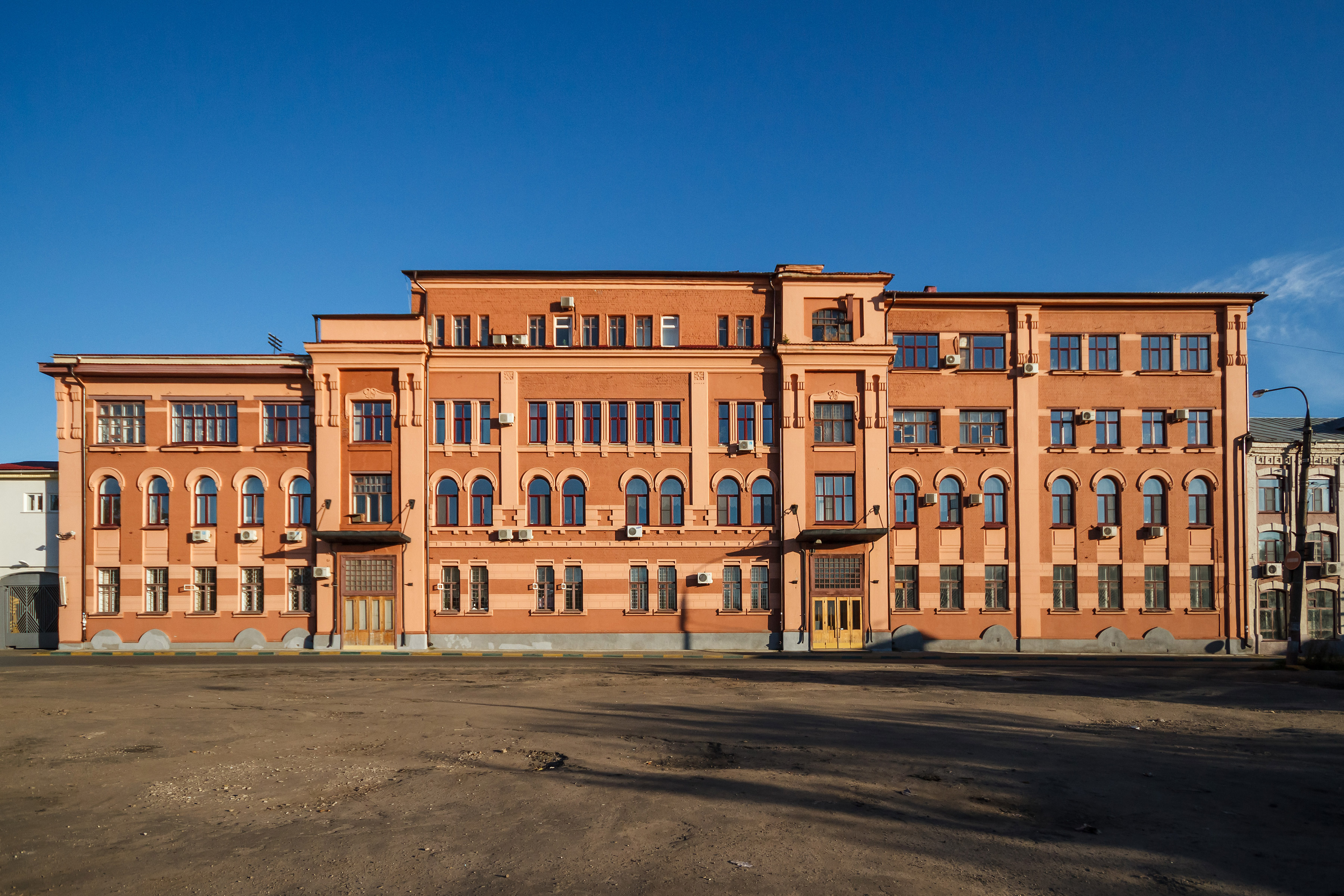
Krasnoye Sormovo Factory No. 112
In 1920, with the Russian Civil War still raging, workers at a factory on the Volga took fourteen burned-out French Renault FT tanks, rebuilt them from wreckage, and assembled one entirely new copy. They named it "Freedom Fighter Lenin." The factory was not a military arsenal. It was a shipyard, the same one that had built Russia's first steam dredger in 1858 and its first open hearth furnace in 1870. That capacity to become whatever the moment demanded -- ships, locomotives, tanks, hydrofoils -- has defined the Krasnoye Sormovo Factory for nearly two centuries.
Hammers on the Volga
The shipyard was founded in 1849 as the Nizhny Novgorod Machine Factory, a joint venture between a local manufacturing company and the Volga Steam Navigation line. Within two years, workers were constructing solid metal steamers. By 1854, the factory had progressed to screw-driven schooners, and four years later it produced the first Russian steam dredger. The plant's ambitions outpaced its original purpose almost immediately. It manufactured steam engines, carriages, bridges, diesel engines, cannons, pontoons, and projectiles alongside the ships. Between 1849 and 1918, 489 vessels left its yards. In 1870, the first open hearth furnace in Russia was built here, followed the next year by the two-decked steamship Perevorot. The factory sat at the intersection of the Volga's commercial power and Russia's hunger for industrialization, and it absorbed every demand the empire could throw at it.
The Locomotive Years
Starting in 1898, steam locomotives became one of Sormovo's chief products. The factory maintained close ties with Krauss Lokomotive Works in Munich -- Krauss delivered its first locomotive to Sormovo in 1884 -- and advertised in industrial magazines across Europe until the outbreak of World War I severed those connections. The output was staggering: 2,164 locomotives between 1898 and 1917, another 1,111 during the early Soviet period through 1935, and 200 specialized 0-8-0 models built in partnership with the Kolomna Locomotive Works. After a wartime pivot to submarine diesel motors, locomotive production resumed from 1947 to 1951 with 411 units of the standard Soviet Su 2-6-2 passenger type. In total, the factory turned out 3,886 steam locomotives over 53 years. Each one was built beside the same Volga riverbanks where the original steamers had launched half a century earlier.
Arsenal of the Volga
War repeatedly transformed Sormovo. During the Civil War, the factory built armored trains and armed vessels for the Volga Military Flotilla. The rebuilt Renault tanks of 1920, dubbed the Russkiy Reno, were among the Red Army's first armored vehicles. In 1922, the word Krasnoye -- "Red" -- was officially added to the factory's name. The real test came during World War II, when the plant shifted to producing the T-34 medium tank, widely regarded as one of the most significant armored vehicles in military history. In 1943, designer V. Kerichev created the turret for the upgunned T-34-85 variant at Sormovo. The factory's wartime contributions earned it two Orders of Lenin, in 1943 and 1949, plus the Order of the Patriotic War, First Class, in 1945.
Ships That Fly
After the war, Sormovo returned to the water with new ambitions. The factory pioneered sectional and large-block ship construction, building sea and river tankers, suction dredgers, and diesel-electric vessels. Its most celebrated postwar achievement was the Raketa, the first Soviet hydrofoil, a vessel that lifted its hull above the water on underwater wings and raced along the Volga at speeds that astonished passengers accustomed to plodding riverboats. The factory also built the Sormovich, Russia's first high-speed passenger hovercraft, diesel-electric railroad ferries for the Baku-Krasnovodsk route across the Caspian Sea, and a unique 250-tonne double-hulled floating crane called Kyor-Ogly. Today, as part of the United Shipbuilding Corporation, the yard operates a cruise ship named after the Bashkir poet Mustai Karim. The factory received the Order of the October Revolution in 1970 and the Order of the Red Banner of Labour in 1939, adding to a collection of state honors that traces the full arc of Russian industrial history from empire to federation.
From the Air
Located at 56.37N, 43.87E in the Sormovsky district of Nizhny Novgorod, on the northern bank of the Volga River. The factory complex is visible as a large industrial area along the riverfront. Nizhny Novgorod Strigino Airport (UWGG) is approximately 15 km to the southwest. The city sits at the confluence of the Volga and Oka rivers, making it easily identifiable from altitude. Best viewed at 3,000-5,000 feet to see the shipyard facilities along the Volga.