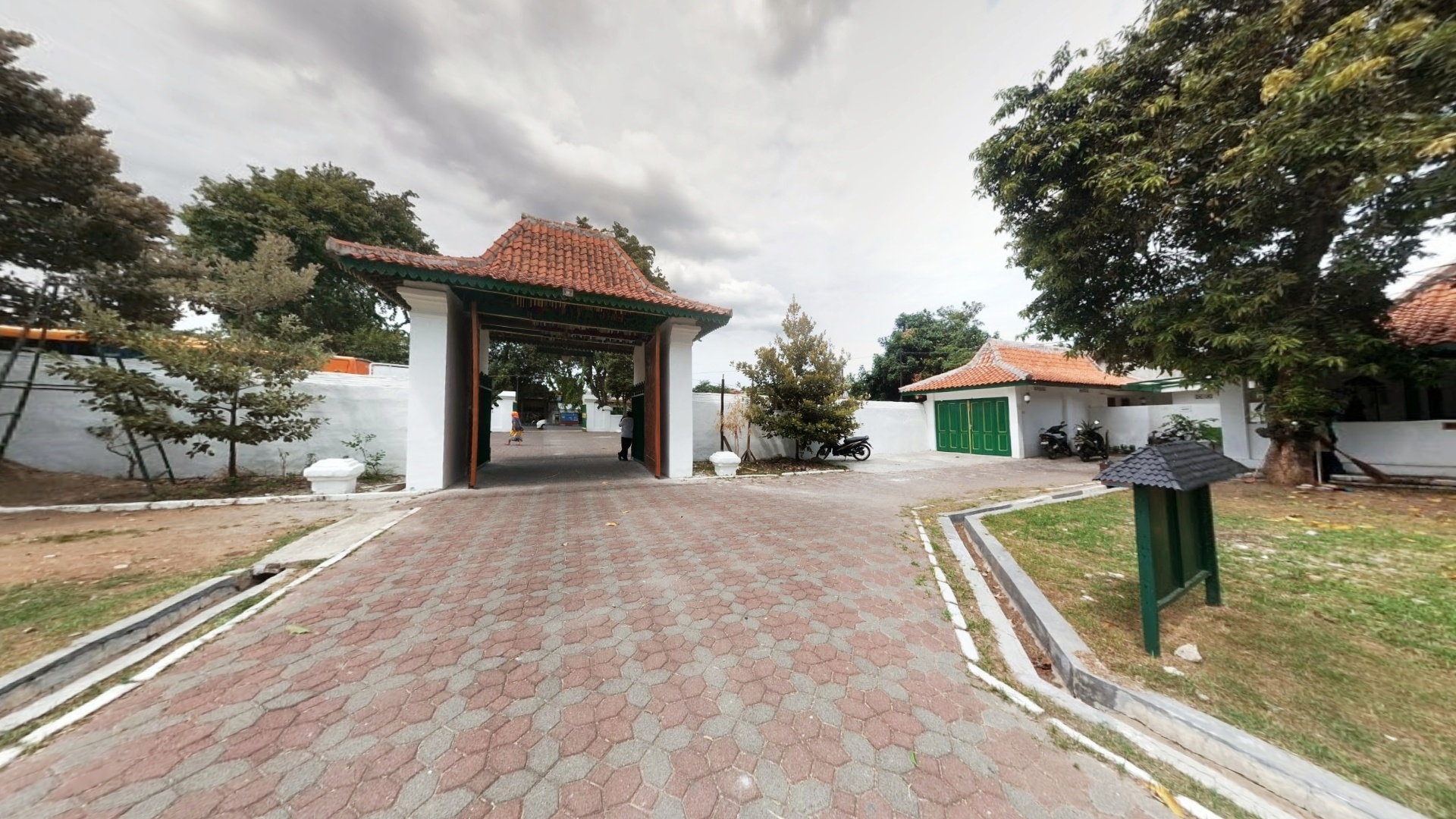
Kraton Kacirebonan
A queen built this palace out of spite and pragmatism in equal measure. After her husband, Sultan Kacirebonan I, died in 1814 having refused to accept a single guilder of Dutch pension money, his widow Resminingpuri faced a practical question: how to raise their five-year-old son and secure a future for a dispossessed royal line. She took the pension. Then she used it to build Kraton Kacirebonan, the youngest of Cirebon's four royal palaces, turning colonial money into a monument of Javanese-Sundanese sovereignty that still stands in the Pulasaren district today.
A Prince in Exile
The story of Kacirebonan begins with defiance. In the early nineteenth century, Prince Raja Kanoman, heir to the throne of the Sultanate of Kanoman, sided with the people of Cirebon against Dutch-imposed taxes. The colonial response was swift and punishing. The Dutch stripped him of his title, seized his rights to the sultanate, and exiled him to the fortress of Viktoria on distant Ambon Island. But the people of Cirebon did not stop resisting. Their continued unrest forced the Dutch to bring the prince back in 1808, calculating that his presence might calm the insurgency. His aristocratic status was restored, though the sultanate itself remained out of reach. He was given the title Sultan Cerbon Amiril Mukminin Sultan Muhammad Khaerudin, and until his death in 1814 he refused any pension from the Netherlands -- a quiet, stubborn act of resistance that defined his legacy.
The Queen's Gambit
Resminingpuri, the queen consort, inherited a title without a palace and a young prince without a throne. After her husband's death, she lived for a time at Taman Sari Cave Sunyaragi before deciding that her son, Prince Raja Madenda Hidayat, needed a proper seat of power. The pension she accepted from the Dutch became the instrument of her ambition. With it she commissioned the main palace building, the Paseban audience hall, and a mosque -- establishing Kacirebonan as a functioning kraton in the Pulosaren neighborhood. The palace occupies approximately 46,500 square meters of land, oriented north to south in keeping with Cirebonese tradition. That a woman built this complex in the early nineteenth century, financing it with the very funds her husband had rejected, gives Kacirebonan a founding narrative unlike any other palace on Java.
Where Cultures Converge
Walk through Kacirebonan and you walk through the cultural history of maritime Southeast Asia. The architecture blends Sundanese and Javanese construction with Islamic decorative motifs, Chinese ornamentation, and Dutch colonial elements -- a layering that reflects Cirebon's centuries-long position as a port city on the border between Java's two great cultural realms. Inside, the palace houses keris daggers, wayang puppets, gamelan instruments, and war equipment from the sultanate era. The broader Cirebon court tradition produced the Megamendung batik pattern, whose swirling cloud motifs draw on Chinese imagery, and the famous Macan Ali flag -- Arabic calligraphy arranged to form a tiger, linking Islamic devotion to the Sundanese Hindu king Siliwangi's tiger banner. Royal carriages like the Singa Barong and Paksi Naga Liman combine eagle, elephant, and dragon forms, symbolizing Hindu, Islamic, and Chinese traditions in a single ornate vehicle.
Living Heritage
Kacirebonan is one of four surviving Cirebon kratons -- alongside Kasepuhan, Kanoman, and Kaprabonan -- that together maintain the city's courtly traditions. The royal families no longer hold political authority, but they remain deeply respected and serve as patrons of Cirebonese arts. Topeng Cirebon, the mask dance inspired by Javanese Panji cycle stories, is performed under their patronage and ranks among Indonesia's most celebrated traditional dances. Each kraton still holds its own ceremonial calendar, and visitors to Kacirebonan can see collections that span the sultanate period. Located about a kilometer southwest of the grand Kasepuhan Palace and 500 meters south of Keraton Kanoman, Kacirebonan sits within walking distance of its older siblings -- yet it tells a distinct story of resistance, loss, and reinvention that the others cannot claim.
From the Air
Located at 6.73S, 108.57E in the heart of Cirebon, West Java, Indonesia. The palace sits in the dense urban fabric of the Pulasaren district, roughly a kilometer southwest of the larger Kasepuhan Palace complex which may be visible from the air. Cirebon's coastline along the Java Sea is immediately to the north. Nearest airport is Penggung Airport (WICD) in Cirebon itself. Husein Sastranegara International Airport (WICC) in Bandung is approximately 120 km to the southeast. Best viewed at 2,000-4,000 feet AGL to appreciate the palace grounds within the surrounding city.