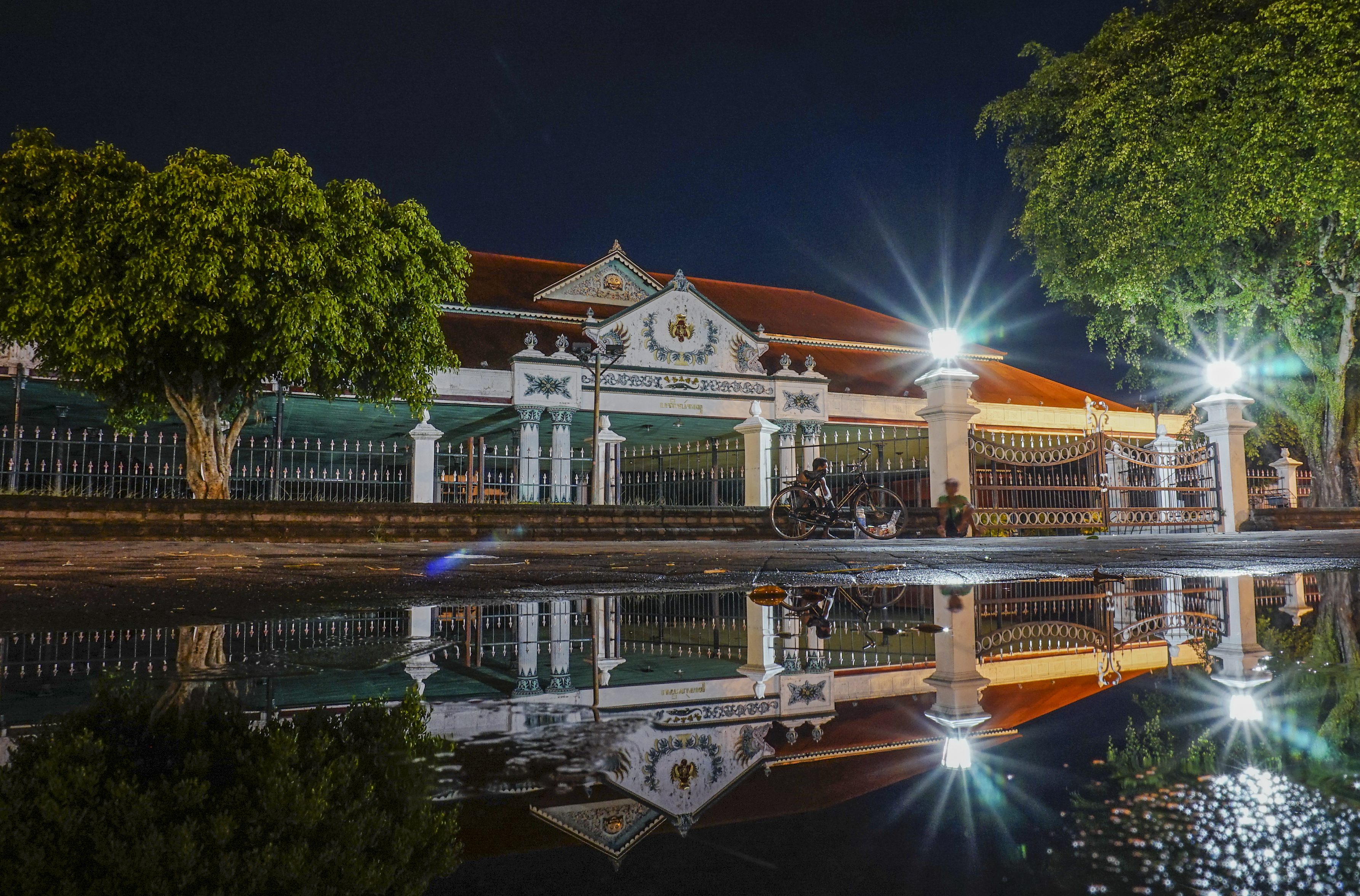
Kraton Ngayogyakarta Hadiningrat
Sand from the south coast of Java covers the main courtyard. Not pavement, not tile -- sand, carried inland and spread deliberately across the ground of the Kraton Ngayogyakarta Hadiningrat, the Royal Palace of Yogyakarta. The detail is small but revealing. This is a place where every material choice carries meaning, where architecture is a form of philosophy, and where a sultan who founded a kingdom in 1755 also served as its chief architect. More than 270 years later, the palace complex remains the seat of the reigning Sultan of Yogyakarta, a center of Javanese culture, and a working institution guarded by the Prajurit Keraton -- the hereditary palace guard regiment -- in a modern Indonesian republic that still grants this particular sultanate its own special governing region.
A Treaty Written in Teak and Brick
The Kraton exists because of a political rupture. In 1755, the Treaty of Giyanti divided the Mataram Sultanate in two under Dutch East India Company mediation, and Hamengkubuwono I claimed the western half as the new Sultanate of Yogyakarta. Building a palace was among his first acts -- not merely a residence but a statement of sovereignty in brick, teak, and cosmological geometry. The complex was completed in 1755-1756 on the Javanese calendar year 1682, following a layout that mirrored the structure of the old city of Yogyakarta itself. Dutch scholars Theodoor Gautier Thomas Pigeaud and Lucien Adam would later praise Hamengkubuwono I's architectural sophistication, calling him a worthy successor to Pakubuwono II, founder of the rival Surakarta Sunanate. The palace he built would survive, though not without damage -- earthquakes in 1876 and 2006 required substantial reconstruction, and much of the current complex dates to the reign of Sultan Hamengkubuwono VIII, who ruled from 1921 to 1939.
Where Pillars Speak in Color
Javanese palace architecture communicates through a precise vocabulary of form and ornament. The buildings of the Kraton are joglo constructions -- wooden structures crowned by distinctive trapezoidal roofs covered in red or gray shingles, supported by a central soko guru pillar and radiating secondary columns. The color code is strict: pillars are dark green or black, highlighted with yellow, light green, red, or gold. Stone pedestals called ompak anchor the columns, their black surfaces incised with gold ornamentation. White dominates the walls. Floors of white marble or patterned tile sit higher than the sandy courtyard below, a deliberate elevation that reinforces hierarchy. Some buildings contain a selo gilang, a square stone platform reserved for the sultan's throne. The degree of decoration itself signals function -- main-class buildings used by the sultan receive elaborate floral, faunal, and nature motifs, while lower-ranking structures remain deliberately plain.
Foreign Echoes in Javanese Walls
Look closely at the Kraton's ornamentation and you find centuries of contact compressed into carved wood and painted tile. Portuguese, Dutch, and Chinese influences all appear alongside traditional Javanese motifs. A Ganesha statue sits in one courtyard. Dvarapala guardian figures flank the Donopratono Gate. The Bangsal Manis pavilion features railings adorned with Javanese Kala faces -- fierce protective deities borrowed from Hindu-Buddhist tradition and absorbed into the palace's Islamic Javanese identity. This layering is not accidental. Yogyakarta sits at a cultural crossroads where Indian, Chinese, European, and Austronesian traditions have intersected for centuries, and the Kraton's architecture reflects that history with an openness that suggests confidence rather than confusion. Each borrowed element has been made Javanese -- integrated so thoroughly that the palace reads as a unified expression rather than a catalogue of foreign influence.
Living Institution, Living Tradition
Unlike most palace complexes in Southeast Asia, the Kraton Ngayogyakarta Hadiningrat is not a relic. The Sultan of Yogyakarta still lives here. The palace guard, Prajurit Keraton Ngayogyakarta Hadiningrat, still serves. Gamelan performances still fill the pendopo pavilions with the layered bronze tones of traditional Javanese music. The complex houses a museum displaying royal artifacts, but it functions first as a seat of governance -- the sultan simultaneously serves as governor of the Special Region of Yogyakarta, a unique arrangement in Indonesian politics that grants this hereditary monarch a formal role in the republic. Visitors who walk through the Donopratono Gate and across the sand-covered courtyard are entering not a preserved monument but an active institution, one that has adapted across colonial occupation, revolution, and democratic reform while maintaining the ceremonial rhythms that Hamengkubuwono I established when the first teak pillars were raised in 1755.
From the Air
Located at 7.81S, 110.36E in the heart of Yogyakarta. The Kraton complex is a large rectangular compound visible in the old city center, south of Fort Vredeburg and Gedung Agung. The Taman Sari water castle ruins lie to the west. Adisucipto International Airport (WARJ) is approximately 9 km to the east. Mount Merapi (2,930m), one of Java's most active volcanoes, rises prominently to the north.