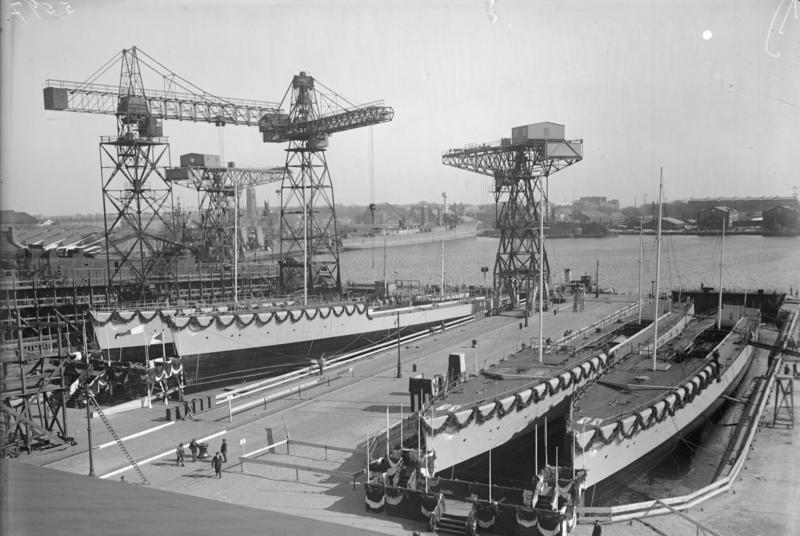
Kriegsmarinewerft Wilhelmshaven
Seventeen thousand people worked at the Kriegsmarinewerft Wilhelmshaven by 1945. Not all of them had chosen to be there. As the war ground on and German manpower thinned, the Nazi state filled its shipyards with prisoners of war, civilians forcibly conscripted from occupied Poland, France, Belgium and the Soviet Union, and concentration camp prisoners. The battleships and U-boats that came down the slips at Wilhelmshaven were built by their hands. Any account of this yard that does not begin with them is not an honest account.
The Yard the Empire Left Behind
The site already had a history. The Wilhelmshaven Imperial Shipyard had built the Kaiser's High Seas Fleet here through World War I; the Treaty of Versailles shut it down in 1919. In 1918 a new shipyard called Reichsmarinewerft Wilhelmshaven was established on the same ground, a much-diminished operation building fishing vessels, cargo ships, and the small warships allowed under the postwar settlement. Twenty-eight fishing vessels came down the slips between 1920 and 1922; four cargo ships in 1922. The yard learned to live small. That was about to change.
Capital Ships for the Kriegsmarine
In 1935 the navy was renamed Kriegsmarine, and the yard's name changed with it - Kriegsmarinewerft Wilhelmshaven. The same year, Germany formally repudiated the naval restrictions of Versailles. The work that followed scaled accordingly. Königsberg-class light cruisers in 1929 and 1930. The Panzerschiff *Admiral Scheer* in 1934. The Deutschland-class *Admiral Graf Spee* in 1936. Then the two ships that would become symbols of the war at sea: the battleship *Scharnhorst*, launched 1936 and completed at Wilhelmshaven, and *Tirpitz*, sister to *Bismarck*, launched here on 1 April 1939. *Bismarck* herself was built across the harbor at the Blohm+Voss yard in Hamburg, but Wilhelmshaven did the fitting-out for *Tirpitz*. Between 1941 and 1944, 27 Type VII U-boats slid down the slipways - the workhorses of the Battle of the Atlantic.
Whose Hands Built These Ships
The German workforce alone could never have produced this output. As skilled German workers were drafted into the Wehrmacht, the yard relied increasingly on forced labor: civilians from occupied territories deported under the *Sauckel* program, prisoners of war kept on starvation rations, and prisoners from sub-camps of the Neuengamme concentration camp system who were marched to the yard each day. Many died - of overwork, of malnutrition, of beatings, of Allied bombs that fell on the harbor and did not distinguish between Germans and the people the Germans had enslaved. Records of individual workers are incomplete and sometimes deliberately destroyed, but the scale is not in dispute. By the war's end Wilhelmshaven held about 17,000 yard workers, a significant fraction of them coerced. The cranes and slipways were built. So were the lives that were ground up to operate them.
The Long Reckoning
On 18 December 1939 the yard found itself at the center of the Battle of the Heligoland Bight, when 22 RAF Wellington bombers tried to attack ships at Wilhelmshaven. German fighters shot down 12 of them - an early lesson in the costs of unescorted daylight bombing. As the war ended, Polish and British troops arrived in May 1945. For a brief period the yard refurbished German ships destined for the Allies as war reparations; from 1946 onward, most of its buildings and equipment were dismantled or blown up. Part of the site has, since 1957, housed an arsenal for the modern German Navy, the Deutsche Bundesmarine. The continuity is uneasy and acknowledged as such. Germany has worked harder than most countries to remember what happened on grounds like these - to name the dead, to mark the camps, to teach the history without sanitizing it. The shipyard's story is part of that work.
From the Air
The former Kriegsmarinewerft site is at approximately 53.53°N, 8.11°E on the western shore of the inner Jade Bight at Wilhelmshaven - now partially occupied by the modern Marinearsenal of the Deutsche Marine. The harbor basins, slipways, and surviving historic structures are visible from low altitude. Recommended viewing altitude FL040-FL060. Nearest airport: Wilhelmshaven-Mariensiel (EDWI), 5 km west. The naval base is restricted airspace; check NOTAMs.