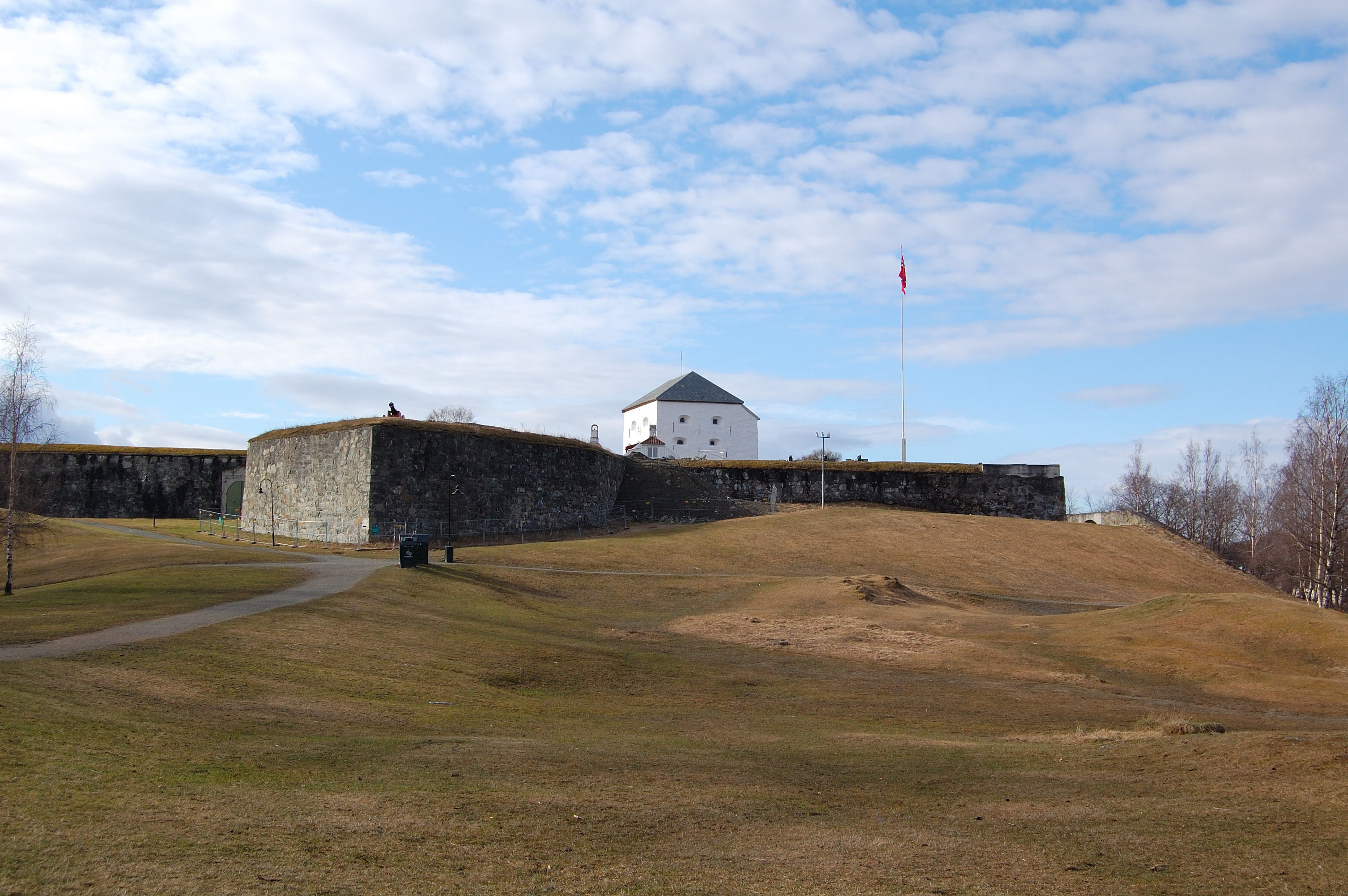
Kristiansten Fortress
On a bitter winter night in 1718, Swedish General Carl Gustaf Armfeldt stared up at the walls of Kristiansten Fortress and decided not to attack. His army of nearly 7,000 men had dwindled to 4,000 through cold, hunger, and Norwegian resistance. The fortress on the hill east of Trondheim - built for exactly this moment - had done its job without firing a decisive shot. Armfeldt retreated across the mountains toward Sweden, and in the crossing that followed, almost his entire remaining army perished in snow and blizzard. Historians have compared the catastrophe to Napoleon's retreat from Moscow.
Born from Fire
Trondheim burned on 18 April 1681. The great fire consumed much of the city, and in the rebuilding that followed, General Johan Caspar von Cicignon - chief inspector of fortifications - redesigned both the city plan and its defenses. Trondheim had traditionally relied on fortifications along the river Nidelven and at Skansen, but the eastern approach remained exposed. Cicignon placed the new fortress on a commanding hill with sightlines stretching from Ila to Lade, covering the vulnerable flank. Named for King Christian V of Denmark-Norway, the fortress was constructed between 1682 and 1684. By 1691 it had been strengthened with an advanced bastion to the east, and by 1695 the now-vanished Mollenberg skanse connected it to the fortified city via a continuous palisade. The central defensive tower, the Donjonen, served as the heart of the complex, housing artillery, quarters, and stores beneath its heavy walls.
The Swedish Siege
The fortress earned its keep during the final years of the Great Northern War. In autumn 1718, Charles XII of Sweden launched a two-pronged invasion of Norway. While the king personally led the main assault on Fredrikshald in the south, Armfeldt's army pushed into Trondelag to seize Trondheim. The defenders under Vincens Budde numbered 6,900 men, and they were not alone - the rural population, bitterly remembering a previous Swedish occupation, actively resisted the invaders. Armfeldt reached the city and laid siege, but the strength of Kristiansten and the surrounding fortifications convinced him to pull back toward Verdal. Charles XII, furious, ordered him to return and take the city. Armfeldt obeyed, surrounding Trondheim again, but Budde's forces held firm. Provisions ran out, disease spread, and the Norwegian winter tightened its grip on the besiegers. When word arrived in December that Charles XII had been killed by a bullet at Fredriksten Fortress, the campaign was over.
Flags, Guns, and Independence
Kristiansten was decommissioned as a military installation in 1816 by King Charles XIV John, and the Donjonen became a fire-watch station. But the fortress continued to play a ceremonial role in Norwegian history. On 9 June 1905, when Norway dissolved its union with Sweden, the Norwegian war flag bearing the union badge was hauled down at Kristiansten and the pure Norwegian flag raised with full military honors and gun salutes for both banners. Five months later, on 18 November, a twenty-one gun salute thundered from the fortress to proclaim the election of Prince Carl of Denmark as King Haakon VII of Norway. The fortress had witnessed the birth of the modern Norwegian state. Today it still fires salutes for royal births and national occasions, the cannons echoing across a city that has grown far beyond the walls Cicignon designed to protect it.
The Darker Legacy
During the German occupation of Norway in World War II, the Nazis used Kristiansten as an execution site, killing Norwegian patriots within its walls. After liberation, the fortress served the same grim function for the other side. It became the official place of execution for convicted traitors and war criminals during the legal purge that followed the war. The most notorious figure to face the firing squad here was Henry Rinnan, a Norwegian who had led a Gestapo-affiliated gang responsible for the torture and murder of fellow Norwegians. Rinnan was executed at Kristiansten on 1 February 1947. Nine of his followers were shot afterward, eight on the same day. Today the fortress is a museum and a public park, offering panoramic views of Trondheim and the hills of Bymarka beyond. From the ramparts, visitors can trace the strandlinja - an ancient shoreline visible as a topographical line along the hillsides, marking where the sea once reached in a landscape that has risen steadily since the last ice age.
From the Air
Located at 63.43N, 10.41E on a prominent hill east of Trondheim city center. The star-shaped fortress is clearly visible from altitude, sitting above the Nidelva river bend. Nearest airport is Trondheim Airport Vaernes (ENVA), approximately 33 km northeast. Best viewed at 2,000-3,000 ft AGL to appreciate the hilltop position and the city it was designed to defend. The Donjonen tower is the most prominent structure.