Krka National Park
Two days after Niagara Falls powered its first electric lights in 1895, the small Croatian city of Sibenik was already glowing. Its power came not from any industrial marvel of the New World but from a modest hydroelectric plant tucked into the canyon of the Krka River, where water had been reshaping stone for millennia. That plant is gone now, reduced to ruins along a walking trail, but the river that powered it still builds and destroys with the patience of deep time. Krka National Park, Croatia's seventh and one of its most visited, protects a stretch of this river where biology and chemistry conspire to construct something rare: waterfalls that grow.
Stone That Breathes
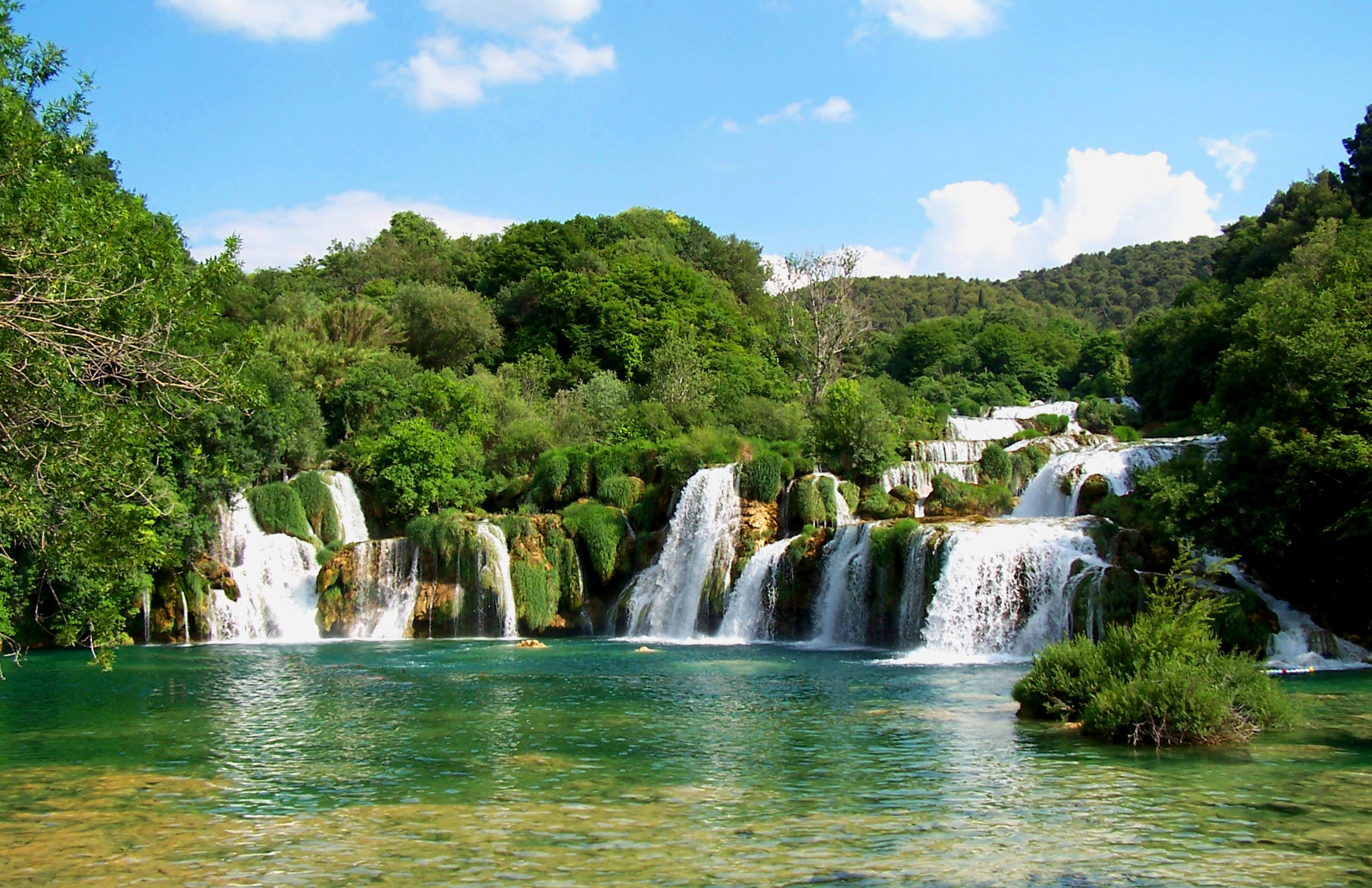
The waterfalls of the Krka are not carved from rock. They are built from it. Travertine, a form of calcium carbonate, precipitates from the river's mineral-rich water onto beds of moss, algae, and bacteria. These organisms become encrusted, layer upon layer, forming natural dams that grow at roughly one centimeter per year. The result is a staircase of cascades that did not exist in their current form a few thousand years ago and will look different a few thousand years from now. Skradinski Buk, the park's landmark waterfall, demonstrates this process on a grand scale: seventeen travertine steps spanning 800 meters in length, with cascades between 200 and 400 meters wide, dropping a total of 45.7 meters. The water flows over these living barriers in thin sheets, catching sunlight and scattering it into greens and blues that shift with the angle of the day. Swimming is prohibited outside designated areas, not merely for safety but because careless contact destroys the fragile travertine structures that took centuries to form.
A River's Menagerie
The Krka is a biological corridor running through the Mediterranean and sub-Mediterranean zones of central Dalmatia. Eighteen species of fish inhabit its waters, and ten of those are found nowhere else on Earth, making this stretch of river a natural landmark of the highest category. Above the surface, 222 species of birds have been recorded, placing the Krka among the most ornithologically significant regions in Europe. Ospreys hunt the pools. Golden eagles and Bonelli's eagles patrol the canyon rims. Peregrine falcons nest on the cliff faces, and griffon vultures ride the thermals that rise from the sun-warmed stone. Among the mammals, eighteen species of bats occupy the caves and overhangs, populations that are endangered or near extinction elsewhere in Europe. The European otter, itself threatened, still fishes these waters. On the slopes surrounding the river, 860 species and subspecies of plants have been cataloged, including several endemic Illyrian-Adriatic species that anchor this landscape to its specific geography.
Islands in the Current
The Krka is not only a river of waterfalls. Midstream, where the current slows and the canyon widens, sits Visovac, a tiny island crowned by a Franciscan monastery that has occupied it since 1445. Accessible only by boat, Visovac feels like a place that time forgot to update. The monastery houses a small collection of archaeological artifacts and early printed books. Upstream from Visovac, the Serbian Orthodox Krka Monastery occupies another pocket of stillness along the river, its origins tracing to the 14th century. The juxtaposition is striking: two monastic traditions, separated by a few kilometers of river, coexisting within a landscape that predates both by geological ages. The park itself stretches along the middle-lower course of the river in Sibenik-Knin county, just a few kilometers northeast of the Adriatic port city of Sibenik. Most of the park's areas of interest are not connected by road or path, so visiting means either committing to a full day on the ferries or leaving and re-entering from the main road for each attraction.
From Roman Amphitheaters to Hydroelectric Ambition
Human history along the Krka runs deep. At Burnum, in the park's northern reaches, the remains of a Roman military camp include the arched walls of an amphitheater where legionnaires once watched gladiatorial combat. The river itself served as a boundary, a trade route, and a source of power long before it became a national park in 1985. The most remarkable chapter in that story of power arrived on August 28, 1895, when the Jaruga hydroelectric plant began operations on the Krka, delivering alternating current to the city of Sibenik. This was one of the first complete polyphase AC systems in the world, beginning operation just two days after Niagara's system. The plant was modest in scale but enormous in implication: a small Dalmatian city running on the same cutting-edge technology as the great industrial centers of the age. The ruins of that plant remain visible along the park's circular walking trail, a quiet monument to a moment when the Krka briefly stood at the frontier of modernity.
The View from Above
From the air, the Krka reveals what the walking trails cannot: the full sweep of the river's path through the Dalmatian karst, the travertine barriers visible as pale lines across the water, and the emerald pools they create stretching between grey canyon walls. Visovac Island appears as a dot of green and terracotta in the widened river, almost too small to hold its monastery. The cascades of Skradinski Buk and Roski Slap read as white threads stitched across the landscape. In the distance, the Adriatic glints beyond Sibenik, and the connection becomes clear: this is a river that starts in the mountains, builds its own architecture of stone, and delivers its water to the sea through one of the most beautiful stretches of coastline in Europe.
From the Air
Located at 43.80N, 15.97E in central Dalmatia, Croatia. The Krka River canyon and its travertine waterfalls are visible from above as white cascades between green pools. Look for the tiny island of Visovac in the widened river. The Adriatic coast and city of Sibenik lie a few kilometers to the southwest. Nearest airports: Split (LDSP) approximately 80 km southeast, Zadar (LDZD) approximately 75 km northwest. Recommended viewing altitude: 3,000-5,000 feet for detail of the waterfalls and canyon.