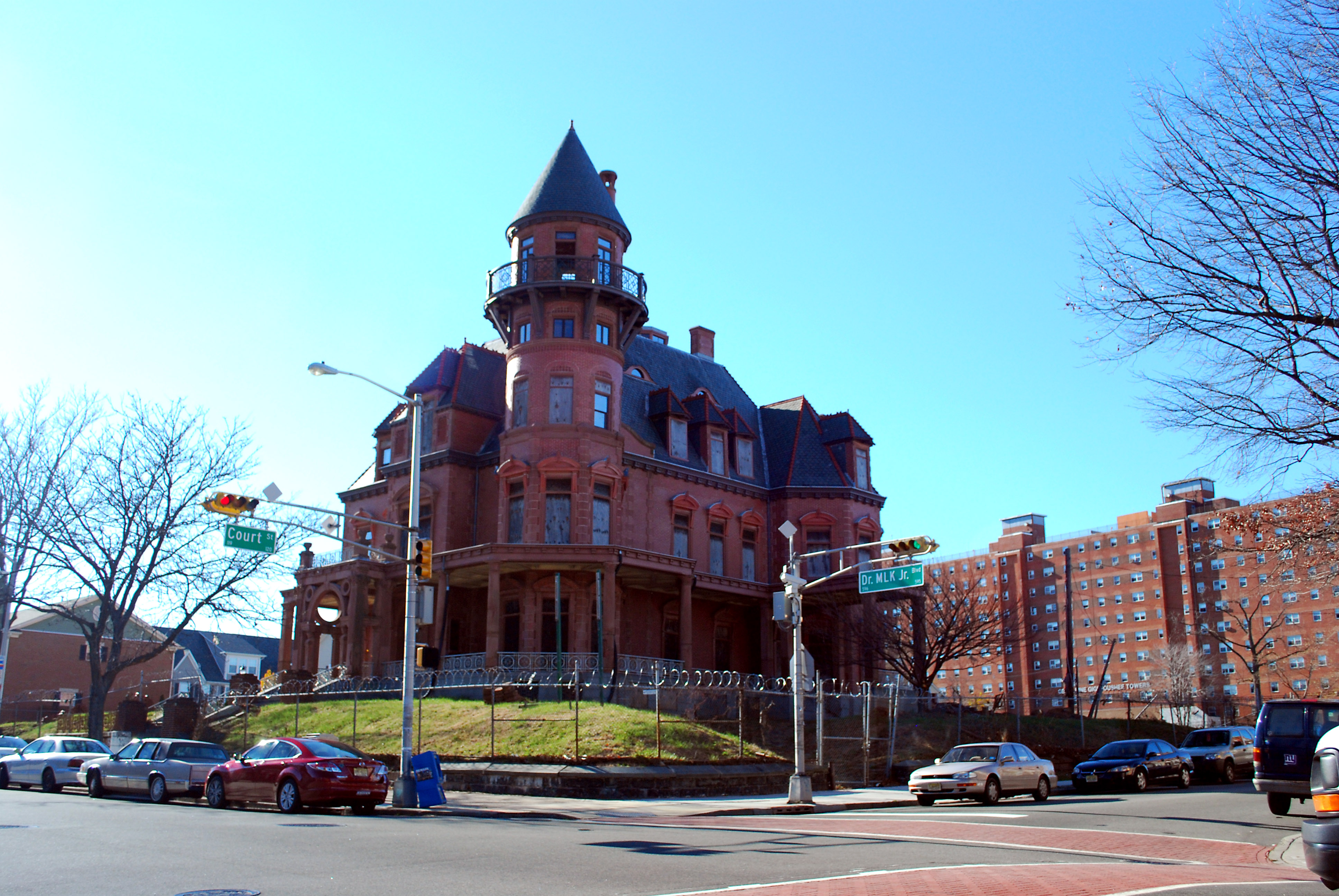
Krueger Mansion
For $250,000 in 1888 dollars, Gottfried Krueger built himself a castle on the corner of Court and High Street in Newark, New Jersey. Forty rooms. The beer baron who founded the Gottfried Krueger Brewing Company did not believe in restraint, and the mansion he raised at what is now Martin Luther King Boulevard announced that conviction to every passerby. What Krueger could not have predicted was the parade of reinventions his home would endure over the next century and a half -- from brewing fortune showcase to Masonic temple, from beauty school to abandoned ruin, and finally to something no one in 1888 could have imagined: an artisanal workspace for a new generation of Newark makers.
The Beer Baron's Palace
Gottfried Krueger arrived in the world in 1837 and spent the next several decades building a brewing empire in Newark. By the time he commissioned his mansion, his name was synonymous with the city's thriving beer industry. The 40-room home was an exercise in Victorian excess -- a statement piece meant to rival anything in New York, built at a cost that would exceed $8 million today. Krueger lived there until 1926, when he died at the age of 89. That same year, the Valley of Newark Scottish Rite Freemasons purchased the property for $100,000 -- less than half its original construction cost -- and added a 700-seat auditorium for their meetings. The mansion's first transformation had begun.
Louise Scott's Second Act
In 1958, a woman named Louise Scott paid $85,000 for the mansion and gave it an entirely new identity. She ran a beauty school out of the first floor while keeping the upper levels as her private residence. For nearly a quarter century, Scott occupied the grand rooms that Krueger had built to host Newark's elite, turning a beer baron's vanity project into a working school. When she died in 1982, the mansion passed to the city of Newark, and a long period of uncertainty began. The building was added to both the New Jersey and National Registers of Historic Places in 1972, which offered recognition but not a clear future.
Millions Spent, Plans Frozen
Newark had ambitious plans. In 1991, the New Jersey Historic Trust funded a $625,812 bond to stabilize the exterior, and the city matched that amount. Over the years, more than $4 million in city funds and an additional $1.5 million from the federal government poured into the project, which aimed to transform the mansion into a center celebrating the Black contribution to Newark's development. But after a decade of work and more than $7 million spent, the city's Municipal Council refused to allocate any more money. The African-American cultural center was never completed. The mansion sat unfinished, a monument to both ambition and bureaucratic gridlock, while the neighborhood around it continued to change.
A Castle Reborn
The breakthrough finally came in 2020, when ground was broken on a new vision: the Krueger-Scott Mansion would become part of an artisanal workspace project called Newark Makerhoods. Instead of a cultural center or a private residence, the building would house working artists and craftspeople in a live-work setting. By 2023, the mansion had been almost completely restored and elaborately landscaped -- a transformation that would have astonished Krueger, Scott, and the Freemasons alike. The mansion even found unexpected fame in popular culture: its design served as the model for the Fitzcarraldo Mansion in the animated series The Venture Bros., granting a Newark landmark a second life in cartoon form.
Newark's Stubborn Survivor
Standing at the corner of Court Street and Dr. Martin Luther King Jr. Boulevard, the Krueger Mansion embodies the cycles that define older American cities. Built during Newark's industrial peak, abandoned during its decline, and revived as the city finds new economic footing, the mansion has outlasted every prediction made about it. Its Victorian facade now looks out on a boulevard named for a civil rights leader, in a neighborhood that has weathered riots, disinvestment, and renewal. The building endures not because anyone planned for it to survive this long, but because enough people -- a brewer, a schoolteacher, preservationists, and finally a new generation of makers -- refused to let it disappear.
From the Air
Located at 40.7325N, 74.1817W in Newark's Central Ward. The mansion sits at the corner of Court Street and MLK Jr. Boulevard. Newark Liberty International Airport (KEWR) is approximately 3 miles south. Best viewed at 1,500-2,000 feet AGL. The Passaic River and downtown Newark skyline provide orientation landmarks.