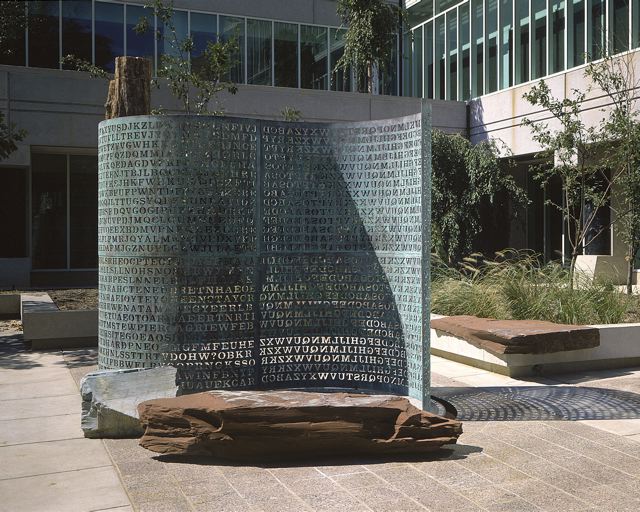
Kryptos
Every day, CIA employees walk past it on their way to the cafeteria. A sinuous S-shaped copper screen rises from the courtyard of the George Bush Center for Intelligence in Langley, Virginia, its surface punched with 1,735 letters that form one of the most tantalizing unsolved puzzles in modern cryptography. Since November 3, 1990, when sculptor Jim Sanborn dedicated this artwork called Kryptos, three of its four encrypted passages have been cracked. The fourth has resisted every attempt by the world's finest codebreakers -- amateur and professional alike -- for more than thirty-five years.
A Riddle Wrapped in Copper
Kryptos is not just letters on metal. The installation sprawls across the CIA courtyard in an assembly of copper plates, red and green granite, white quartz, petrified wood, and a reflecting pool flanked by wooden benches. Morse code messages hide in copper sheets sandwiched between granite slabs near the building entrance. A compass rose points to a lodestone. The complexity builds as you move deeper into the courtyard, as if walking through geological time -- Sanborn intended the experience to feel like encountering a fossil. To create the cryptographic systems, Sanborn collaborated with Edward Scheidt, a retiring CIA cryptographer who rated the encryption difficulty at nine out of ten and expected it would take five to ten years to solve.
The Race to Crack the Code
The first three passages fell to determined minds working independently. An NSA team led by Ken Miller quietly solved passages one through three by late 1992, though the agency kept this secret for years. CIA analyst David Stein cracked the same sections in 1998 using nothing but pencil and paper, his achievement circulating only within the intelligence community. It was Jim Gillogly, a computer scientist from southern California, who went public in 1999 and revealed what the passages actually said. The first, encrypted with a Vigenere cipher keyed to the word PALIMPSEST, reads: "Between subtle shading and the absence of light lies the nuance of iqlusion." The second passage encodes coordinates -- 38 degrees 57 minutes north, 77 degrees 8 minutes west -- pointing to a spot on the CIA grounds itself, and whispers of something buried underground.
The Stubborn Fourth Passage
Passage four, known as K4, contains just 97 characters and has defeated every known approach. Sanborn has dripped out clues over the years like a spymaster running an operation. In 2014, he revealed that letters 70 through 74 decrypt to CLOCK, and hinted at the Berlin World Clock. In 2020, he confirmed positions 26 through 34 spell NORTHEAST, and positions 22 through 25 read EAST. Each clue narrows the field without breaking it open. There are deliberate misspellings in the solved passages -- IQLUSION for ILLUSION, UNDERGRUUND for UNDERGROUND -- and Sanborn has said the sculpture contains a riddle within a riddle, solvable only after all four passages yield their secrets.
Secrets for Sale
In August 2025, at age 79, Sanborn wrote to The Washington Post announcing that he would auction the solution to K4. He acknowledged the decision was painful: "Many in the Kryptos community will find it upsetting," he wrote, but explained he no longer had the physical, mental, or financial resources to maintain the mystery. On November 20, 2025 -- his 80th birthday -- the Kryptos archive sold through Boston-based RR Auction for $962,500, far exceeding the expected $300,000 to $500,000. Sanborn then asked the Smithsonian to seal the relevant files for fifty years, until 2075. Meanwhile, researchers Jarett Kobek and Richard Byrne discovered the K4 plaintext in Sanborn's papers at the Smithsonian archives, though legal threats from the auction house have kept them from publishing it.
The Code That Keeps Giving
Kryptos has infiltrated popular culture far beyond Langley's fences. Dan Brown wove references to it into The Da Vinci Code and The Lost Symbol. The TV show Alias featured a character casually cracking it during a CIA tour. Online communities dedicated to solving K4 have operated for decades, their members analyzing letter frequencies, testing cipher systems, and debating every scrap of information Sanborn releases. The sculpture stands as proof that in an age of supercomputers and artificial intelligence, a single artist working with a retired cryptographer can still create a puzzle that humbles the best minds on the planet. Somewhere in those 97 characters, a secret waits -- sealed now in the Smithsonian, patient as copper turning green.
From the Air
Located at 38.95N, 77.15W on the grounds of the CIA George Bush Center for Intelligence in Langley, Virginia. The sculpture sits in the courtyard of the New Headquarters Building and is not visible from the air, but the sprawling CIA campus along the Potomac River is a prominent landmark. Best viewed from 3,000-5,000 feet AGL. Nearby airports include KIAD (Washington Dulles International, 14nm west) and KDCA (Ronald Reagan Washington National, 8nm southeast). The restricted airspace over Washington D.C. (P-56 and the DC SFRA/FRZ) heavily restricts general aviation in this area.