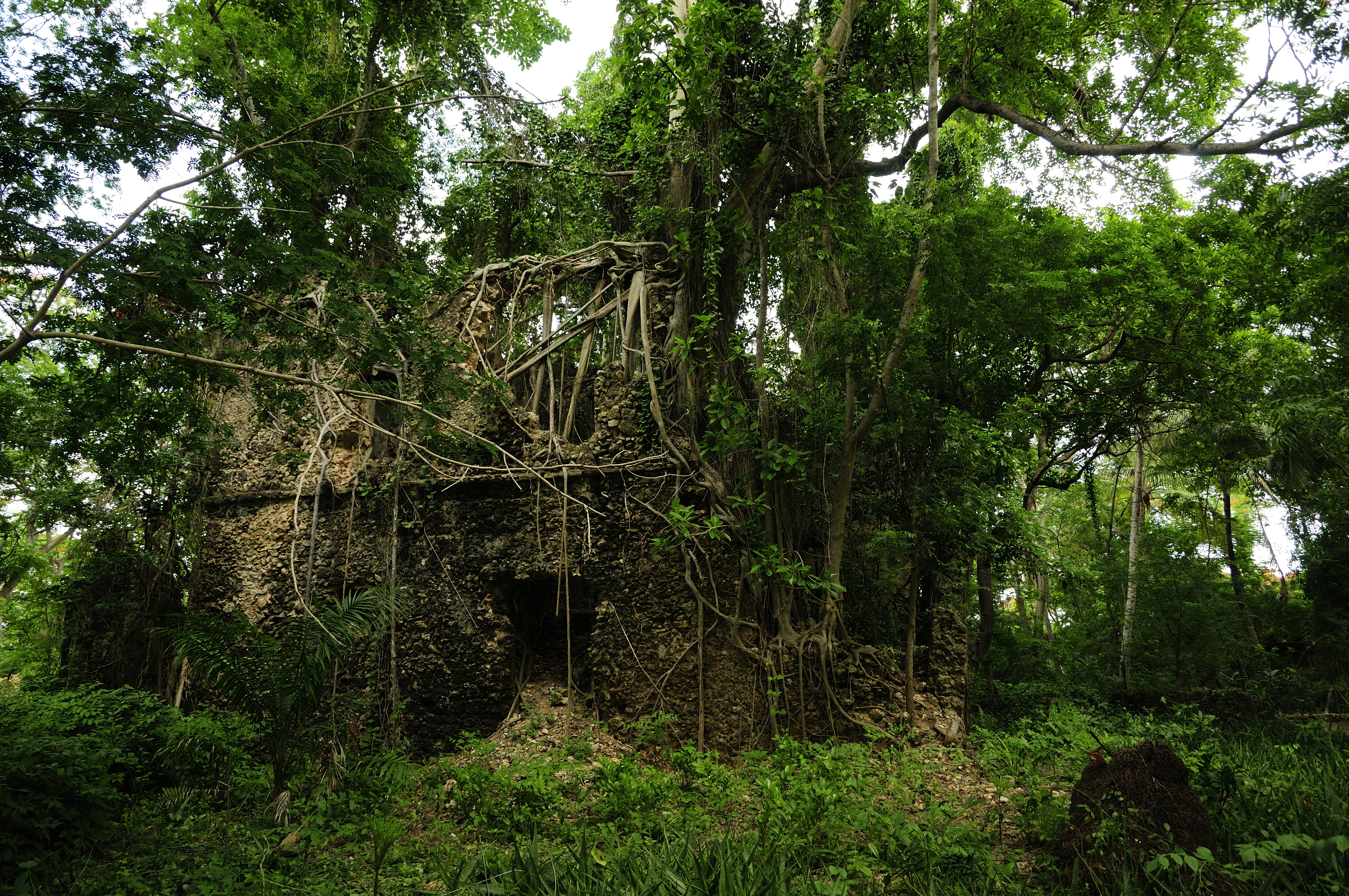
Kua Ruins
European historians and archaeologists called it the Pompeii of East Africa, and the comparison was not entirely misplaced. Like Pompeii, Kua was a thriving settlement frozen in time by sudden catastrophe -- though here the destroyer was not a volcano but a slave raid from Madagascar in the early 19th century. Unlike Pompeii, Kua has never been systematically excavated. The coral-stone ruins sit on the southwest shore of Juani Island in Tanzania's Mafia Archipelago, swallowed by tropical vegetation so dense that historical accounts repeatedly note the overgrowth as an obstacle to survey. What recent mapping has revealed, even through the canopy, is enormous: seven mosques, four cemeteries, a double-story palace, at least ten multi-room residential complexes, and roughly thirty walled courtyards spread across 30 to 40 acres.
Shirazi Founders and Arab Geographers
According to the Kua Chronicle, compiled by historian Freeman-Grenville in 1955, the settlement was founded by Shirazi people 'who had come long ago from Persia.' The exact founding date remains uncertain, but the site appears on the maps of Arab geographer Al-Idrisi in 1154 as 'Kahua.' The ancient core of the settlement lay in an area south of the main ruin complex known as Mkokotoni, which numismatic evidence -- coins found in the soil -- suggests was inhabited from at least the 13th century. Freeman-Grenville cited the potential existence of celadon pottery at the site, which would connect Kua to the same Indian Ocean trade networks that supplied Chinese porcelain to the stone towns of Kilwa and Songo Mnara. Like those better-known settlements, Kua was part of the Swahili coast's web of coral-stone trading towns, each linked to one another and to the wider world by monsoon-driven commerce.
Coral and Community
Kua's architecture tells the story of a settlement built to the same pattern as other Swahili stone towns, but on a scale that rivals any of them. The coral-stone buildings -- mosques, houses, the palace -- were likely encircled by a web of smaller settlements made from less durable materials, as was typical along the coast. The thirty walled courts may have been connected to homes built of wattle and daub rather than stone, suggesting a population far larger than the stone ruins alone would indicate. The main settlement appears to have been most actively occupied from the early 16th century through the early 19th century, though the Mkokotoni area to the south pushes habitation back several centuries further. The internal and external latrines found across the site indicate sophisticated sanitation planning, while the seven mosques -- an extraordinary number for a single settlement -- point to a community deeply structured around Islamic worship and communal gathering.
Destruction and Abandonment
Kua's end came violently. In the early 19th century, raiders from Madagascar -- part of the wider upheaval along the East African coast during the era of intensified slave trading -- attacked the settlement. The population fled or was taken, and Kua was abandoned. The abruptness of the departure is what earned it the Pompeii comparison: buildings left standing, artifacts left in place, daily life interrupted rather than gradually wound down. But where Pompeii was sealed under volcanic ash, Kua was left open to the tropical climate. Roots cracked coral walls. Vegetation overtook courtyards. The jungle moved in with a thoroughness that has frustrated every subsequent attempt to survey the site comprehensively.
Endangered and Unexcavated
As of 2016, Kua was listed among 50 at-risk cultural heritage sites across 36 countries. It is designated a National Historic Site of Tanzania, located in the Jibondo ward of Mafia District in Pwani Region. Yet there has never been a systematic archaeological investigation of the standing remains and the material culture that surrounds them. Scholars disagree about the quality of the demolished buildings from an architectural standpoint -- some consider them exceptional, others less so. What is not in dispute is the scale. A settlement covering 30 to 40 acres, with seven mosques and a double-story palace, represents one of the largest Swahili stone town complexes on the coast. The absence of systematic excavation means that Kua's full story -- its trade connections, its population, its daily life -- remains locked in the coral rubble and tangled roots of Juani Island, waiting.
From the Air
Located at 8.00S, 39.76E on the southwest shore of Juani Island in Tanzania's Mafia Archipelago. Best viewed from 1,500-2,500 feet AGL approaching from the west, where the island's coastline and the vegetation-covered ruins are visible against the turquoise waters of the Indian Ocean. The larger Mafia Island lies to the northwest. Nearest airfield: Mafia Airport (HTMA) on the main island. The Kilwa coast and its UNESCO ruins are approximately 100 km to the south.