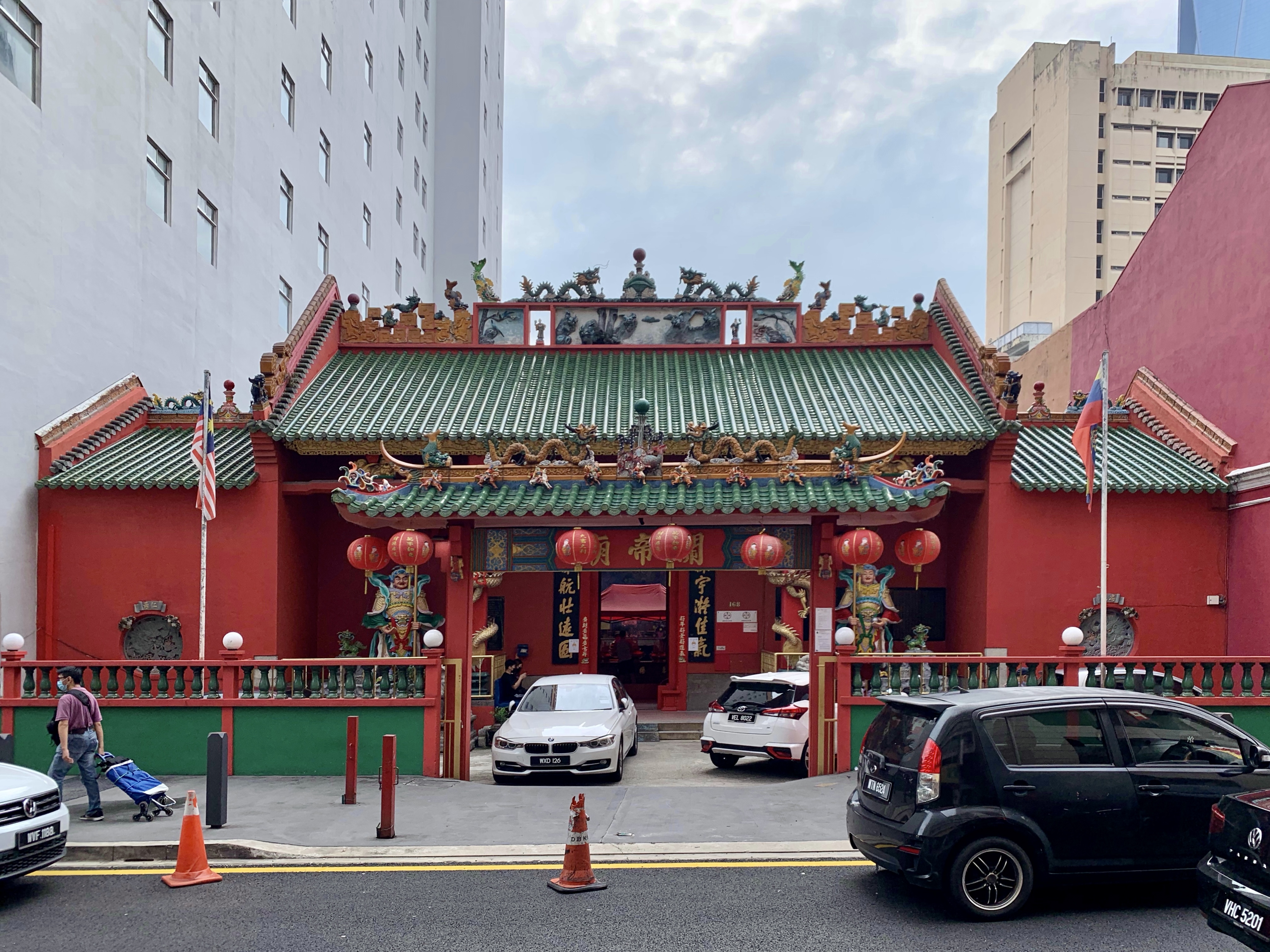
Kuala Lumpur Guan Di Temple
A 59-kilogram bronze blade rests inside one of Kuala Lumpur's oldest buildings. Once a year, between the first and fifteenth days of the Chinese calendar, devotees line up to grip its handle and hoist it overhead, believing the act banishes misfortune and invites prosperity. The weapon is a replica of the legendary Green Dragon Crescent Blade, and it has been the most sacred possession of the Guan Di Temple since the Qing dynasty. That a ritual involving a war god's weapon endures in the middle of a modern capital says something about this temple's hold on the city's Chinese community, a hold that has lasted since 1887.
Roots in Red Earth
The temple traces its founding to 1887, the 14th year of the Guangxu Emperor's reign. The Selangor and Federal Territory Kwong Siew Association, a clan group representing Cantonese immigrants from the Guangzhou and Zhaoqing prefectures, conceived the shrine as a community anchor. Two prominent members, Zhao Yu and Wang Chunlin, proposed the idea and donated the land. They dedicated it to Guan Sheng Dijun, the deified form of the Three Kingdoms general Guan Yu, a figure revered across East Asia for loyalty, righteousness, and martial valor. The building materials, including timber, bricks, tiles, and intricate stone carvings, were imported from Guangdong. They traveled by ship to Singapore first, then overland to Kuala Lumpur, where Chinese migrants assembled the temple through volunteer labor and community fundraising.
More Than a Place of Worship
From the late 1800s through the early 1900s, the temple served as far more than a religious sanctuary. It functioned as a communal court where disputes among the Kwong Siew community could be resolved. The ethical principles associated with Guan Di, particularly loyalty and integrity, carried weight in matters of trade and family life, giving the temple a role in sustaining social order. It also became a center for charitable drives, directing donations toward disaster relief throughout Malaya. During the Japanese occupation in World War II, activities shrank to small-scale rituals. But after the war, the association revived the site with religious festivals and educational programs. The Kwong Siew Free School, which operates beside the temple, still teaches Mandarin and Chinese customs today. It is regarded as the last free school of its kind in Kuala Lumpur.
Red Walls and Dragon Columns
The temple's architecture follows the traditional Lingnan style of southern China. Red walls rise beneath green-tiled roofs, their ridges adorned with porcelain shard decorations known as jian ci and ceramic figurines depicting legendary characters. At the entrance, a pair of stone lions stand guard beneath a gilded signboard inscribed with the characters for Guan Di Temple in traditional Chinese. Dragon-carved columns support the front veranda, and paintings of the Door Gods flank each side of the doorway. Inside, the layout centers on an open courtyard and a main hall where coils of incense hang from the ceiling, their slow-burning spirals releasing threads of fragrant smoke. The primary altar houses a wooden statue of Guan Di flanked by effigies of Guan Ping and Zhou Cang, his adopted son and sworn bodyguard from the Romance of the Three Kingdoms.
Blade, Bamboo, and Fortune
The temple's most treasured artifact is the Green Dragon Crescent Blade, a bronze weapon dating to the Qing dynasty that weighs roughly 59 kilograms. During festive occasions, devotees are permitted to touch it, believing it brings courage and wards off evil spirits. The temple also supports the practice of kau chim divination: worshippers shake a bamboo cylinder filled with fortune sticks until one falls out, then consult the corresponding text for guidance on health, wealth, or life decisions. Every year on the 24th day of the sixth lunar month, thousands gather for the festival honoring Guan Sheng Dijun. Additional ceremonies mark Chinese New Year, Chap Goh Meh, and the Mid-Autumn Festival. Year-round, the temple offers Tai Sui blessings and lamp-lighting rituals.
A Landmark on the Heritage Walk
As Kuala Lumpur modernized through the late twentieth century, the temple gained recognition as a heritage landmark along Petaling Street, the spine of the city's Chinatown. Heritage tourism efforts now highlight it alongside the Sri Mahamariamman Temple and the Sin Sze Si Ya Temple as part of historic walking routes through Kuala Lumpur's old city quarter. Where high-rise towers and monorail lines define the modern skyline, this pocket of red walls, incense smoke, and stone lions persists. The Guan Di Temple is not preserved in amber; it is a working place of worship where the rituals of a 19th-century immigrant community continue to draw devotees and visitors from around the world.
From the Air
Located at 3.144°N, 101.697°E on Jalan Tun H S Lee in central Kuala Lumpur. Best viewed at lower altitudes when approaching the city from the south. The temple sits within the dense Chinatown district near Petaling Street, identifiable by its green-tiled roof amid the surrounding commercial buildings. Sultan Abdul Aziz Shah Airport (WMSA) lies 25 km west; Kuala Lumpur International Airport (WMKK) is 50 km south.